Kingdom
Bacillati
Phylum
Bacillota
Class
Clostridia
Order
Eubacteriales
Family
Clostridiaceae
Genus
Clostridium
Description
Taxonomy
| Kingdom | Bacillati |
|---|---|
| Phylum | Bacillota |
| Class | Clostridia |
| Order | Eubacteriales |
| Family | Clostridiaceae |
| Genus | Clostridium |
| Species | Clostridium botulinum |
| Strain | strain RF5 |
Profile
| Physiology | |
|---|---|
| Gram staining properties | Positive |
| Shape | Rod |
| Mobility | Yes |
| Flagellar presence | Yes |
| Number of membranes | 1 |

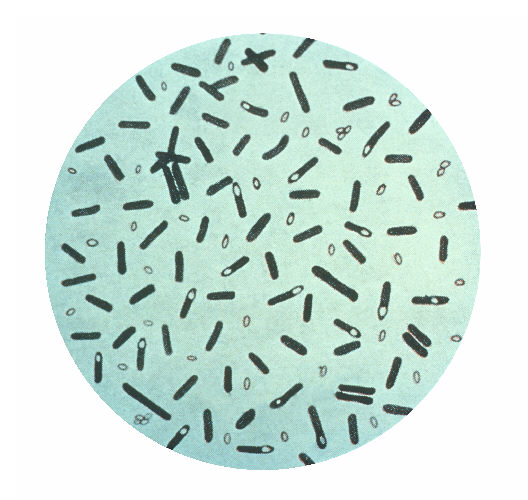
Image source: Wikipedia/Wikimedia
| Ecology, Host, and Life Cycle | |
|---|---|
| Oxygen requirements | Anaerobe |
| Optimal temperature | 37 |
| Temperature range | Mesophilic |
| Habitat | Multiple |
| Biotic relationship | Free living |
| Host(s) | Homo sapiens, Bos, Metazoa |
| Cell arrangement | Pairs - Singles - Chains |
| Sporulation | Not Available |
| Energy source | Chemoorganotroph |
| Pathogenicity | Not Available |
Gene Summary
Adenine Count
1416430 bp
Thymine Count
1471138 bp
Guanine Count
537670 bp
Cytosine Count
573509 bp
Genome Length
3998747 bp
Protein-coding Genes
3614 genes
Non-Coding Genes
109 genes
# of Chromosomes/Plasmids
1
Genes
| Name | Locus Tag | UniProt ID | Strand Orientation | Gene Start/End | Protein Molecular Weight |
|---|---|---|---|---|---|
| sporulation protein yabp | C7M58_RS14080 | Not Available | Negative | 3028865 - 3029155 | 10853.1 |
| rna-binding s4 domain-containing protein | C7M58_RS14085 | Not Available | Negative | 3029273 - 3029512 | 9238.43 |
| hu family dna-binding protein | C7M58_RS14090 | Not Available | Negative | 3029586 - 3029864 | 10193.3 |
| nucleoside triphosphate pyrophosphohydrolase | C7M58_RS14095 | Not Available | Negative | 3029992 - 3031437 | 55392.3 |
| polysaccharide biosynthesis protein | C7M58_RS14100 | Not Available | Negative | 3031452 - 3032987 | 56494.2 |
| stage v sporulation protein t | C7M58_RS14105 | Not Available | Negative | 3033120 - 3033671 | 20518.6 |
| peptidylprolyl isomerase | C7M58_RS14110 | Not Available | Negative | 3033870 - 3034880 | 38776.9 |
| transcription-repair coupling factor | C7M58_RS14115 | Not Available | Negative | 3034965 - 3038471 | 134760.0 |
| aminoacyl-trna hydrolase | C7M58_RS14120 | Not Available | Negative | 3038629 - 3039198 | 20964.4 |
| s1c family serine protease | C7M58_RS14125 | Not Available | Negative | 3039308 - 3040480 | 41709.9 |
Pathways
1096 pathways
Health Effects
| Health Condition | Relation | Reference |
|---|---|---|
| Wound botulism | Causes | PMC8283217 |
| Botulism | Causes | PMC2693436 |
| Botulism | Causes | PMC13317340 |
| Botulism | Causes | PMC3232984 |
| Botulism | Causes | PMC5113727 |
| Botulism | Causes | PMC7904509 |