Kingdom
Bacillati
Phylum
Bacillota
Class
Clostridia
Order
Eubacteriales
Family
Clostridiaceae
Genus
Clostridium
Description
Taxonomy
| Kingdom | Bacillati |
|---|---|
| Phylum | Bacillota |
| Class | Clostridia |
| Order | Eubacteriales |
| Family | Clostridiaceae |
| Genus | Clostridium |
| Species | Clostridium botulinum |
| Strain | strain RF5 |
Profile
| Physiology | |
|---|---|
| Gram staining properties | Positive |
| Shape | Rod |
| Mobility | Yes |
| Flagellar presence | Yes |
| Number of membranes | 1 |

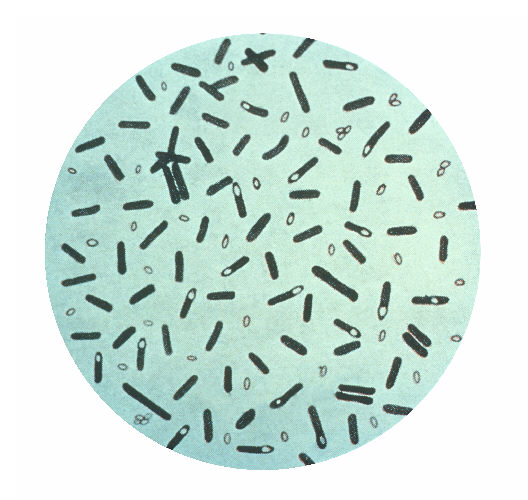
Image source: Wikipedia/Wikimedia
| Ecology, Host, and Life Cycle | |
|---|---|
| Oxygen requirements | Anaerobe |
| Optimal temperature | 37 |
| Temperature range | Mesophilic |
| Habitat | Multiple |
| Biotic relationship | Free living |
| Host(s) | Homo sapiens, Bos, Metazoa |
| Cell arrangement | Pairs - Singles - Chains |
| Sporulation | Not Available |
| Energy source | Chemoorganotroph |
| Pathogenicity | Not Available |
Gene Summary
Adenine Count
1416430 bp
Thymine Count
1471138 bp
Guanine Count
537670 bp
Cytosine Count
573509 bp
Genome Length
3998747 bp
Protein-coding Genes
3614 genes
Non-Coding Genes
109 genes
# of Chromosomes/Plasmids
1
Genes
| Name | Locus Tag | UniProt ID | Strand Orientation | Gene Start/End | Protein Molecular Weight |
|---|---|---|---|---|---|
| glutamate/gamma-aminobutyrate family transporter yjem | C7M58_RS11850 | Not Available | Negative | 2532415 - 2533941 | 55537.0 |
| duf2935 domain-containing protein | C7M58_RS11855 | Not Available | Negative | 2534402 - 2535211 | 31330.0 |
| spore coat protein | C7M58_RS11860 | Not Available | Negative | 2535325 - 2535630 | 11099.2 |
| hypothetical protein | C7M58_RS11865 | Not Available | Negative | 2535632 - 2535850 | 8112.89 |
| site-specific integrase | C7M58_RS11870 | Not Available | Negative | 2536535 - 2536858 | 12625.0 |
| sporulation transcription factor spo0a | C7M58_RS11875 | Not Available | Negative | 2537050 - 2537871 | 30839.6 |
| spoivb peptidase | C7M58_RS11880 | Not Available | Negative | 2538293 - 2539522 | 44924.9 |
| homoserine o-succinyltransferase | C7M58_RS11885 | Not Available | Negative | 2539942 - 2540838 | 35422.9 |
| homoserine dehydrogenase | C7M58_RS11890 | Not Available | Negative | 2540865 - 2542091 | 45806.8 |
| o-acetylhomoserine aminocarboxypropyltransferase/cysteine synthase family protein | C7M58_RS11895 | Not Available | Negative | 2542131 - 2543411 | 47020.2 |
Pathways
1096 pathways
Health Effects
| Health Condition | Relation | Reference |
|---|---|---|
| Wound botulism | Causes | PMC8283217 |
| Botulism | Causes | PMC2693436 |
| Botulism | Causes | PMC13317340 |
| Botulism | Causes | PMC3232984 |
| Botulism | Causes | PMC5113727 |
| Botulism | Causes | PMC7904509 |