Kingdom
Bacillati
Phylum
Bacillota
Class
Clostridia
Order
Eubacteriales
Family
Clostridiaceae
Genus
Clostridium
Description
Taxonomy
| Kingdom | Bacillati |
|---|---|
| Phylum | Bacillota |
| Class | Clostridia |
| Order | Eubacteriales |
| Family | Clostridiaceae |
| Genus | Clostridium |
| Species | Clostridium botulinum |
| Strain | strain RF5 |
Profile
| Physiology | |
|---|---|
| Gram staining properties | Positive |
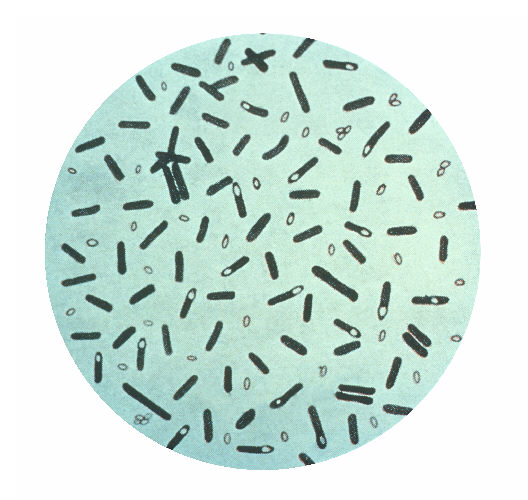
| Shape | Rod |
| Mobility | Yes |
| Flagellar presence | Yes |
| Number of membranes | 1 |

Image source: Wikipedia/Wikimedia
| Ecology, Host, and Life Cycle | |
|---|---|
| Oxygen requirements | Anaerobe |
| Optimal temperature | 37 |
| Temperature range | Mesophilic |
| Habitat | Multiple |
| Biotic relationship | Free living |
| Host(s) | Homo sapiens, Bos, Metazoa |
| Cell arrangement | Pairs - Singles - Chains |
| Sporulation | Not Available |
| Energy source | Chemoorganotroph |
| Pathogenicity | Not Available |
Gene Summary
Adenine Count
1416430 bp
Thymine Count
1471138 bp
Guanine Count
537670 bp
Cytosine Count
573509 bp
Genome Length
3998747 bp
Protein-coding Genes
3614 genes
Non-Coding Genes
109 genes
# of Chromosomes/Plasmids
1
Genes
| Name | Locus Tag | UniProt ID | Strand Orientation | Gene Start/End | Protein Molecular Weight |
|---|---|---|---|---|---|
| tagatose bisphosphate family class ii aldolase | C7M58_RS10985 | Not Available | Positive | 2333460 - 2334320 | 31453.8 |
| 1-phosphofructokinase | C7M58_RS10990 | Not Available | Positive | 2334340 - 2335263 | 34556.4 |
| pts fructose transporter subunit iic | C7M58_RS10995 | Not Available | Positive | 2335264 - 2336658 | 48982.0 |
| pts sugar transporter subunit iia | C7M58_RS11000 | Not Available | Positive | 2336792 - 2337232 | 16275.8 |
| trehalose operon repressor | C7M58_RS11005 | Not Available | Negative | 2337441 - 2338151 | 27923.7 |
| alpha,alpha-phosphotrehalase | C7M58_RS11010 | Not Available | Negative | 2338172 - 2339851 | 66489.4 |
| pts system trehalose-specific eiibc component | C7M58_RS11015 | Not Available | Negative | 2340069 - 2341496 | 51616.6 |
| muts-related protein | C7M58_RS11020 | Not Available | Negative | 2341962 - 2343527 | 60446.3 |
| molecular chaperone htpg | C7M58_RS11025 | Not Available | Positive | 2344057 - 2345937 | 72954.5 |
| potassium/proton antiporter | C7M58_RS11030 | Not Available | Positive | 2346483 - 2347913 | 51841.3 |
Pathways
1096 pathways
Health Effects
| Health Condition | Relation | Reference |
|---|---|---|
| Wound botulism | Causes | PMC8283217 |
| Botulism | Causes | PMC2693436 |
| Botulism | Causes | PMC13317340 |
| Botulism | Causes | PMC3232984 |
| Botulism | Causes | PMC5113727 |
| Botulism | Causes | PMC7904509 |