Kingdom
Pseudomonadati
Phylum
Spirochaetota
Class
Spirochaetia
Order
Spirochaetales
Family
Treponemataceae
Genus
Treponema
Description
Taxonomy
| Kingdom | Pseudomonadati |
|---|---|
| Phylum | Spirochaetota |
| Class | Spirochaetia |
| Order | Spirochaetales |
| Family | Treponemataceae |
| Genus | Treponema |
| Species | Treponema pallidum |
| Strain | subsp. pertenue strain Kampung Dalan K363 |
Profile
| Physiology | |
|---|---|
| Gram staining properties | Negative |
| Shape | Spirilla |
| Mobility | No |
| Flagellar presence | Yes |
| Number of membranes | 2 |

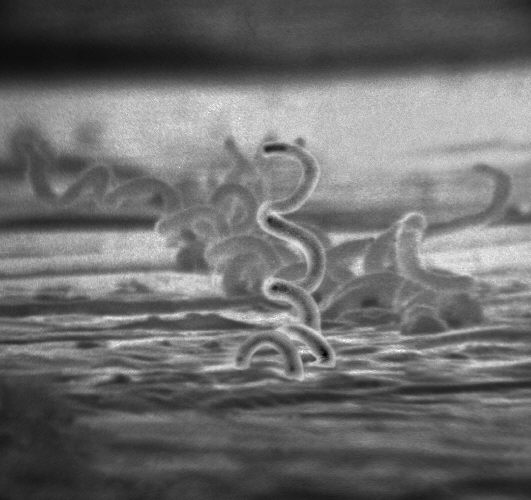
Image source: Wikipedia/Wikimedia
| Ecology, Host, and Life Cycle | |
|---|---|
| Oxygen requirements | Anaerobe |
| Optimal temperature | Not Available |
| Temperature range | Mesophilic |
| Habitat | HostAssociated |
| Biotic relationship | Free living |
| Host(s) | Homo sapiens |
| Cell arrangement | Singles |
| Sporulation | Not Available |
| Energy source | Not Available |
| Pathogenicity | Not Available |
Gene Summary
Adenine Count
268148 bp
Thymine Count
269857 bp
Guanine Count
302737 bp
Cytosine Count
298790 bp
Genome Length
1139764 bp
Protein-coding Genes
990 genes
Non-Coding Genes
54 genes
# of Chromosomes/Plasmids
1
Genes
| Name | Locus Tag | UniProt ID | Strand Orientation | Gene Start/End | Protein Molecular Weight |
|---|---|---|---|---|---|
| hypothetical protein | TPEKDK363_RS00735 | Not Available | Negative | 159655 - 160392 | 26966.4 |
| potassium channel family protein | TPEKDK363_RS00740 | Not Available | Negative | 160400 - 161092 | 25324.8 |
| trkh family potassium uptake protein | TPEKDK363_RS00745 | Not Available | Negative | 161132 - 162850 | 61989.0 |
| methylated-dna--[protein]-cysteine s-methyltransferase | TPEKDK363_RS00750 | Not Available | Positive | 163031 - 163564 | 19379.7 |
| abc transporter atp-binding protein | TPEKDK363_RS00755 | Not Available | Negative | 163515 - 164177 | 24067.2 |
| abc transporter permease | TPEKDK363_RS00760 | Not Available | Negative | 164170 - 165912 | 63492.6 |
| thiamine abc transporter substrate binding subunit | TPEKDK363_RS00765 | Not Available | Negative | 165909 - 166916 | 36815.0 |
| amp-dependent synthetase/ligase | TPEKDK363_RS00770 | Not Available | Positive | 167026 - 168996 | 72215.4 |
| Trna-leu | Not Available | Not Available | Positive | 169071 - 169152 | Not Available |
| chromate transporter | TPEKDK363_RS00780 | Not Available | Positive | 169127 - 169816 | 25314.7 |
Pathways
0 pathways
No pathways found
No metabolic pathways have been associated with this bacterium yet.