Kingdom
Pseudomonadati
Phylum
Pseudomonadota
Class
Gammaproteobacteria
Order
Enterobacterales
Family
Enterobacteriaceae
Genus
Escherichia
Description
Taxonomy
| Kingdom | Pseudomonadati |
|---|---|
| Phylum | Pseudomonadota |
| Class | Gammaproteobacteria |
| Order | Enterobacterales |
| Family | Enterobacteriaceae |
| Genus | Escherichia |
| Species | Escherichia coli |
| Strain | strain 7/2 |
Profile
| Physiology | |
|---|---|
| Gram staining properties | Negative |
| Shape | Rod |
| Mobility | Yes |
| Flagellar presence | Yes |
| Number of membranes | 2 |

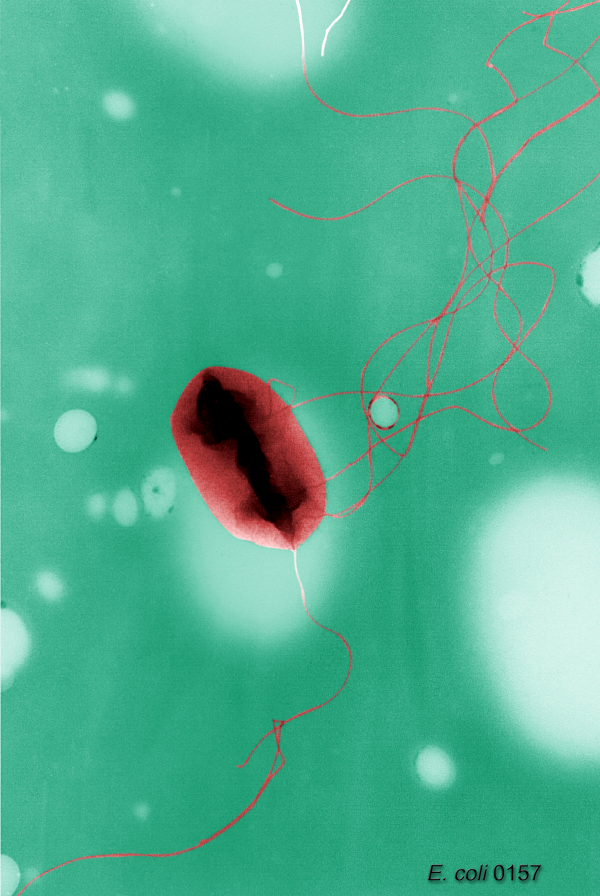
Image source: Wikipedia/Wikimedia
| Ecology, Host, and Life Cycle | |
|---|---|
| Oxygen requirements | Facultative anaerobe |
| Optimal temperature | 37 |
| Temperature range | Mesophilic |
| Habitat | HostAssociated |
| Biotic relationship | Free living |
| Host(s) | Homo sapiens, Gallus gallus, Bos taurus |
| Cell arrangement | Pairs - Singles |
| Sporulation | Not Available |
| Energy source | Not Available |
| Pathogenicity | Human |
Genome Summary
Escherichia coli strain 7/2 plasmid p7_2.2, complete sequence.
Gene Summary
Adenine Count
12864 bp
Thymine Count
12530 bp
Guanine Count
8117 bp
Cytosine Count
9402 bp
Genome Length
42913 bp
Protein-coding Genes
61 genes
Non-Coding Genes
0 genes
# of Chromosomes/Plasmids
5
Genes
| Name | Locus Tag | UniProt ID | Strand Orientation | Gene Start/End | Protein Molecular Weight |
|---|---|---|---|---|---|
| propanediol utilization system shell hexameric protein grpk | CRT46_RS23215 | Not Available | Negative | 4751692 - 4751991 | 11098.7 |
| propanediol utilization system aldehyde dehydrogenase grpj | CRT46_RS23220 | Not Available | Negative | 4752015 - 4753532 | 53717.9 |
| propanediol utilization microcompartment protein grpi | CRT46_RS23225 | Not Available | Negative | 4753593 - 4754378 | 27115.2 |
| propanediol utilization system shell hexameric protein grph | CRT46_RS23230 | Not Available | Negative | 4754400 - 4754681 | 9468.66 |
| propanediol utilization system propionate kinase grpg | CRT46_RS23235 | Not Available | Negative | 4754966 - 4756162 | 42845.6 |
| propanediol utilization system heme-binding protein grpf | CRT46_RS23240 | Not Available | Negative | 4756191 - 4756688 | 17973.7 |
| propanediol utilization microcompartment vertex protein grpe | CRT46_RS23245 | Not Available | Negative | 4756716 - 4756985 | 9204.01 |
| propanediol utilization system flavoprotein grpd | CRT46_RS23250 | Not Available | Negative | 4756997 - 4757722 | 26446.1 |
| propanediol utilization system chaperone grpc | CRT46_RS23255 | Not Available | Negative | 4757706 - 4758464 | 26080.7 |
| propanediol utilization system phosphotransacylase grpb | CRT46_RS23260 | Not Available | Negative | 4758519 - 4759205 | 24588.7 |
Pathways
0 pathways
No pathways found
No metabolic pathways have been associated with this bacterium yet.
Health Effects
| Health Condition | Relation | Reference |
|---|---|---|
| Gi disease | Causes | PMC11149725 |
| Utis | Causes | PMC11434687 |
| Colorectal cancer | Causes | PMC12198655 |
| Pyogenic liver abscesses | Causes | PMC12392612 |
| Uti | Causes | PMC13014981 |
| Colibacillosis | Causes | PMC13255289 |
| Enteric infections | Causes | PMC13255289 |
| Foodborne infections | Causes | PMC13255289 |
| Clinical mastitis | Causes | PMC13293316 |
| Diarrhea | Causes | PMC3035056 |