Kingdom
Pseudomonadati
Phylum
Pseudomonadota
Class
Gammaproteobacteria
Order
Enterobacterales
Family
Enterobacteriaceae
Genus
Salmonella
Description
Taxonomy
| Kingdom | Pseudomonadati |
|---|---|
| Phylum | Pseudomonadota |
| Class | Gammaproteobacteria |
| Order | Enterobacterales |
| Family | Enterobacteriaceae |
| Genus | Salmonella |
| Species | Salmonella enterica |
| Strain | subsp. enterica serovar Macclesfield |
Profile
| Physiology | |
|---|---|
| Gram staining properties | Negative |
| Shape | Spirilla |
| Mobility | No |
| Flagellar presence | Yes |
| Number of membranes | 2 |

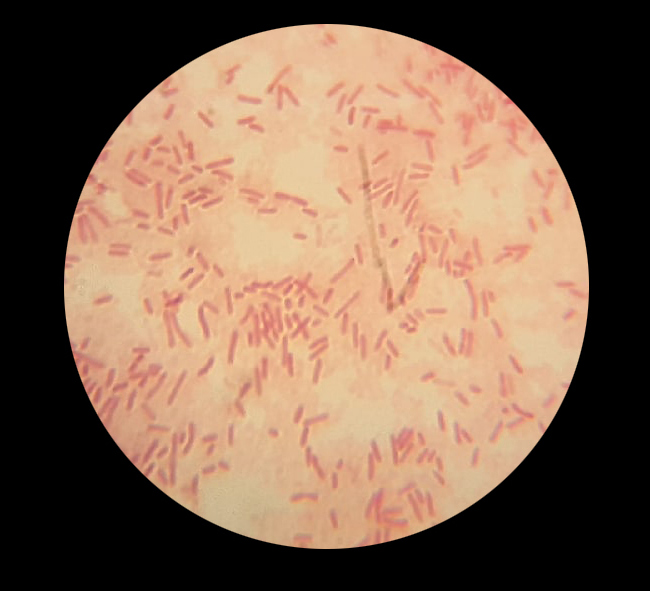
Image source: Wikipedia/Wikimedia
| Ecology, Host, and Life Cycle | |
|---|---|
| Oxygen requirements | Microaerophilic |
| Optimal temperature | 37 |
| Temperature range | Mesophilic |
| Habitat | HostAssociated |
| Biotic relationship | Free living |
| Host(s) | Not Available |
| Cell arrangement | Chains - Singles |
| Sporulation | Not Available |
| Energy source | Chemoorganotroph |
| Pathogenicity | Not Available |
Gene Summary
Adenine Count
1151682 bp
Thymine Count
1150664 bp
Guanine Count
1260217 bp
Cytosine Count
1259576 bp
Genome Length
4822139 bp
Protein-coding Genes
4270 genes
Non-Coding Genes
463 genes
# of Chromosomes/Plasmids
1
Genes
| Name | Locus Tag | UniProt ID | Strand Orientation | Gene Start/End | Protein Molecular Weight |
|---|---|---|---|---|---|
| nadp-dependent oxaloacetate-decarboxylating malate dehydrogenase | LFZ25_RS06810 | Not Available | Positive | 1358625 - 1360904 | 82313.0 |
| ethanolamine utilization microcompartment protein euts | LFZ25_RS06815 | Not Available | Positive | 1361317 - 1361652 | 11673.4 |
| ethanolamine utilization acetate kinase eutp | LFZ25_RS06820 | Not Available | Positive | 1361665 - 1362144 | 17742.9 |
| ethanolamine utilization acetate kinase eutq | LFZ25_RS06825 | Not Available | Positive | 1362122 - 1362811 | 25058.0 |
| ethanolamine utilization cob(i)yrinic acid a,c-diamide adenosyltransferase eutt | LFZ25_RS06830 | Not Available | Positive | 1362808 - 1363611 | 30195.3 |
| phosphate acetyltransferase | LFZ25_RS06835 | Not Available | Positive | 1363608 - 1364624 | 36237.9 |
| ethanolamine utilization microcompartment protein eutm | LFZ25_RS06840 | Not Available | Positive | 1364665 - 1364955 | 9843.12 |
| ethanolamine utilization microcompartment protein eutn | LFZ25_RS06845 | Not Available | Positive | 1365068 - 1365355 | 9905.11 |
| aldehyde dehydrogenase family protein | LFZ25_RS06850 | Not Available | Positive | 1365367 - 1366770 | 49190.6 |
| ethanolamine utilization protein eutj | LFZ25_RS06855 | Not Available | Positive | 1366781 - 1367620 | 30075.9 |
Pathways
0 pathways
No pathways found
No metabolic pathways have been associated with this bacterium yet.
Health Effects
No health effects information available for this bacterium.