
Kingdom
Pseudomonadati
Phylum
Pseudomonadota
Class
Gammaproteobacteria
Order
Vibrionales
Family
Vibrionaceae
Genus
Vibrio
Description
Taxonomy
| Kingdom | Pseudomonadati |
|---|---|
| Phylum | Pseudomonadota |
| Class | Gammaproteobacteria |
| Order | Vibrionales |
| Family | Vibrionaceae |
| Genus | Vibrio |
| Species | Vibrio anguillarum |
| Strain | strain JLL237 |
Profile
| Physiology | |
|---|---|
| Gram staining properties | Negative |
| Shape | CurvedShaped |
| Mobility | Yes |
| Flagellar presence | Not Available |
| Number of membranes | Not Available |
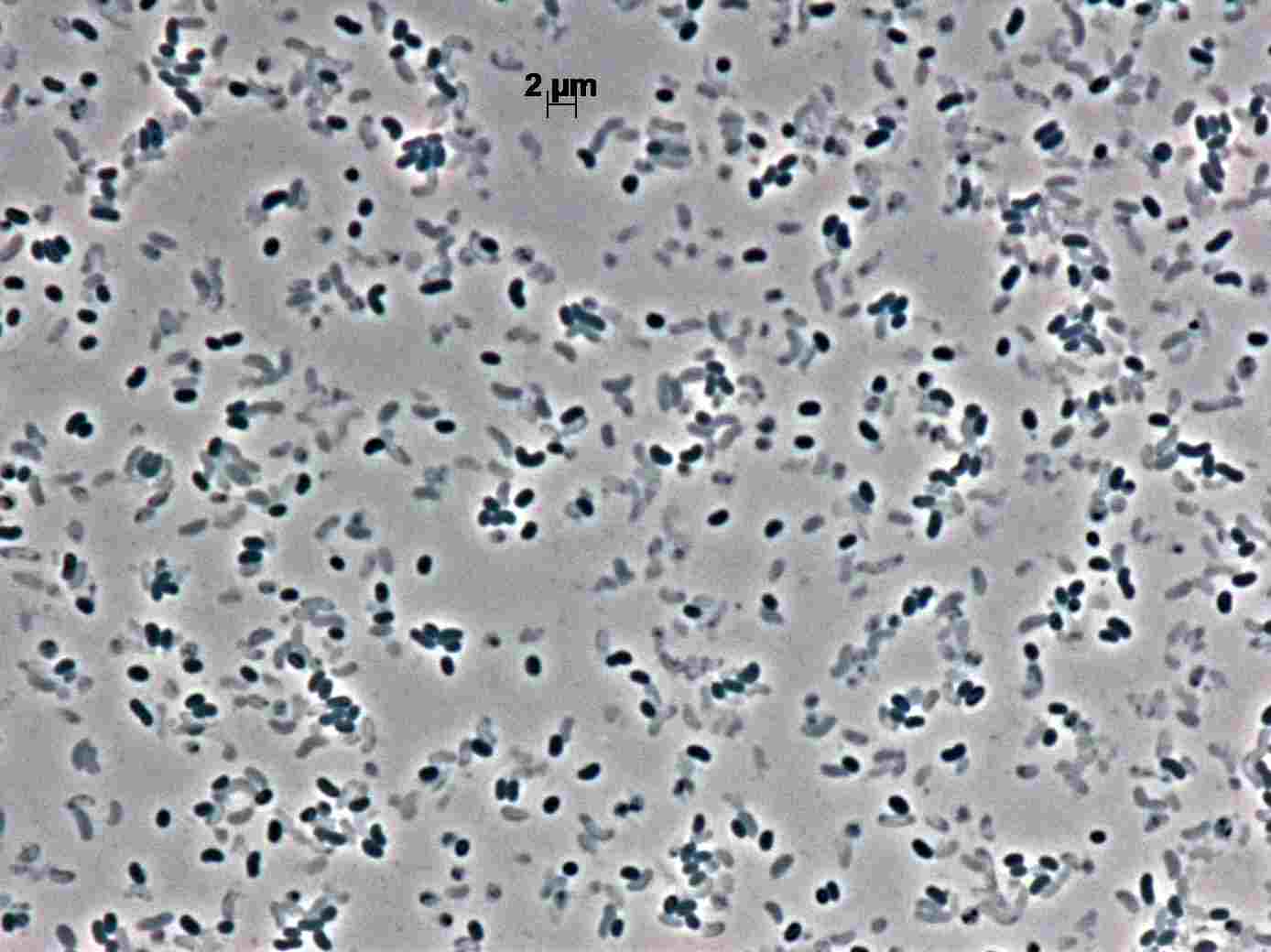
Image source: Wikipedia/Wikimedia
| Ecology, Host, and Life Cycle | |
|---|---|
| Oxygen requirements | Facultative |
| Optimal temperature | Not Available |
| Temperature range | Mesophilic |
| Habitat | HostAssociated |
| Biotic relationship | Free living |
| Host(s) | Homo sapiens |
| Cell arrangement | Singles |
| Sporulation | Nonsporulating |
| Energy source | Heterotroph |
| Pathogenicity | Animal |
Genome Summary
Vibrio anguillarum strain JLL237 chromosome 2, complete sequence.
Gene Summary
Adenine Count
323931 bp
Thymine Count
329680 bp
Guanine Count
256785 bp
Cytosine Count
253771 bp
Genome Length
1164167 bp
Protein-coding Genes
1010 genes
Non-Coding Genes
4 genes
# of Chromosomes/Plasmids
4
Genes
| Name | Locus Tag | UniProt ID | Strand Orientation | Gene Start/End | Protein Molecular Weight |
|---|---|---|---|---|---|
| yeac family protein | CEJ46_RS05360 | Not Available | Positive | 1146571 - 1146855 | 10641.6 |
| asparaginase | CEJ46_RS05365 | Not Available | Negative | 1146948 - 1147961 | 36926.5 |
| signal peptide peptidase sppa | CEJ46_RS05370 | Not Available | Negative | 1148082 - 1149932 | 67633.8 |
| nadph-dependent 2,4-dienoyl-coa reductase | CEJ46_RS05375 | Not Available | Positive | 1150145 - 1152148 | 73359.8 |
| formyltetrahydrofolate deformylase | CEJ46_RS05380 | Not Available | Negative | 1152274 - 1153107 | 31522.8 |
| hypothetical protein | CEJ46_RS05385 | Not Available | Positive | 1153295 - 1153495 | 7715.2 |
| atp-dependent dna helicase | CEJ46_RS05390 | Not Available | Positive | 1153590 - 1155533 | 71826.5 |
| trna (adenosine(37)-n6)-threonylcarbamoyltransferase complex dimerization subunit type 1 tsab | CEJ46_RS05395 | Not Available | Positive | 1155542 - 1156243 | 25373.4 |
| chromosome partitioning protein para | CEJ46_RS05400 | Not Available | Positive | 1156297 - 1156602 | 11006.2 |
| slp family lipoprotein | CEJ46_RS05405 | Not Available | Positive | 1156618 - 1157181 | 20711.9 |
Pathways
0 pathways
No pathways found
No metabolic pathways have been associated with this bacterium yet.
Health Effects
| Health Condition | Relation | Reference |
|---|---|---|
| Vibriosis | Causes | PMC8416912 |
| Vibriosis | Causes | PMC11577842 |
| Vibriosis | Causes | PMC11790442 |
| Hemorrhagic septicemia | Causes | PMC11790442 |


