
Kingdom
Pseudomonadati
Phylum
Pseudomonadota
Class
Betaproteobacteria
Order
Burkholderiales
Family
Burkholderiaceae
Genus
Burkholderia
Description
Taxonomy
| Kingdom | Pseudomonadati |
|---|---|
| Phylum | Pseudomonadota |
| Class | Betaproteobacteria |
| Order | Burkholderiales |
| Family | Burkholderiaceae |
| Genus | Burkholderia |
| Species | Burkholderia cepacia |
| Strain | strain FDAARGOS_345 |
Profile
| Physiology | |
|---|---|
| Gram staining properties | Negative |
| Shape | Not Available |
| Mobility | Not Available |
| Flagellar presence | Not Available |
| Number of membranes | Not Available |
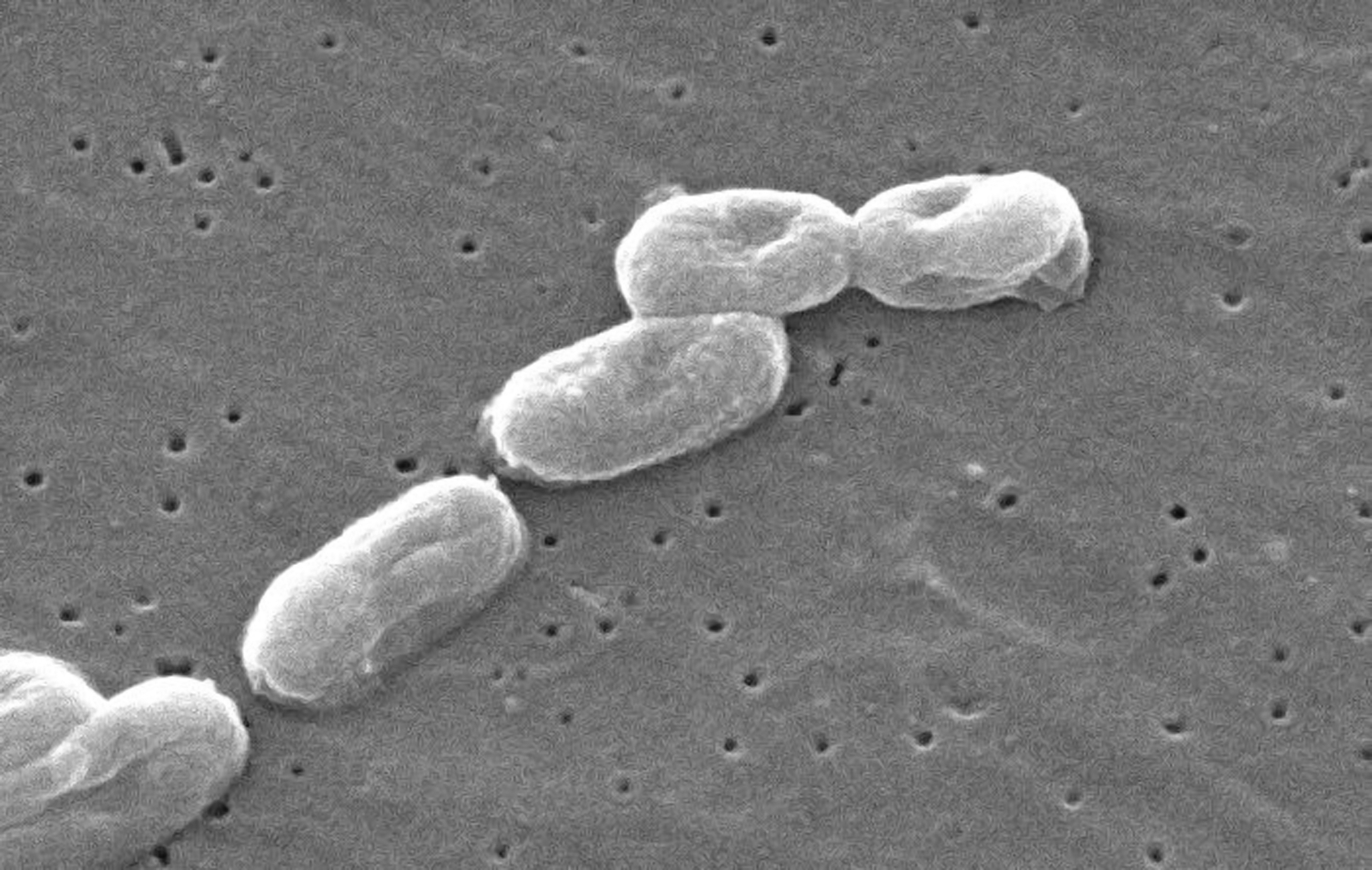
Image source: Wikipedia/Wikimedia
| Ecology, Host, and Life Cycle | |
|---|---|
| Oxygen requirements | Microaerophile |
| Optimal temperature | Not Available |
| Temperature range | Not Available |
| Habitat | rhizosphere |
| Biotic relationship | Not Available |
| Host(s) | Homo sapiens, Viridiplantae, Anura |
| Cell arrangement | Not Available |
| Sporulation | Not Available |
| Energy source | Not Available |
| Pathogenicity | Not Available |
Genome Summary
Burkholderia cepacia strain FDAARGOS_345 chromosome 3, complete
Gene Summary
Adenine Count
198842 bp
Thymine Count
199897 bp
Guanine Count
396164 bp
Cytosine Count
393081 bp
Genome Length
1187984 bp
Protein-coding Genes
1064 genes
Non-Coding Genes
5 genes
# of Chromosomes/Plasmids
4
Genes
| Name | Locus Tag | UniProt ID | Strand Orientation | Gene Start/End | Protein Molecular Weight |
|---|---|---|---|---|---|
| hypothetical protein | CEQ23_RS41065 | Not Available | Positive | 1948455 - 1948676 | 7681.27 |
| response regulator | CEQ23_RS15650 | Not Available | Positive | 1948643 - 1949305 | 23955.1 |
| atp-binding protein | CEQ23_RS15655 | Not Available | Positive | 1949309 - 1950655 | 48045.8 |
| degq family serine endoprotease | CEQ23_RS15660 | Not Available | Positive | 1950767 - 1952251 | 50965.7 |
| carboxypeptidase-like regulatory domain-containing protein | CEQ23_RS15665 | Not Available | Positive | 1952356 - 1952793 | 15145.8 |
| duf427 domain-containing protein | CEQ23_RS15670 | Not Available | Positive | 1952926 - 1953285 | 13175.5 |
| coxg family protein | CEQ23_RS15675 | Not Available | Positive | 1953314 - 1954021 | 25569.8 |
| helix-turn-helix domain-containing protein | CEQ23_RS15680 | Not Available | Negative | 1954063 - 1955076 | 35668.1 |
| cysteine hydrolase family protein | CEQ23_RS15685 | Not Available | Positive | 1955229 - 1955894 | 22935.0 |
| tetr family transcriptional regulator | CEQ23_RS15690 | Not Available | Negative | 1955995 - 1956636 | 24320.7 |
Pathways
1357 pathways
Health Effects
| Health Condition | Relation | Reference |
|---|---|---|
| Infective endocarditis | Causes | PMC3112426 |
| Native valve endocarditis | Causes | PMC3112426 |
| Pneumonia | Causes | PMC9294674 |



