
Kingdom
Pseudomonadati
Phylum
Pseudomonadota
Class
Betaproteobacteria
Order
Burkholderiales
Family
Burkholderiaceae
Genus
Burkholderia
Description
Taxonomy
| Kingdom | Pseudomonadati |
|---|---|
| Phylum | Pseudomonadota |
| Class | Betaproteobacteria |
| Order | Burkholderiales |
| Family | Burkholderiaceae |
| Genus | Burkholderia |
| Species | Burkholderia cepacia |
| Strain | strain FDAARGOS_345 |
Profile
| Physiology | |
|---|---|
| Gram staining properties | Negative |
| Shape | Not Available |
| Mobility | Not Available |
| Flagellar presence | Not Available |
| Number of membranes | Not Available |
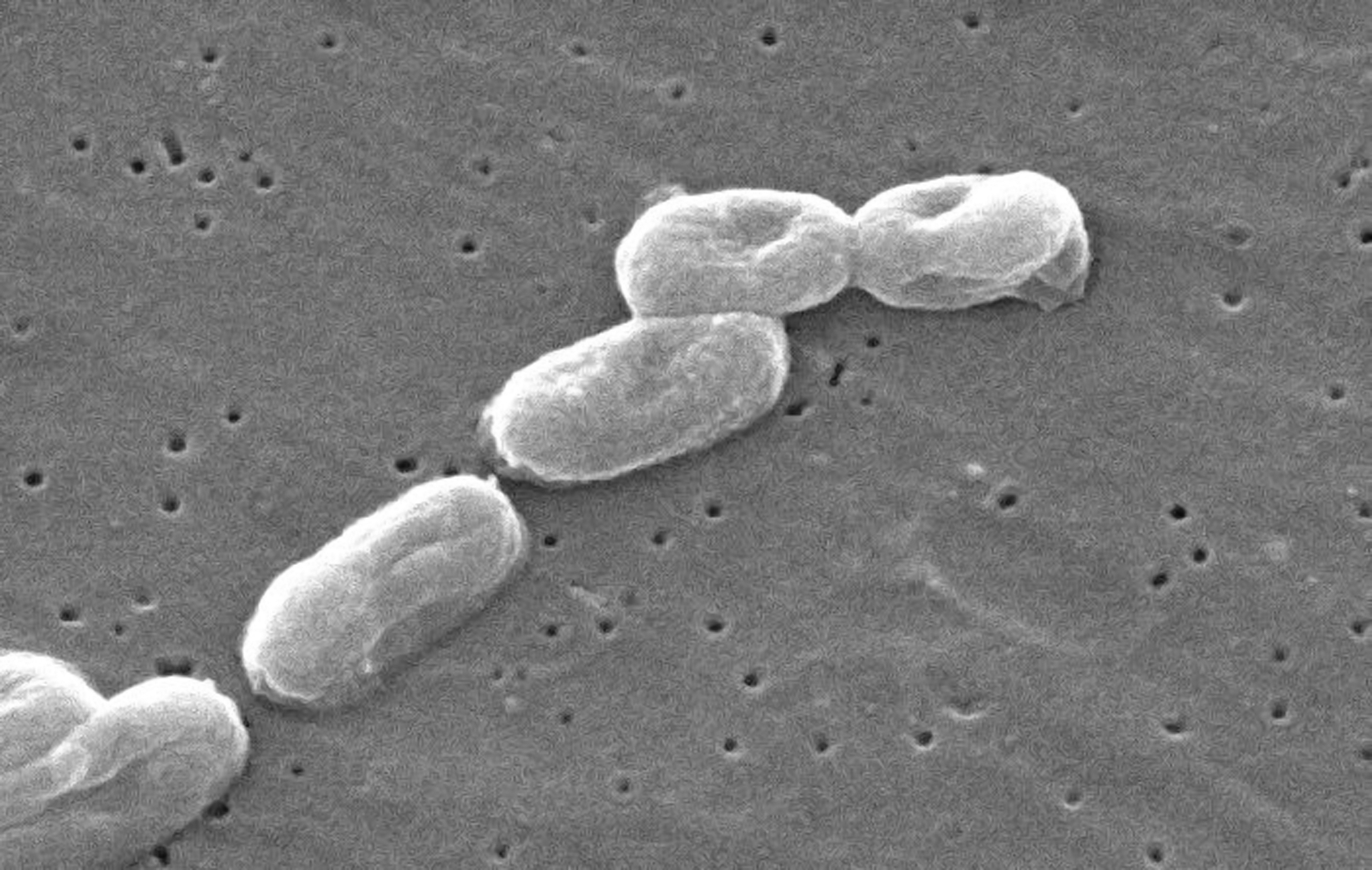
Image source: Wikipedia/Wikimedia
| Ecology, Host, and Life Cycle | |
|---|---|
| Oxygen requirements | Microaerophile |
| Optimal temperature | Not Available |
| Temperature range | Not Available |
| Habitat | rhizosphere |
| Biotic relationship | Not Available |
| Host(s) | Homo sapiens, Viridiplantae, Anura |
| Cell arrangement | Not Available |
| Sporulation | Not Available |
| Energy source | Not Available |
| Pathogenicity | Not Available |
Genome Summary
Burkholderia cepacia strain FDAARGOS_345 chromosome 3, complete
Gene Summary
Adenine Count
198842 bp
Thymine Count
199897 bp
Guanine Count
396164 bp
Cytosine Count
393081 bp
Genome Length
1187984 bp
Protein-coding Genes
1064 genes
Non-Coding Genes
5 genes
# of Chromosomes/Plasmids
4
Genes
| Name | Locus Tag | UniProt ID | Strand Orientation | Gene Start/End | Protein Molecular Weight |
|---|---|---|---|---|---|
| hypothetical protein | CEQ23_RS41850 | Not Available | Negative | 1937329 - 1937457 | 4253.36 |
| pyruvate kinase | CEQ23_RS15605 | Not Available | Positive | 1937456 - 1938892 | 51388.4 |
| class ii fructose-bisphosphate aldolase | CEQ23_RS15610 | Not Available | Positive | 1939209 - 1940273 | 38435.1 |
| phosphoribosylaminoimidazolesuccinocarboxamide synthase | CEQ23_RS15615 | Not Available | Positive | 1940507 - 1941397 | 32604.8 |
| 5-(carboxyamino)imidazole ribonucleotide mutase | CEQ23_RS15620 | Not Available | Positive | 1941414 - 1941935 | 18117.0 |
| 5-(carboxyamino)imidazole ribonucleotide synthase | CEQ23_RS15625 | Not Available | Positive | 1942026 - 1943237 | 42115.2 |
| l-threonylcarbamoyladenylate synthase | CEQ23_RS15630 | Not Available | Positive | 1943249 - 1944277 | 35701.3 |
| sgnh/gdsl hydrolase family protein | CEQ23_RS15635 | Not Available | Negative | 1944364 - 1945509 | 39065.8 |
| sterol desaturase family protein | CEQ23_RS15640 | Not Available | Negative | 1945605 - 1946519 | 35150.3 |
| d-alanyl-d-alanine carboxypeptidase/d-alanyl-d-alanine-endopeptidase | CEQ23_RS15645 | Not Available | Negative | 1946924 - 1948456 | 53244.7 |
Pathways
1357 pathways
Health Effects
| Health Condition | Relation | Reference |
|---|---|---|
| Infective endocarditis | Causes | PMC3112426 |
| Native valve endocarditis | Causes | PMC3112426 |
| Pneumonia | Causes | PMC9294674 |



