
Kingdom
Pseudomonadati
Phylum
Pseudomonadota
Class
Betaproteobacteria
Order
Burkholderiales
Family
Burkholderiaceae
Genus
Burkholderia
Description
Taxonomy
| Kingdom | Pseudomonadati |
|---|---|
| Phylum | Pseudomonadota |
| Class | Betaproteobacteria |
| Order | Burkholderiales |
| Family | Burkholderiaceae |
| Genus | Burkholderia |
| Species | Burkholderia cepacia |
| Strain | strain FDAARGOS_345 |
Profile
| Physiology | |
|---|---|
| Gram staining properties | Negative |
| Shape | Not Available |
| Mobility | Not Available |
| Flagellar presence | Not Available |
| Number of membranes | Not Available |
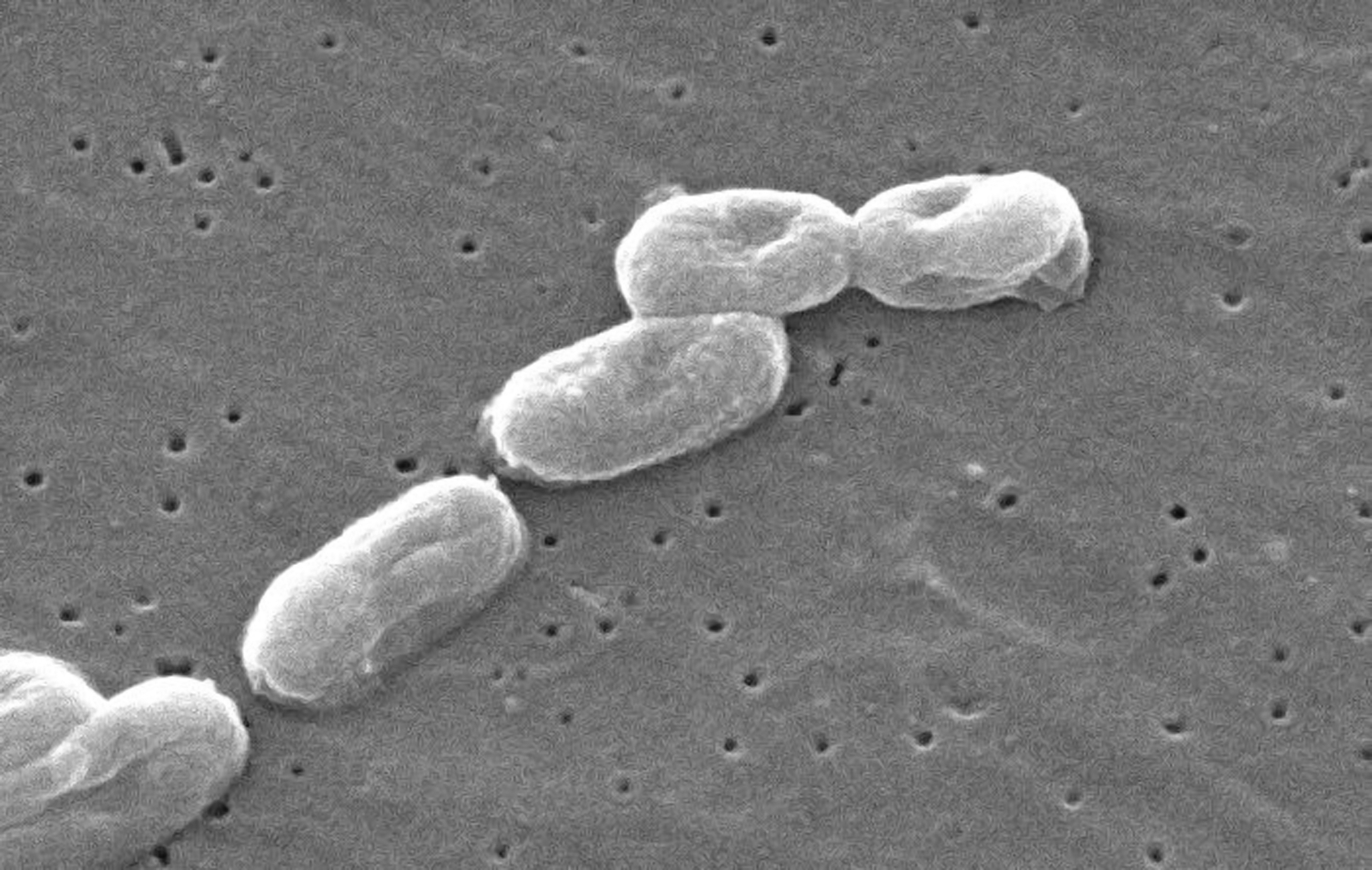
Image source: Wikipedia/Wikimedia
| Ecology, Host, and Life Cycle | |
|---|---|
| Oxygen requirements | Microaerophile |
| Optimal temperature | Not Available |
| Temperature range | Not Available |
| Habitat | rhizosphere |
| Biotic relationship | Not Available |
| Host(s) | Homo sapiens, Viridiplantae, Anura |
| Cell arrangement | Not Available |
| Sporulation | Not Available |
| Energy source | Not Available |
| Pathogenicity | Not Available |
Genome Summary
Burkholderia cepacia strain FDAARGOS_345 chromosome 3, complete
Gene Summary
Adenine Count
198842 bp
Thymine Count
199897 bp
Guanine Count
396164 bp
Cytosine Count
393081 bp
Genome Length
1187984 bp
Protein-coding Genes
1064 genes
Non-Coding Genes
5 genes
# of Chromosomes/Plasmids
4
Genes
| Name | Locus Tag | UniProt ID | Strand Orientation | Gene Start/End | Protein Molecular Weight |
|---|---|---|---|---|---|
| biotin--[acetyl-coa-carboxylase] ligase | CEQ23_RS14190 | Not Available | Negative | 1633795 - 1634715 | 31350.5 |
| hypothetical protein | CEQ23_RS14200 | Not Available | Negative | 1635230 - 1635781 | 19080.0 |
| tetratricopeptide repeat protein | CEQ23_RS14205 | Not Available | Negative | 1635981 - 1636826 | 29435.0 |
| bifunctional 2',3'-cyclic-nucleotide 2'-phosphodiesterase/3'-nucleotidase | CEQ23_RS14210 | Not Available | Negative | 1636835 - 1638904 | 73252.7 |
| mlae family abc transporter permease | CEQ23_RS14215 | Not Available | Positive | 1639207 - 1640331 | 39892.4 |
| abc transporter atp-binding protein | CEQ23_RS14220 | Not Available | Positive | 1640328 - 1641242 | 32574.8 |
| mlad family protein | CEQ23_RS14225 | Not Available | Positive | 1641261 - 1642190 | 32822.2 |
| abc-type transport auxiliary lipoprotein family protein | CEQ23_RS14230 | Not Available | Positive | 1642229 - 1642852 | 21389.4 |
| vanz family protein | CEQ23_RS14235 | Not Available | Positive | 1642872 - 1644023 | 41073.6 |
| (2fe-2s) ferredoxin domain-containing protein | CEQ23_RS14240 | Not Available | Positive | 1644341 - 1644658 | 11996.3 |
Pathways
1357 pathways
Health Effects
| Health Condition | Relation | Reference |
|---|---|---|
| Infective endocarditis | Causes | PMC3112426 |
| Native valve endocarditis | Causes | PMC3112426 |
| Pneumonia | Causes | PMC9294674 |



