
Kingdom
Pseudomonadati
Phylum
Pseudomonadota
Class
Betaproteobacteria
Order
Burkholderiales
Family
Burkholderiaceae
Genus
Burkholderia
Description
Taxonomy
| Kingdom | Pseudomonadati |
|---|---|
| Phylum | Pseudomonadota |
| Class | Betaproteobacteria |
| Order | Burkholderiales |
| Family | Burkholderiaceae |
| Genus | Burkholderia |
| Species | Burkholderia cepacia |
| Strain | strain FDAARGOS_345 |
Profile
| Physiology | |
|---|---|
| Gram staining properties | Negative |
| Shape | Not Available |
| Mobility | Not Available |
| Flagellar presence | Not Available |
| Number of membranes | Not Available |
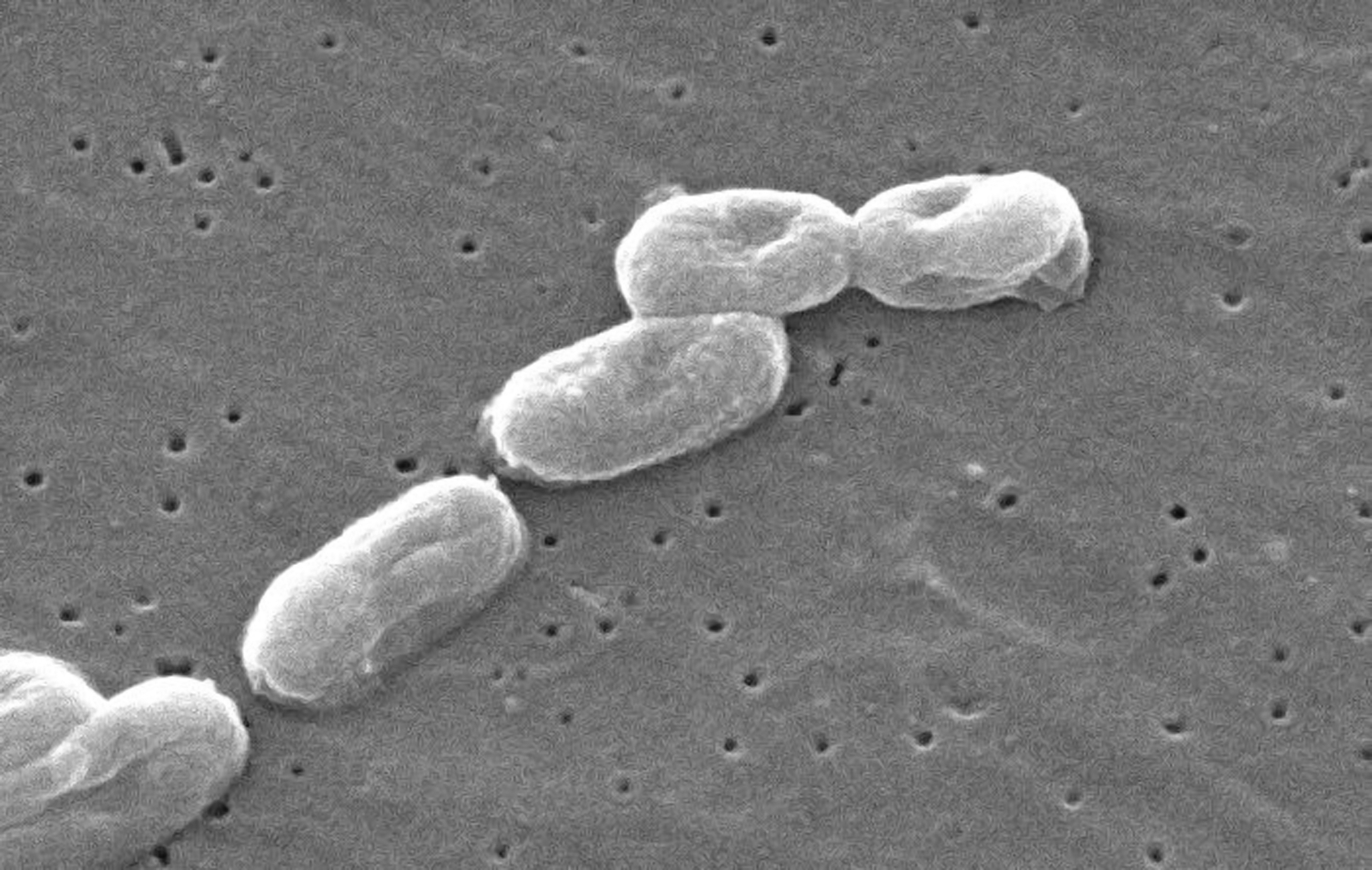
Image source: Wikipedia/Wikimedia
| Ecology, Host, and Life Cycle | |
|---|---|
| Oxygen requirements | Microaerophile |
| Optimal temperature | Not Available |
| Temperature range | Not Available |
| Habitat | rhizosphere |
| Biotic relationship | Not Available |
| Host(s) | Homo sapiens, Viridiplantae, Anura |
| Cell arrangement | Not Available |
| Sporulation | Not Available |
| Energy source | Not Available |
| Pathogenicity | Not Available |
Genome Summary
Burkholderia cepacia strain FDAARGOS_345 chromosome 3, complete
Gene Summary
Adenine Count
198842 bp
Thymine Count
199897 bp
Guanine Count
396164 bp
Cytosine Count
393081 bp
Genome Length
1187984 bp
Protein-coding Genes
1064 genes
Non-Coding Genes
5 genes
# of Chromosomes/Plasmids
4
Genes
| Name | Locus Tag | UniProt ID | Strand Orientation | Gene Start/End | Protein Molecular Weight |
|---|---|---|---|---|---|
| duf721 domain-containing protein | CEQ23_RS09930 | Not Available | Positive | 761583 - 762059 | 17262.0 |
| udp-3-o-acyl-n-acetylglucosamine deacetylase | CEQ23_RS09935 | Not Available | Negative | 762140 - 763057 | 33474.1 |
| peroxiredoxin | CEQ23_RS09940 | Not Available | Negative | 763298 - 763804 | 17670.2 |
| cell division protein ftsz | CEQ23_RS09945 | Not Available | Negative | 763993 - 765189 | 41623.6 |
| cell division protein ftsa | CEQ23_RS09955 | Not Available | Negative | 765303 - 766535 | 43821.1 |
| cell division protein ftsq/divib | CEQ23_RS09960 | Not Available | Negative | 766562 - 767314 | 28128.4 |
| d-alanine--d-alanine ligase | CEQ23_RS09965 | Not Available | Negative | 767334 - 768275 | 33338.8 |
| udp-n-acetylmuramate--l-alanine ligase | CEQ23_RS09970 | Not Available | Negative | 768277 - 769674 | 49044.8 |
| undecaprenyldiphospho-muramoylpentapeptide beta-n-acetylglucosaminyltransferase | CEQ23_RS09975 | Not Available | Negative | 769671 - 770774 | 38395.8 |
| putative lipid ii flippase ftsw | CEQ23_RS09980 | Not Available | Negative | 770771 - 772054 | 46385.6 |
Pathways
1357 pathways
Health Effects
| Health Condition | Relation | Reference |
|---|---|---|
| Infective endocarditis | Causes | PMC3112426 |
| Native valve endocarditis | Causes | PMC3112426 |
| Pneumonia | Causes | PMC9294674 |



