
Kingdom
Pseudomonadati
Phylum
Pseudomonadota
Class
Betaproteobacteria
Order
Burkholderiales
Family
Burkholderiaceae
Genus
Burkholderia
Description
Taxonomy
| Kingdom | Pseudomonadati |
|---|---|
| Phylum | Pseudomonadota |
| Class | Betaproteobacteria |
| Order | Burkholderiales |
| Family | Burkholderiaceae |
| Genus | Burkholderia |
| Species | Burkholderia cepacia |
| Strain | strain FDAARGOS_345 |
Profile
| Physiology | |
|---|---|
| Gram staining properties | Negative |
| Shape | Not Available |
| Mobility | Not Available |
| Flagellar presence | Not Available |
| Number of membranes | Not Available |
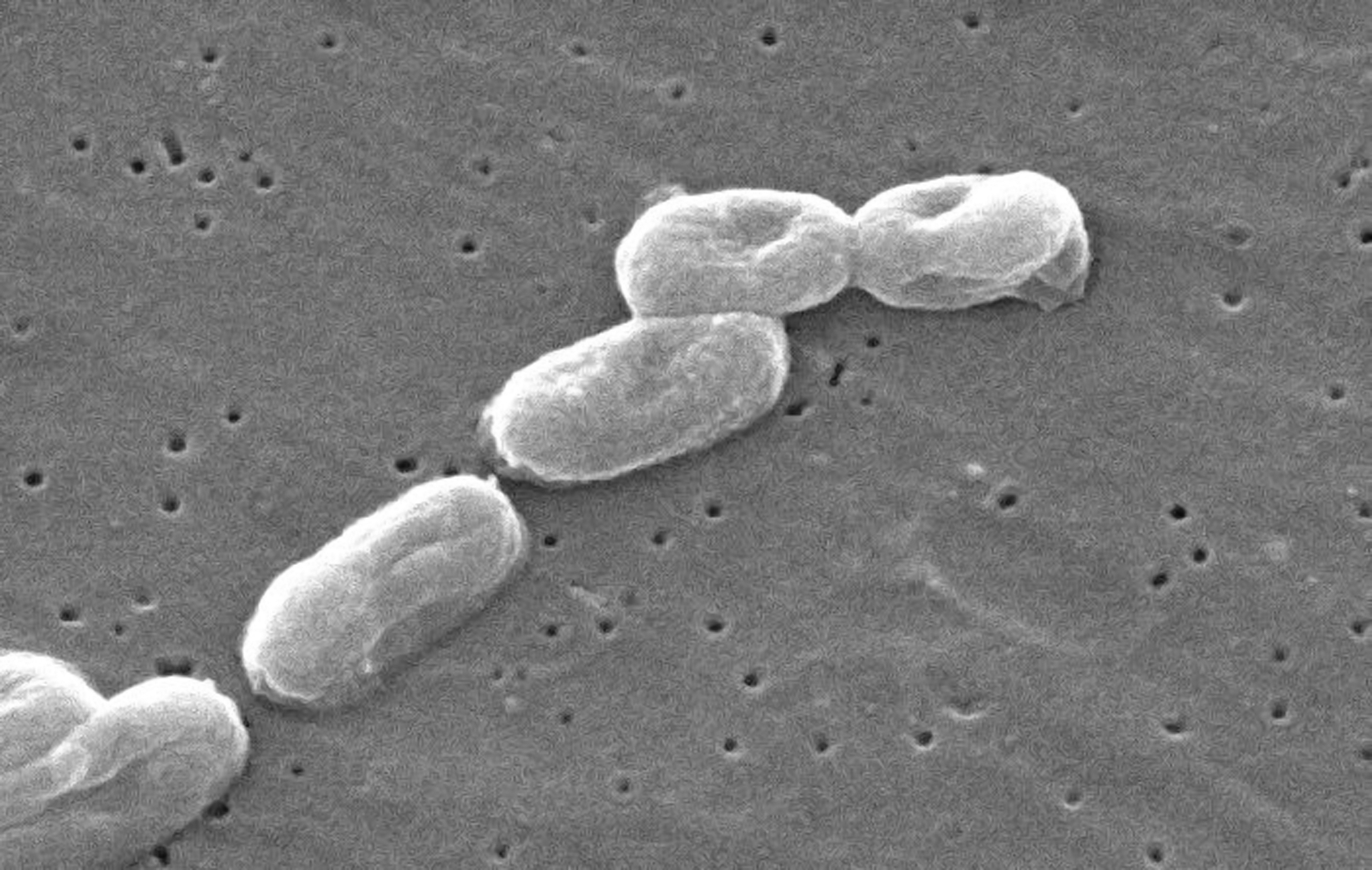
Image source: Wikipedia/Wikimedia
| Ecology, Host, and Life Cycle | |
|---|---|
| Oxygen requirements | Microaerophile |
| Optimal temperature | Not Available |
| Temperature range | Not Available |
| Habitat | rhizosphere |
| Biotic relationship | Not Available |
| Host(s) | Homo sapiens, Viridiplantae, Anura |
| Cell arrangement | Not Available |
| Sporulation | Not Available |
| Energy source | Not Available |
| Pathogenicity | Not Available |
Genome Summary
Burkholderia cepacia strain FDAARGOS_345 chromosome 3, complete
Gene Summary
Adenine Count
198842 bp
Thymine Count
199897 bp
Guanine Count
396164 bp
Cytosine Count
393081 bp
Genome Length
1187984 bp
Protein-coding Genes
1064 genes
Non-Coding Genes
5 genes
# of Chromosomes/Plasmids
4
Genes
| Name | Locus Tag | UniProt ID | Strand Orientation | Gene Start/End | Protein Molecular Weight |
|---|---|---|---|---|---|
| beta-lactamase transcriptional regulator penr | CEQ23_RS33850 | Not Available | Positive | 1977631 - 1978521 | 32534.3 |
| hypothetical protein | CEQ23_RS33855 | Not Available | Negative | 1979020 - 1979271 | 8971.46 |
| amylo-alpha-1,6-glucosidase | CEQ23_RS33860 | Not Available | Negative | 1979368 - 1981590 | 80179.3 |
| autotransporter-associated beta strand repeat-containing protein | CEQ23_RS33865 | Not Available | Negative | 1981749 - 1990304 | 263270.0 |
| ydcf family protein | CEQ23_RS33870 | Not Available | Negative | 1990907 - 1991596 | 24978.4 |
| rod shape-determining protein | CEQ23_RS33875 | Not Available | Negative | 1991866 - 1992900 | 35918.3 |
| patatin-like phospholipase family protein | CEQ23_RS33880 | Not Available | Positive | 1993172 - 1995565 | 84794.0 |
| fmn-dependent nadh-azoreductase | CEQ23_RS33885 | Not Available | Negative | 1995623 - 1996246 | 23034.3 |
| atp-binding protein | CEQ23_RS33890 | Not Available | Negative | 1996580 - 1997710 | 42805.0 |
| response regulator | CEQ23_RS33895 | Not Available | Negative | 1997775 - 1998485 | 26677.9 |
Pathways
1357 pathways
Health Effects
| Health Condition | Relation | Reference |
|---|---|---|
| Infective endocarditis | Causes | PMC3112426 |
| Native valve endocarditis | Causes | PMC3112426 |
| Pneumonia | Causes | PMC9294674 |



