
Kingdom
Pseudomonadati
Phylum
Pseudomonadota
Class
Betaproteobacteria
Order
Burkholderiales
Family
Burkholderiaceae
Genus
Burkholderia
Description
Taxonomy
| Kingdom | Pseudomonadati |
|---|---|
| Phylum | Pseudomonadota |
| Class | Betaproteobacteria |
| Order | Burkholderiales |
| Family | Burkholderiaceae |
| Genus | Burkholderia |
| Species | Burkholderia cepacia |
| Strain | strain FDAARGOS_345 |
Profile
| Physiology | |
|---|---|
| Gram staining properties | Negative |
| Shape | Not Available |
| Mobility | Not Available |
| Flagellar presence | Not Available |
| Number of membranes | Not Available |
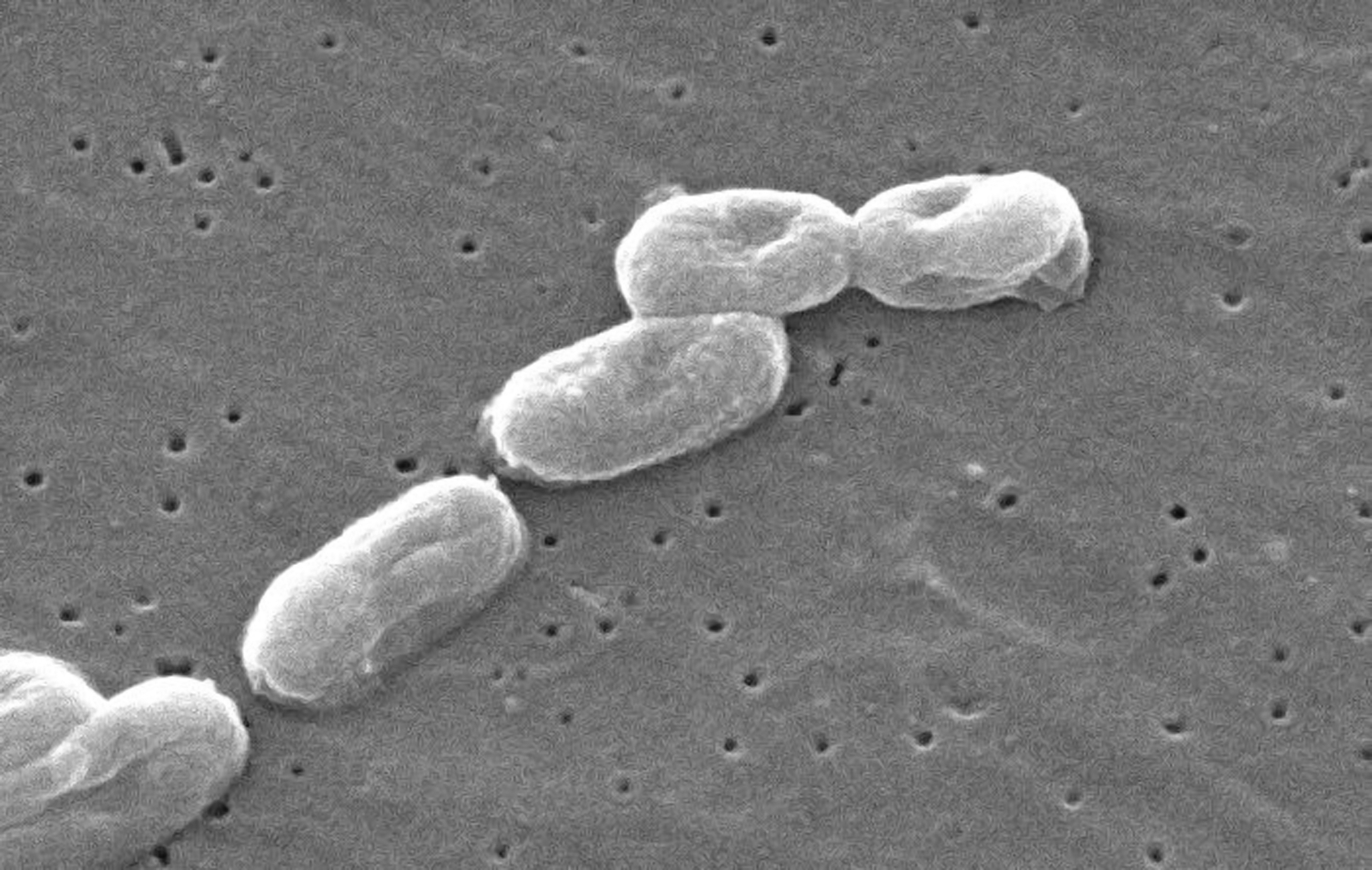
Image source: Wikipedia/Wikimedia
| Ecology, Host, and Life Cycle | |
|---|---|
| Oxygen requirements | Microaerophile |
| Optimal temperature | Not Available |
| Temperature range | Not Available |
| Habitat | rhizosphere |
| Biotic relationship | Not Available |
| Host(s) | Homo sapiens, Viridiplantae, Anura |
| Cell arrangement | Not Available |
| Sporulation | Not Available |
| Energy source | Not Available |
| Pathogenicity | Not Available |
Genome Summary
Burkholderia cepacia strain FDAARGOS_345 chromosome 3, complete
Gene Summary
Adenine Count
198842 bp
Thymine Count
199897 bp
Guanine Count
396164 bp
Cytosine Count
393081 bp
Genome Length
1187984 bp
Protein-coding Genes
1064 genes
Non-Coding Genes
5 genes
# of Chromosomes/Plasmids
4
Genes
| Name | Locus Tag | UniProt ID | Strand Orientation | Gene Start/End | Protein Molecular Weight |
|---|---|---|---|---|---|
| m20 family metallopeptidase | CEQ23_RS33750 | Not Available | Negative | 1954275 - 1955729 | 52245.3 |
| nad(p)h-dependent flavin oxidoreductase | CEQ23_RS33755 | Not Available | Negative | 1955812 - 1956882 | 37324.7 |
| arginine/agmatine antiporter | CEQ23_RS33760 | Not Available | Positive | 1957315 - 1958847 | 53132.0 |
| orn/lys/arg decarboxylase n-terminal domain-containing protein | CEQ23_RS33765 | Not Available | Positive | 1958851 - 1961190 | 85721.2 |
| dknyy domain-containing protein | CEQ23_RS33770 | Not Available | Negative | 1961390 - 1963816 | 90309.3 |
| transcriptional regulator ftra | CEQ23_RS33775 | Not Available | Negative | 1963905 - 1964879 | 35267.6 |
| rhodanese-like domain-containing protein | CEQ23_RS33780 | Not Available | Positive | 1964991 - 1965410 | 14682.4 |
| superinfection immunity protein | CEQ23_RS33785 | Not Available | Positive | 1965512 - 1965838 | 12121.9 |
| cytochrome p450 | CEQ23_RS33790 | Not Available | Negative | 1965854 - 1967059 | 41321.2 |
| yodc family protein | CEQ23_RS33795 | Not Available | Negative | 1967161 - 1967427 | 10254.3 |
Pathways
1357 pathways
Health Effects
| Health Condition | Relation | Reference |
|---|---|---|
| Infective endocarditis | Causes | PMC3112426 |
| Native valve endocarditis | Causes | PMC3112426 |
| Pneumonia | Causes | PMC9294674 |



