
Kingdom
Pseudomonadati
Phylum
Pseudomonadota
Class
Betaproteobacteria
Order
Burkholderiales
Family
Burkholderiaceae
Genus
Burkholderia
Description
Taxonomy
| Kingdom | Pseudomonadati |
|---|---|
| Phylum | Pseudomonadota |
| Class | Betaproteobacteria |
| Order | Burkholderiales |
| Family | Burkholderiaceae |
| Genus | Burkholderia |
| Species | Burkholderia cepacia |
| Strain | strain FDAARGOS_345 |
Profile
| Physiology | |
|---|---|
| Gram staining properties | Negative |
| Shape | Not Available |
| Mobility | Not Available |
| Flagellar presence | Not Available |
| Number of membranes | Not Available |
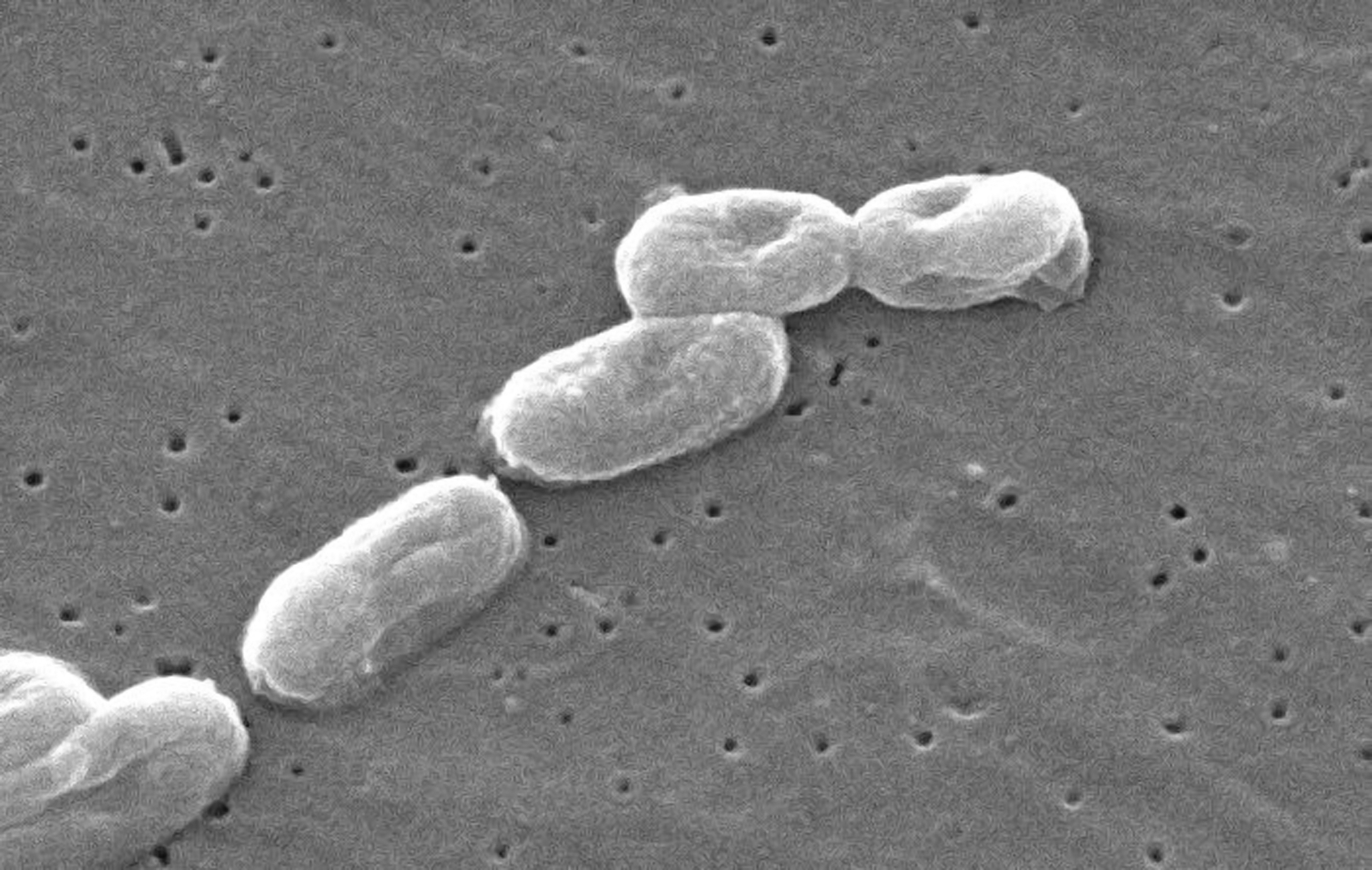
Image source: Wikipedia/Wikimedia
| Ecology, Host, and Life Cycle | |
|---|---|
| Oxygen requirements | Microaerophile |
| Optimal temperature | Not Available |
| Temperature range | Not Available |
| Habitat | rhizosphere |
| Biotic relationship | Not Available |
| Host(s) | Homo sapiens, Viridiplantae, Anura |
| Cell arrangement | Not Available |
| Sporulation | Not Available |
| Energy source | Not Available |
| Pathogenicity | Not Available |
Genome Summary
Burkholderia cepacia strain FDAARGOS_345 chromosome 3, complete
Gene Summary
Adenine Count
198842 bp
Thymine Count
199897 bp
Guanine Count
396164 bp
Cytosine Count
393081 bp
Genome Length
1187984 bp
Protein-coding Genes
1064 genes
Non-Coding Genes
5 genes
# of Chromosomes/Plasmids
4
Genes
| Name | Locus Tag | UniProt ID | Strand Orientation | Gene Start/End | Protein Molecular Weight |
|---|---|---|---|---|---|
| hypothetical protein | CEQ23_RS33455 | Not Available | Negative | 1894242 - 1894385 | 5182.18 |
| winged helix-turn-helix domain-containing protein | CEQ23_RS33460 | Not Available | Positive | 1894790 - 1895188 | 15191.5 |
| lysr family transcriptional regulator | CEQ23_RS33465 | Not Available | Positive | 1895705 - 1895887 | 6674.04 |
| asparagine synthase (glutamine-hydrolyzing) | CEQ23_RS33470 | Not Available | Negative | 1895907 - 1897874 | 72595.8 |
| helix-turn-helix transcriptional regulator | CEQ23_RS33475 | Not Available | Negative | 1898151 - 1898984 | 30547.7 |
| helix-turn-helix transcriptional regulator | CEQ23_RS33480 | Not Available | Positive | 1899269 - 1900174 | 33742.2 |
| nramp family divalent metal transporter | CEQ23_RS33485 | Not Available | Negative | 1900290 - 1901936 | 58857.2 |
| hypothetical protein | CEQ23_RS41250 | Not Available | Negative | 1902053 - 1902190 | 5310.64 |
| hypothetical protein | CEQ23_RS33490 | Not Available | Positive | 1903260 - 1903529 | 9472.89 |
| carbohydrate porin | CEQ23_RS33495 | Not Available | Positive | 1903632 - 1905104 | 51511.4 |
Pathways
1357 pathways
Health Effects
| Health Condition | Relation | Reference |
|---|---|---|
| Infective endocarditis | Causes | PMC3112426 |
| Native valve endocarditis | Causes | PMC3112426 |
| Pneumonia | Causes | PMC9294674 |



