
Kingdom
Pseudomonadati
Phylum
Pseudomonadota
Class
Betaproteobacteria
Order
Burkholderiales
Family
Burkholderiaceae
Genus
Burkholderia
Description
Taxonomy
| Kingdom | Pseudomonadati |
|---|---|
| Phylum | Pseudomonadota |
| Class | Betaproteobacteria |
| Order | Burkholderiales |
| Family | Burkholderiaceae |
| Genus | Burkholderia |
| Species | Burkholderia cepacia |
| Strain | strain FDAARGOS_345 |
Profile
| Physiology | |
|---|---|
| Gram staining properties | Negative |
| Shape | Not Available |
| Mobility | Not Available |
| Flagellar presence | Not Available |
| Number of membranes | Not Available |
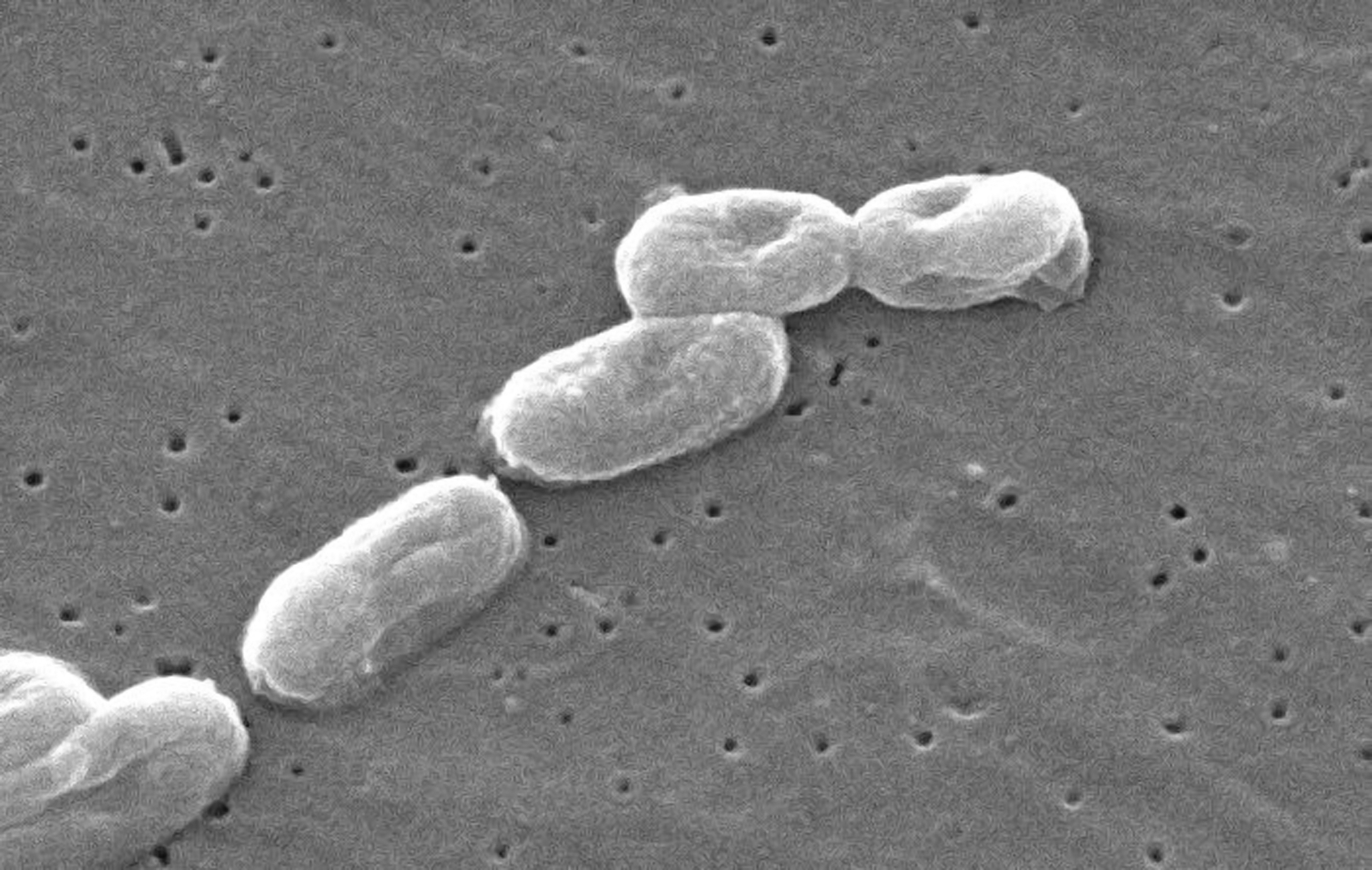
Image source: Wikipedia/Wikimedia
| Ecology, Host, and Life Cycle | |
|---|---|
| Oxygen requirements | Microaerophile |
| Optimal temperature | Not Available |
| Temperature range | Not Available |
| Habitat | rhizosphere |
| Biotic relationship | Not Available |
| Host(s) | Homo sapiens, Viridiplantae, Anura |
| Cell arrangement | Not Available |
| Sporulation | Not Available |
| Energy source | Not Available |
| Pathogenicity | Not Available |
Genome Summary
Burkholderia cepacia strain FDAARGOS_345 chromosome 3, complete
Gene Summary
Adenine Count
198842 bp
Thymine Count
199897 bp
Guanine Count
396164 bp
Cytosine Count
393081 bp
Genome Length
1187984 bp
Protein-coding Genes
1064 genes
Non-Coding Genes
5 genes
# of Chromosomes/Plasmids
4
Genes
| Name | Locus Tag | UniProt ID | Strand Orientation | Gene Start/End | Protein Molecular Weight |
|---|---|---|---|---|---|
| marr family winged helix-turn-helix transcriptional regulator | CEQ23_RS32130 | Not Available | Negative | 1620426 - 1620887 | 17106.5 |
| sdr family oxidoreductase | CEQ23_RS32135 | Not Available | Negative | 1621048 - 1621761 | 25096.1 |
| hypothetical protein | CEQ23_RS32140 | Not Available | Negative | 1621834 - 1622208 | 13447.1 |
| nmra family nad(p)-binding protein | CEQ23_RS32145 | Not Available | Negative | 1622242 - 1623123 | 32420.6 |
| sulfite dehydrogenase | CEQ23_RS32150 | Not Available | Positive | 1623434 - 1624690 | 46008.4 |
| c-type cytochrome | CEQ23_RS32155 | Not Available | Positive | 1624683 - 1625207 | 17837.5 |
| abc transporter permease | CEQ23_RS32160 | Not Available | Negative | 1625475 - 1626362 | 31754.6 |
| abc transporter atp-binding protein | CEQ23_RS32165 | Not Available | Negative | 1626359 - 1627348 | 35862.8 |
| abc transporter substrate-binding protein | CEQ23_RS32170 | Not Available | Negative | 1627416 - 1628447 | 36830.9 |
| taud/tfda dioxygenase family protein | CEQ23_RS32175 | Not Available | Negative | 1628496 - 1629422 | 34566.9 |
Pathways
1357 pathways
Health Effects
| Health Condition | Relation | Reference |
|---|---|---|
| Infective endocarditis | Causes | PMC3112426 |
| Native valve endocarditis | Causes | PMC3112426 |
| Pneumonia | Causes | PMC9294674 |



