
Kingdom
Pseudomonadati
Phylum
Pseudomonadota
Class
Betaproteobacteria
Order
Burkholderiales
Family
Burkholderiaceae
Genus
Burkholderia
Description
Taxonomy
| Kingdom | Pseudomonadati |
|---|---|
| Phylum | Pseudomonadota |
| Class | Betaproteobacteria |
| Order | Burkholderiales |
| Family | Burkholderiaceae |
| Genus | Burkholderia |
| Species | Burkholderia cepacia |
| Strain | strain FDAARGOS_345 |
Profile
| Physiology | |
|---|---|
| Gram staining properties | Negative |
| Shape | Not Available |
| Mobility | Not Available |
| Flagellar presence | Not Available |
| Number of membranes | Not Available |
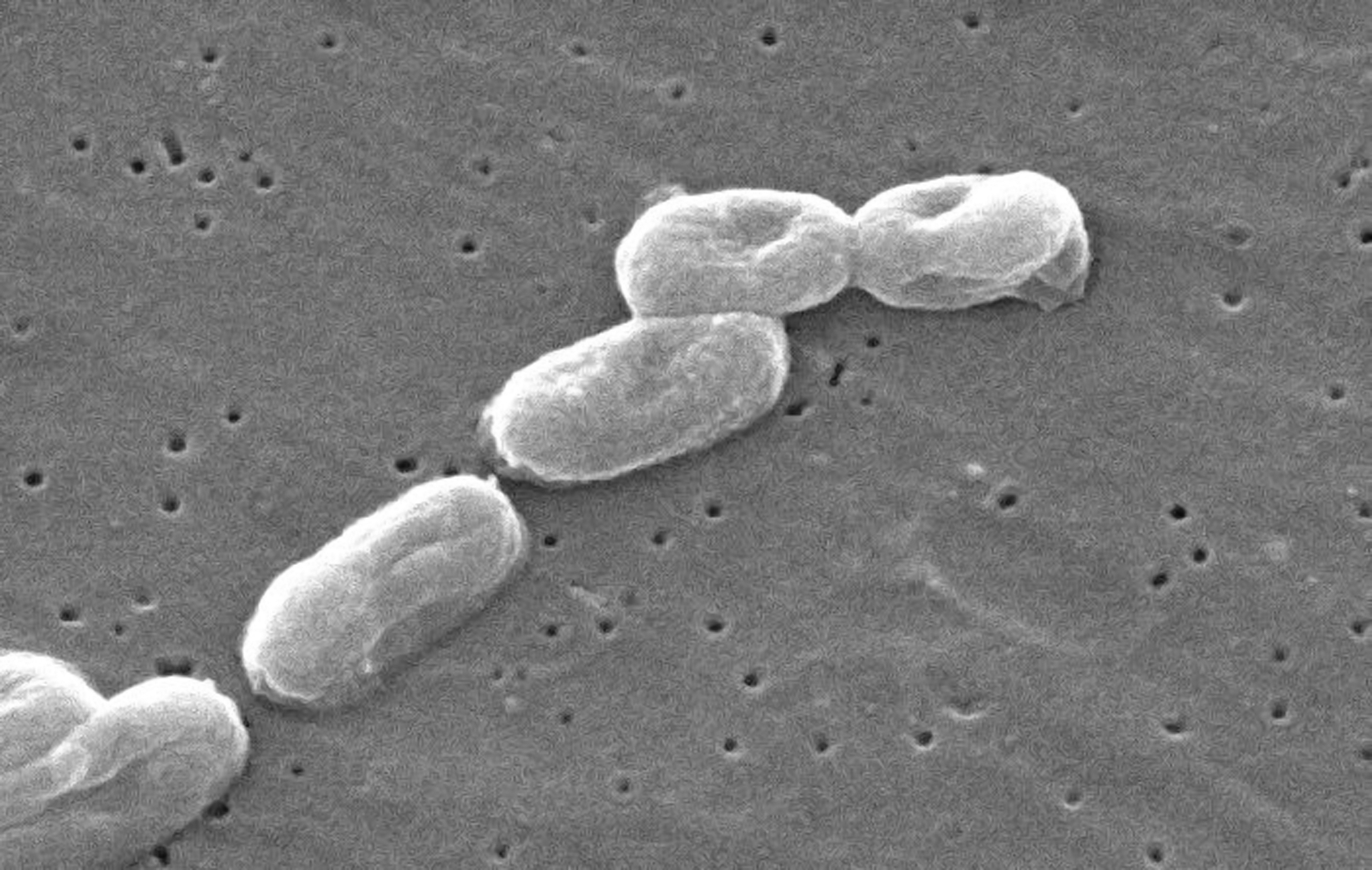
Image source: Wikipedia/Wikimedia
| Ecology, Host, and Life Cycle | |
|---|---|
| Oxygen requirements | Microaerophile |
| Optimal temperature | Not Available |
| Temperature range | Not Available |
| Habitat | rhizosphere |
| Biotic relationship | Not Available |
| Host(s) | Homo sapiens, Viridiplantae, Anura |
| Cell arrangement | Not Available |
| Sporulation | Not Available |
| Energy source | Not Available |
| Pathogenicity | Not Available |
Genome Summary
Burkholderia cepacia strain FDAARGOS_345 chromosome 3, complete
Gene Summary
Adenine Count
198842 bp
Thymine Count
199897 bp
Guanine Count
396164 bp
Cytosine Count
393081 bp
Genome Length
1187984 bp
Protein-coding Genes
1064 genes
Non-Coding Genes
5 genes
# of Chromosomes/Plasmids
4
Genes
| Name | Locus Tag | UniProt ID | Strand Orientation | Gene Start/End | Protein Molecular Weight |
|---|---|---|---|---|---|
| sialidase family protein | CEQ23_RS30515 | Not Available | Positive | 1277612 - 1279081 | 51982.3 |
| alcohol dehydrogenase adhp | CEQ23_RS30520 | Not Available | Negative | 1279146 - 1280174 | 36136.5 |
| tonb-dependent receptor | CEQ23_RS30525 | Not Available | Positive | 1280606 - 1282684 | 74621.2 |
| methyl-accepting chemotaxis protein | CEQ23_RS30530 | Not Available | Positive | 1283154 - 1284773 | 56763.1 |
| alpha,alpha-trehalose-phosphate synthase (udp-forming) | CEQ23_RS30535 | Not Available | Positive | 1285372 - 1286778 | 52817.2 |
| osmc family protein | CEQ23_RS30540 | Not Available | Negative | 1286786 - 1287253 | 16322.6 |
| atp-dependent zinc metalloprotease ftsh | CEQ23_RS30545 | Not Available | Negative | 1287337 - 1289319 | 71371.6 |
| acid phosphatase | CEQ23_RS30555 | Not Available | Positive | 1289792 - 1291450 | 60426.8 |
| fad-dependent oxidoreductase | CEQ23_RS30560 | Not Available | Negative | 1291588 - 1293084 | 53446.9 |
| hypothetical protein | CEQ23_RS30565 | Not Available | Negative | 1293358 - 1293567 | 7214.96 |
Pathways
1357 pathways
Health Effects
| Health Condition | Relation | Reference |
|---|---|---|
| Infective endocarditis | Causes | PMC3112426 |
| Native valve endocarditis | Causes | PMC3112426 |
| Pneumonia | Causes | PMC9294674 |



