
Kingdom
Pseudomonadati
Phylum
Pseudomonadota
Class
Gammaproteobacteria
Order
Lysobacterales
Family
Lysobacteraceae
Genus
Xanthomonas
Description
Taxonomy
| Kingdom | Pseudomonadati |
|---|---|
| Phylum | Pseudomonadota |
| Class | Gammaproteobacteria |
| Order | Lysobacterales |
| Family | Lysobacteraceae |
| Genus | Xanthomonas |
| Species | Xanthomonas vesicatoria |
| Strain | strain LM159 |
Profile
| Physiology | |
|---|---|
| Gram staining properties | Not Available |
| Shape | Rod |
| Mobility | Not Available |
| Flagellar presence | Yes |
| Number of membranes | Not Available |
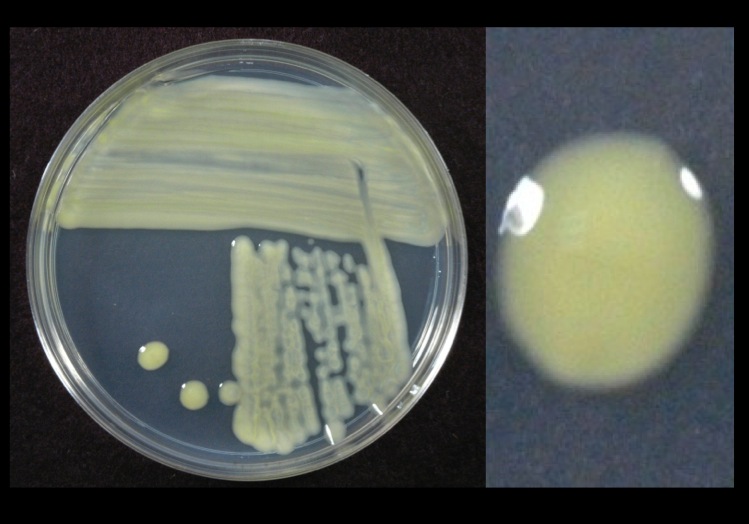
Image source: Wikipedia/Wikimedia
| Ecology, Host, and Life Cycle | |
|---|---|
| Oxygen requirements | Not Available |
| Optimal temperature | Not Available |
| Temperature range | Not Available |
| Habitat | Not Available |
| Biotic relationship | Not Available |
| Host(s) | Solanum lycopersicum |
| Cell arrangement | Not Available |
| Sporulation | Not Available |
| Energy source | Not Available |
| Pathogenicity | Not Available |
Genome Summary
Xanthomonas vesicatoria strain LM159 plasmid pLM159.1, complete
Gene Summary
Adenine Count
41673 bp
Thymine Count
40862 bp
Guanine Count
59178 bp
Cytosine Count
59720 bp
Genome Length
201433 bp
Protein-coding Genes
199 genes
Non-Coding Genes
1 genes
# of Chromosomes/Plasmids
3
Genes
| Name | Locus Tag | UniProt ID | Strand Orientation | Gene Start/End | Protein Molecular Weight |
|---|---|---|---|---|---|
| flagellar basal-body ms-ring/collar protein flif | BI313_RS03900 | Not Available | Negative | 601946 - 603670 | 61596.1 |
| flagellar hook-basal body complex protein flie | BI313_RS03905 | Not Available | Negative | 603684 - 604055 | 12887.3 |
| glycosyltransferase | BI313_RS03920 | Not Available | Negative | 605132 - 608629 | 127638.0 |
| class i sam-dependent methyltransferase | BI313_RS03925 | Not Available | Negative | 608773 - 609327 | 20653.2 |
| class i sam-dependent methyltransferase | BI313_RS03930 | Not Available | Negative | 609324 - 611195 | 70619.7 |
| fkbm family methyltransferase | BI313_RS03935 | Not Available | Negative | 611381 - 612904 | 56700.1 |
| udp-3-o-(3-hydroxymyristoyl)glucosamine n-acyltransferase | BI313_RS03940 | Not Available | Negative | 612901 - 613524 | 22671.9 |
| aromatic ring-hydroxylating oxygenase subunit alpha | BI313_RS03945 | Not Available | Negative | 613514 - 614659 | 43976.4 |
| neud/pglb/viob family sugar acetyltransferase | BI313_RS03950 | Not Available | Negative | 614672 - 615337 | 23086.4 |
| sdr family nad(p)-dependent oxidoreductase | BI313_RS03955 | Not Available | Negative | 615334 - 616113 | 27273.3 |
Pathways
0 pathways
No pathways found
No metabolic pathways have been associated with this bacterium yet.