
Kingdom
Pseudomonadati
Phylum
Pseudomonadota
Class
Gammaproteobacteria
Order
Vibrionales
Family
Vibrionaceae
Genus
Photobacterium
Description
Taxonomy
| Kingdom | Pseudomonadati |
|---|---|
| Phylum | Pseudomonadota |
| Class | Gammaproteobacteria |
| Order | Vibrionales |
| Family | Vibrionaceae |
| Genus | Photobacterium |
| Species | Photobacterium damselae |
| Strain | strain Phdp Wu-1 |
Profile
| Physiology | |
|---|---|
| Gram staining properties | Negative |
| Shape | Coccus |
| Mobility | Yes |
| Flagellar presence | Yes |
| Number of membranes | Not Available |
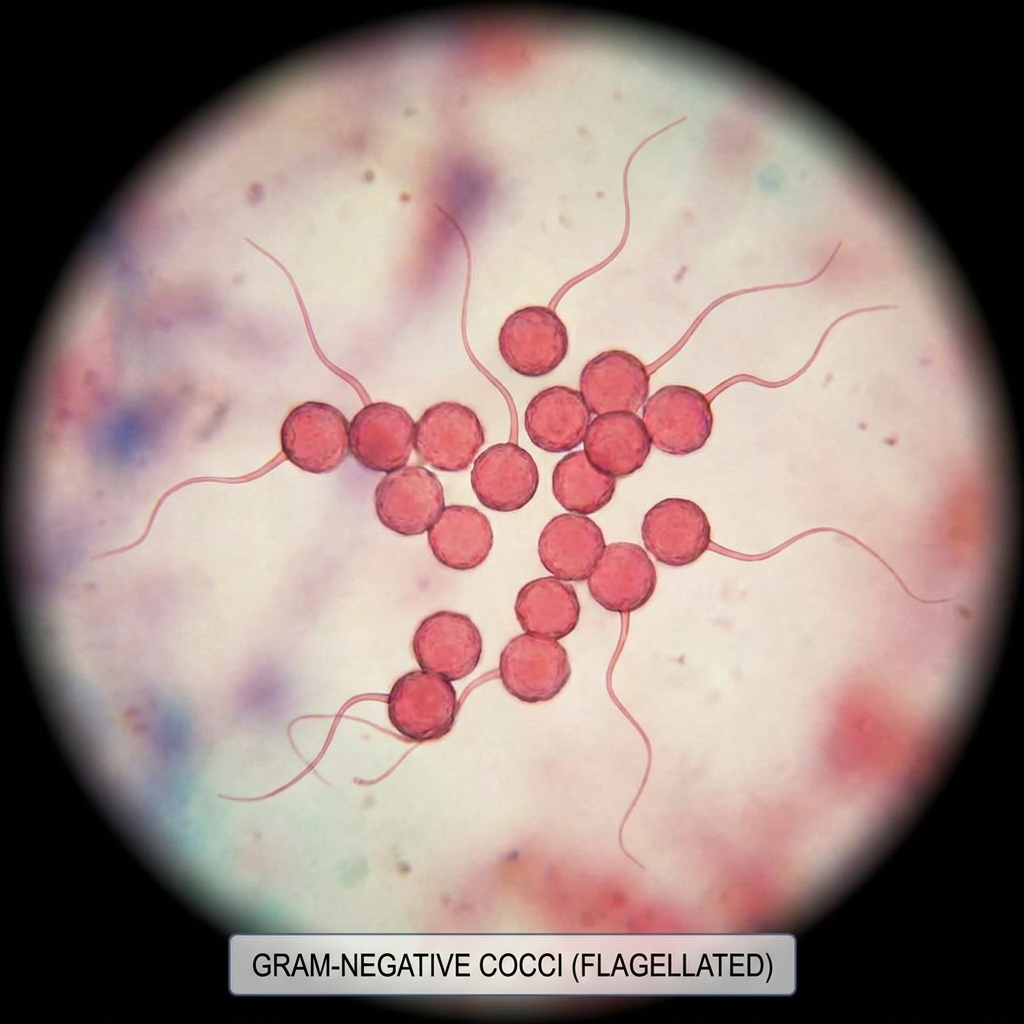
AI-generated image based on bacteria physiology
| Ecology, Host, and Life Cycle | |
|---|---|
| Oxygen requirements | Not Available |
| Optimal temperature | Not Available |
| Temperature range | mesophilic |
| Habitat | Italian aquaculture; Marine |
| Biotic relationship | Not Available |
| Host(s) | Homo sapiens, Alca torda |
| Cell arrangement | Not Available |
| Sporulation | Not Available |
| Energy source | Not Available |
| Pathogenicity | Not Available |
Genome Summary
Photobacterium damselae strain Phdp Wu-1 chromosome 1, complete
Gene Summary
Adenine Count
929587 bp
Thymine Count
931950 bp
Guanine Count
663051 bp
Cytosine Count
665361 bp
Genome Length
3189949 bp
Protein-coding Genes
2659 genes
Non-Coding Genes
265 genes
# of Chromosomes/Plasmids
3
Genes
| Name | Locus Tag | UniProt ID | Strand Orientation | Gene Start/End | Protein Molecular Weight |
|---|---|---|---|---|---|
| trna (guanosine(37)-n1)-methyltransferase trmd | BST98_RS02760 | Not Available | Positive | 532085 - 532831 | 27776.2 |
| 50s ribosomal protein l19 | BST98_RS02765 | Not Available | Positive | 532868 - 533218 | 13072.9 |
| glycine zipper 2tm domain-containing protein | BST98_RS02770 | Not Available | Positive | 533394 - 533870 | 15681.9 |
| carbon starvation protein a | BST98_RS02775 | Not Available | Negative | 533986 - 535464 | 53294.0 |
| duf2799 domain-containing protein | BST98_RS02780 | Not Available | Positive | 535699 - 536082 | 14259.6 |
| two-component system response regulator btsr | BST98_RS02785 | Not Available | Negative | 536086 - 536799 | 27201.3 |
| sensor histidine kinase | BST98_RS02790 | Not Available | Negative | 536792 - 538498 | 62748.7 |
| 3-deoxy-7-phosphoheptulonate synthase | BST98_RS02795 | Not Available | Positive | 538699 - 539766 | 39086.8 |
| bifunctional chorismate mutase/prephenate dehydrogenase | BST98_RS02800 | Not Available | Positive | 539787 - 540917 | 42177.6 |
| prephenate dehydratase | BST98_RS02805 | Not Available | Negative | 540968 - 542140 | 43826.4 |
Pathways
0 pathways
No pathways found
No metabolic pathways have been associated with this bacterium yet.
