Kingdom
Pseudomonadati
Phylum
Pseudomonadota
Class
Gammaproteobacteria
Order
Enterobacterales
Family
Enterobacteriaceae
Genus
Escherichia
Description
Taxonomy
| Kingdom | Pseudomonadati |
|---|---|
| Phylum | Pseudomonadota |
| Class | Gammaproteobacteria |
| Order | Enterobacterales |
| Family | Enterobacteriaceae |
| Genus | Escherichia |
| Species | Escherichia coli |
| Strain | O157:H7 strain PA20 |
Profile
| Physiology | |
|---|---|
| Gram staining properties | Negative |
| Shape | Rod |
| Mobility | Yes |
| Flagellar presence | Yes |
| Number of membranes | 2 |

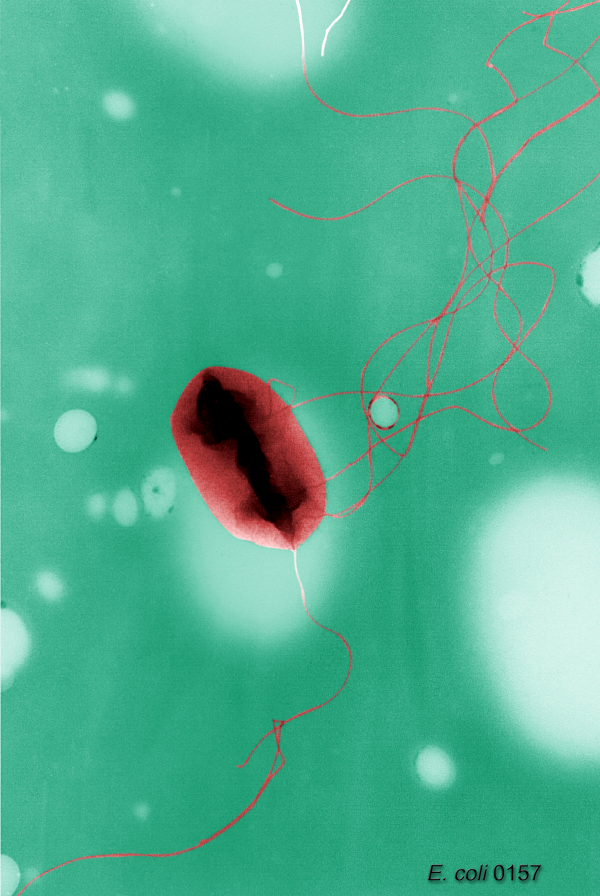
Image source: Wikipedia/Wikimedia
| Ecology, Host, and Life Cycle | |
|---|---|
| Oxygen requirements | Facultative anaerobe |
| Optimal temperature | 37 |
| Temperature range | Mesophilic |
| Habitat | HostAssociated |
| Biotic relationship | Free living |
| Host(s) | Homo sapiens, Bos taurus, Bos |
| Cell arrangement | Pairs - Singles |
| Sporulation | Not Available |
| Energy source | Not Available |
| Pathogenicity | Not Available |
Gene Summary
Adenine Count
24872 bp
Thymine Count
23752 bp
Guanine Count
23870 bp
Cytosine Count
20261 bp
Genome Length
92755 bp
Protein-coding Genes
95 genes
Non-Coding Genes
0 genes
# of Chromosomes/Plasmids
1
Genes
| Name | Locus Tag | UniProt ID | Strand Orientation | Gene Start/End | Protein Molecular Weight |
|---|---|---|---|---|---|
| is3 family transposase | AU473_RS28410 | Not Available | Positive | 7518 - 8689 | 45362.6 |
| enterohemolysin-activating lysine-acyltransferase ehxc | AU473_RS28415 | Not Available | Positive | 9230 - 9745 | 20137.3 |
| enterohemolysin ehxa | AU473_RS28420 | Not Available | Positive | 9747 - 12743 | 107054.0 |
| enterohemolysin t1ss abc transporter permease/atpase ehxb | AU473_RS28425 | Not Available | Positive | 12793 - 14913 | 79819.7 |
| enterohemolysin t1ss abc transporter subunit ehxd | AU473_RS28430 | Not Available | Positive | 14917 - 16356 | 54526.8 |
| hypothetical protein | AU473_RS32995 | Not Available | Positive | 16423 - 16617 | 7548.67 |
| marr family transcriptional regulator | AU473_RS33000 | Not Available | Positive | 16647 - 16931 | 11030.4 |
| hypothetical protein | AU473_RS31220 | Not Available | Positive | 17100 - 17330 | 8978.82 |
| tyrosine-type recombinase/integrase | AU473_RS28450 | Not Available | Positive | 17451 - 18191 | 28225.5 |
| repb family plasmid replication initiator protein | AU473_RS28455 | Not Available | Negative | 18476 - 19453 | 37238.0 |
Pathways
0 pathways
No pathways found
No metabolic pathways have been associated with this bacterium yet.
Health Effects
| Health Condition | Relation | Reference |
|---|---|---|
| Diarrhea | Causes | PMC3035056 |
| Hemorrhagic diarrhea | Causes | PMC4726323 |
| Renal failure | Causes | PMC4726323 |
| Anemia | Causes | PMC4726323 |
| Hus | Causes | PMC7320338 |
| Hemolytic uremic syndrome | Causes | PMC7320338 |
| Hemorrhagic colitis | Causes | PMC13022023 |
| Hus | Causes | PMC13022023 |
| Hemolytic uremic syndrome | Causes | PMC3338595 |
| Hemorrhagic colitis | Causes | PMC3667801 |