
Kingdom
Pseudomonadati
Phylum
Pseudomonadota
Class
Betaproteobacteria
Order
Burkholderiales
Family
Burkholderiaceae
Genus
Burkholderia
Description
Taxonomy
| Kingdom | Pseudomonadati |
|---|---|
| Phylum | Pseudomonadota |
| Class | Betaproteobacteria |
| Order | Burkholderiales |
| Family | Burkholderiaceae |
| Genus | Burkholderia |
| Species | Burkholderia cepacia |
| Strain | JBK9 |
Profile
| Physiology | |
|---|---|
| Gram staining properties | Negative |
| Shape | Not Available |
| Mobility | Not Available |
| Flagellar presence | Not Available |
| Number of membranes | Not Available |
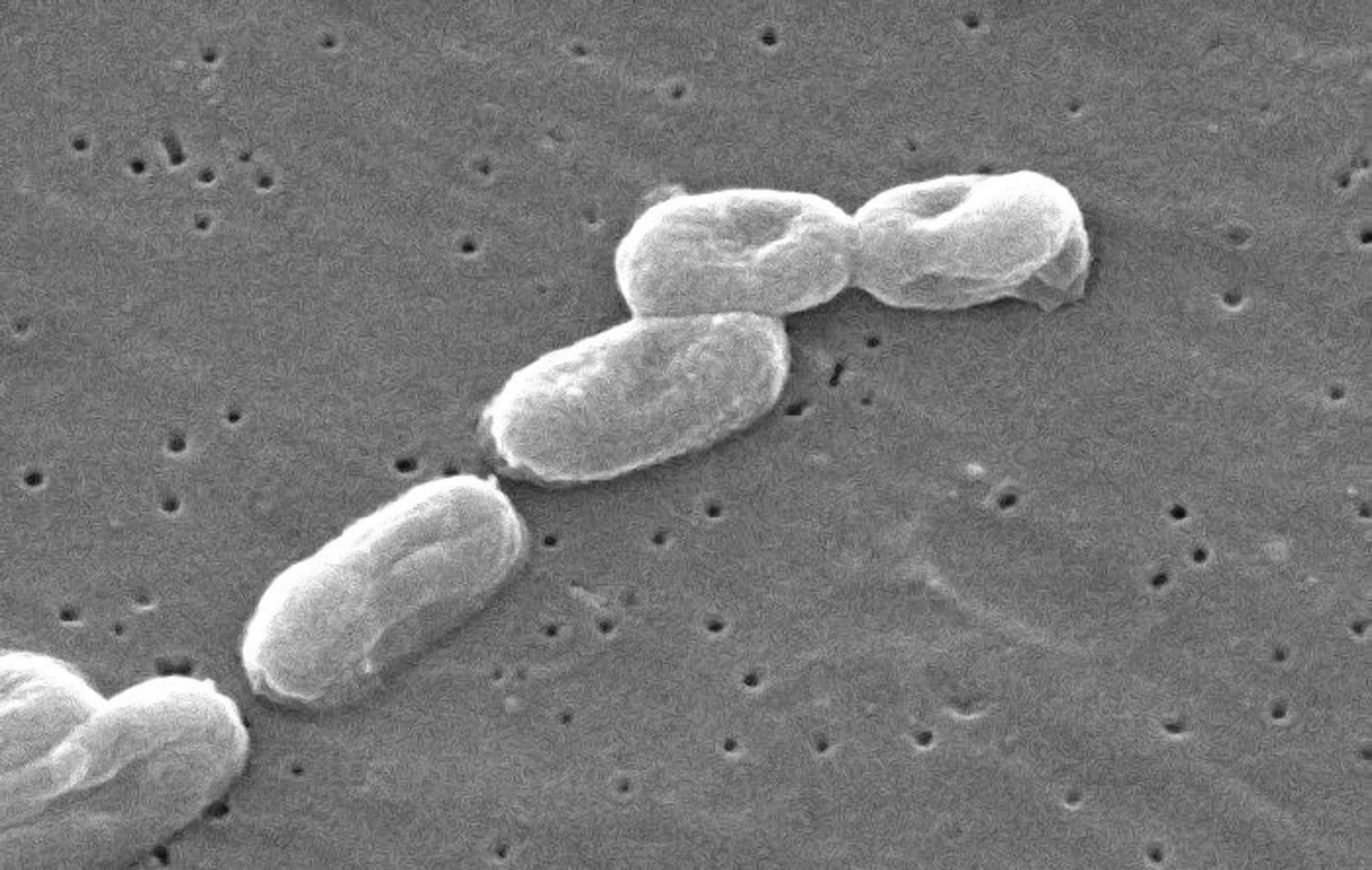
Image source: Wikipedia/Wikimedia
| Ecology, Host, and Life Cycle | |
|---|---|
| Oxygen requirements | Microaerophile |
| Optimal temperature | Not Available |
| Temperature range | Not Available |
| Habitat | Not Available |
| Biotic relationship | Not Available |
| Host(s) | Not Available |
| Cell arrangement | Not Available |
| Sporulation | Not Available |
| Energy source | Not Available |
| Pathogenicity | Not Available |
Gene Summary
Adenine Count
217900 bp
Thymine Count
215538 bp
Guanine Count
427819 bp
Cytosine Count
429135 bp
Genome Length
1290392 bp
Protein-coding Genes
1070 genes
Non-Coding Genes
5 genes
# of Chromosomes/Plasmids
2
Genes
| Name | Locus Tag | UniProt ID | Strand Orientation | Gene Start/End | Protein Molecular Weight |
|---|---|---|---|---|---|
| atp-dependent clp protease atp-binding subunit | P350_RS36490 | Not Available | Positive | 1026176 - 1029013 | 103524.0 |
| fdhf/ydep family oxidoreductase | P350_RS36495 | Not Available | Positive | 1029139 - 1031418 | 83074.0 |
| cytosine permease | P350_RS36500 | Not Available | Negative | 1031528 - 1032949 | 50320.3 |
| lysr substrate-binding domain-containing protein | P350_RS36505 | Not Available | Positive | 1033346 - 1034269 | 34221.1 |
| acetylornithine deacetylase | P350_RS36510 | Not Available | Negative | 1034324 - 1035487 | 41402.7 |
| duf1028 domain-containing protein | P350_RS36515 | Not Available | Negative | 1035480 - 1036157 | 23366.8 |
| rida family protein | P350_RS36520 | Not Available | Negative | 1036154 - 1036603 | 16754.9 |
| nad(p)/fad-dependent oxidoreductase | P350_RS36525 | Not Available | Negative | 1036679 - 1038001 | 47577.1 |
| arac family transcriptional regulator | P350_RS36530 | Not Available | Positive | 1038320 - 1039198 | 32578.6 |
| thiamine pyrophosphate-binding protein | P350_RS36535 | Not Available | Positive | 1039277 - 1041019 | 61104.4 |
Pathways
0 pathways
No pathways found
No metabolic pathways have been associated with this bacterium yet.
Health Effects
No health effects information available for this bacterium.



