
Kingdom
Pseudomonadati
Phylum
Pseudomonadota
Class
Betaproteobacteria
Order
Burkholderiales
Family
Burkholderiaceae
Genus
Burkholderia
Description
Taxonomy
| Kingdom | Pseudomonadati |
|---|---|
| Phylum | Pseudomonadota |
| Class | Betaproteobacteria |
| Order | Burkholderiales |
| Family | Burkholderiaceae |
| Genus | Burkholderia |
| Species | Burkholderia cepacia |
| Strain | JBK9 |
Profile
| Physiology | |
|---|---|
| Gram staining properties | Negative |
| Shape | Not Available |
| Mobility | Not Available |
| Flagellar presence | Not Available |
| Number of membranes | Not Available |
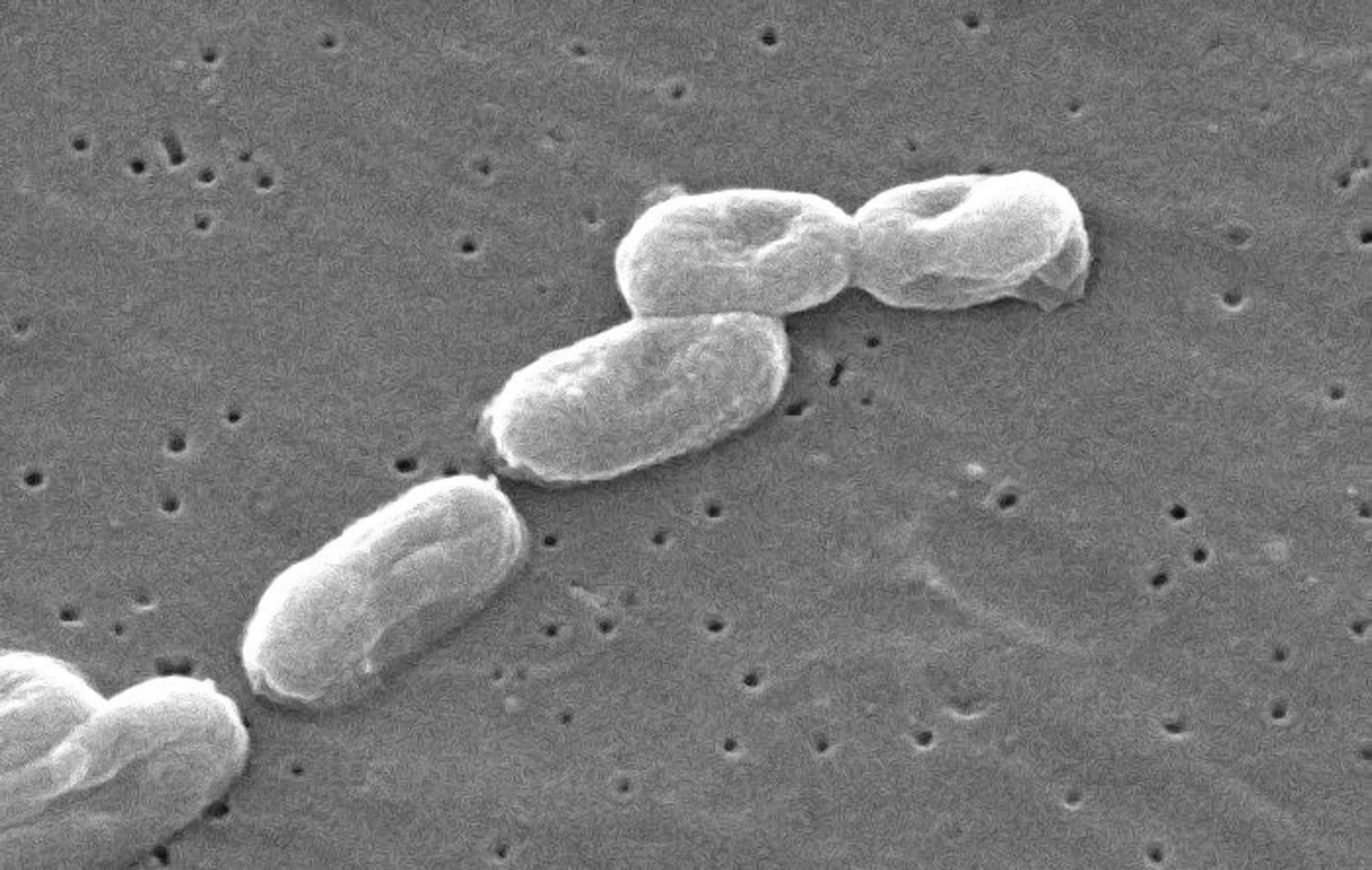
Image source: Wikipedia/Wikimedia
| Ecology, Host, and Life Cycle | |
|---|---|
| Oxygen requirements | Microaerophile |
| Optimal temperature | Not Available |
| Temperature range | Not Available |
| Habitat | Not Available |
| Biotic relationship | Not Available |
| Host(s) | Not Available |
| Cell arrangement | Not Available |
| Sporulation | Not Available |
| Energy source | Not Available |
| Pathogenicity | Not Available |
Gene Summary
Adenine Count
217900 bp
Thymine Count
215538 bp
Guanine Count
427819 bp
Cytosine Count
429135 bp
Genome Length
1290392 bp
Protein-coding Genes
1070 genes
Non-Coding Genes
5 genes
# of Chromosomes/Plasmids
2
Genes
| Name | Locus Tag | UniProt ID | Strand Orientation | Gene Start/End | Protein Molecular Weight |
|---|---|---|---|---|---|
| 2-oxo-4-hydroxy-4-carboxy-5-ureidoimidazoline decarboxylase | P350_RS14955 | Not Available | Positive | 3226026 - 3226553 | 19511.1 |
| trna (guanosine(46)-n7)-methyltransferase trmb | P350_RS14960 | Not Available | Positive | 3226902 - 3227669 | 28459.9 |
| isl3 family transposase | P350_RS14965 | Not Available | Positive | 3227781 - 3229001 | 47661.9 |
| undecaprenyl-diphosphate phosphatase | P350_RS14970 | Not Available | Negative | 3229076 - 3229906 | 30299.6 |
| duf1439 domain-containing protein | P350_RS14975 | Not Available | Negative | 3229986 - 3230567 | 20580.9 |
| ykgj family cysteine cluster protein | P350_RS14980 | Not Available | Negative | 3230564 - 3230890 | 11082.4 |
| oxygen-independent coproporphyrinogen iii oxidase | P350_RS14985 | Not Available | Positive | 3231050 - 3232441 | 51224.1 |
| hypothetical protein | P350_RS14990 | Not Available | Positive | 3232514 - 3232771 | 9396.37 |
| protein-l-isoaspartate o-methyltransferase | P350_RS14995 | Not Available | Positive | 3232876 - 3233532 | 24202.3 |
| rhodanese-like domain-containing protein | P350_RS15000 | Not Available | Positive | 3233547 - 3233870 | 11855.2 |
Pathways
0 pathways
No pathways found
No metabolic pathways have been associated with this bacterium yet.
Health Effects
No health effects information available for this bacterium.



