
Kingdom
Pseudomonadati
Phylum
Pseudomonadota
Class
Betaproteobacteria
Order
Burkholderiales
Family
Burkholderiaceae
Genus
Burkholderia
Description
Taxonomy
| Kingdom | Pseudomonadati |
|---|---|
| Phylum | Pseudomonadota |
| Class | Betaproteobacteria |
| Order | Burkholderiales |
| Family | Burkholderiaceae |
| Genus | Burkholderia |
| Species | Burkholderia cepacia |
| Strain | JBK9 |
Profile
| Physiology | |
|---|---|
| Gram staining properties | Negative |
| Shape | Not Available |
| Mobility | Not Available |
| Flagellar presence | Not Available |
| Number of membranes | Not Available |
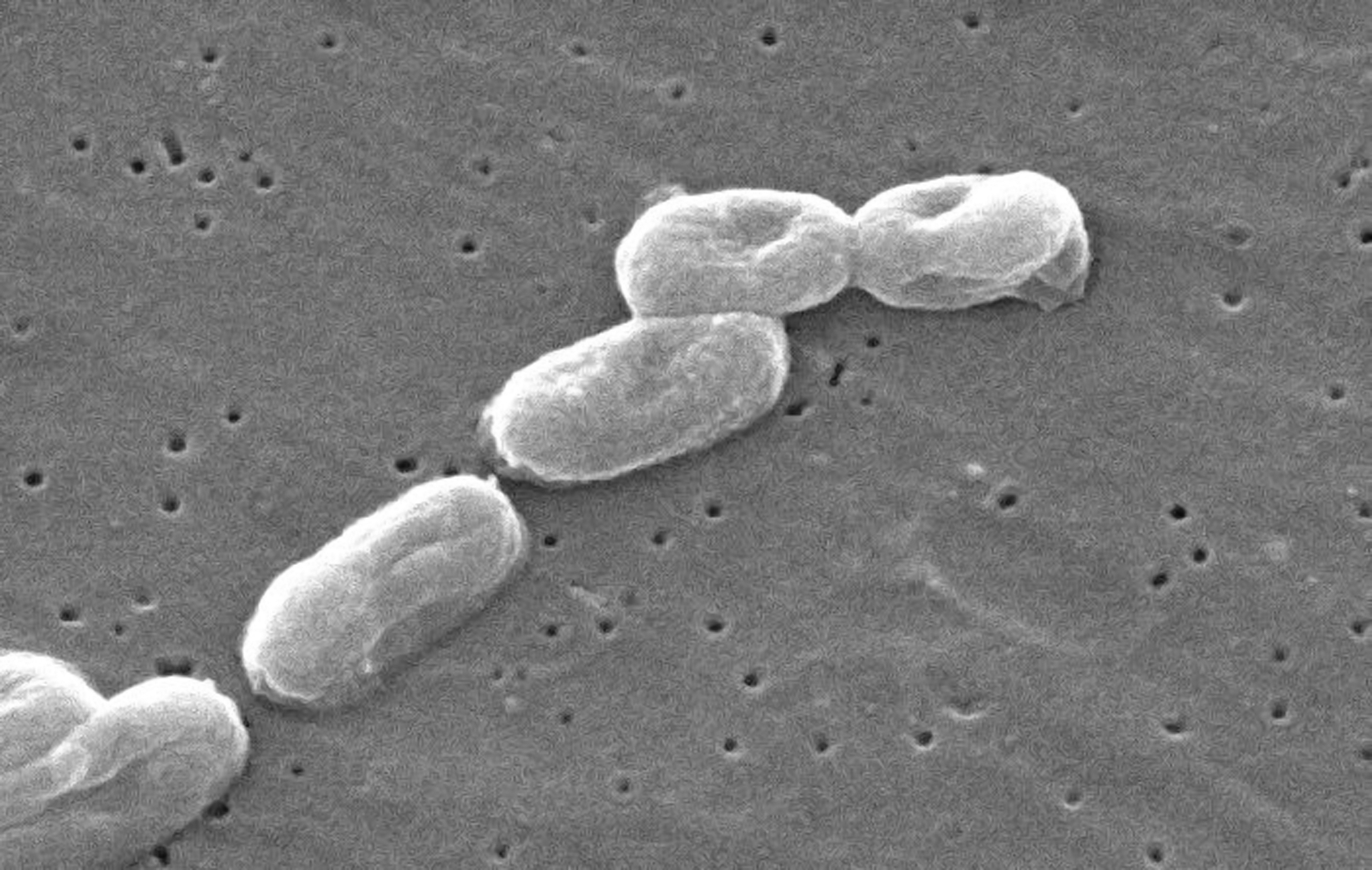
Image source: Wikipedia/Wikimedia
| Ecology, Host, and Life Cycle | |
|---|---|
| Oxygen requirements | Microaerophile |
| Optimal temperature | Not Available |
| Temperature range | Not Available |
| Habitat | Not Available |
| Biotic relationship | Not Available |
| Host(s) | Not Available |
| Cell arrangement | Not Available |
| Sporulation | Not Available |
| Energy source | Not Available |
| Pathogenicity | Not Available |
Gene Summary
Adenine Count
217900 bp
Thymine Count
215538 bp
Guanine Count
427819 bp
Cytosine Count
429135 bp
Genome Length
1290392 bp
Protein-coding Genes
1070 genes
Non-Coding Genes
5 genes
# of Chromosomes/Plasmids
2
Genes
| Name | Locus Tag | UniProt ID | Strand Orientation | Gene Start/End | Protein Molecular Weight |
|---|---|---|---|---|---|
| hypothetical protein | P350_RS40320 | Not Available | Negative | 2176889 - 2177260 | 13752.6 |
| hypothetical protein | P350_RS39655 | Not Available | Negative | 2177450 - 2177791 | 12450.7 |
| helix-turn-helix domain-containing protein | P350_RS40325 | Not Available | Positive | 2177971 - 2178993 | 37962.0 |
| glycine zipper 2tm domain-containing protein | P350_RS10135 | Not Available | Negative | 2179117 - 2179335 | 6682.33 |
| gh36-type glycosyl hydrolase domain-containing protein | P350_RS10140 | Not Available | Negative | 2179498 - 2188143 | 313807.0 |
| type ii toxin-antitoxin system hicb family antitoxin | P350_RS10145 | Not Available | Negative | 2188206 - 2188694 | 17968.4 |
| slipin family protein | P350_RS10150 | Not Available | Positive | 2188986 - 2189858 | 31235.2 |
| sbma/baca-like family transporter | P350_RS10155 | Not Available | Positive | 2190478 - 2190957 | 18366.3 |
| luxr family transcriptional regulator | P350_RS10160 | Not Available | Negative | 2191170 - 2191886 | 26098.4 |
| helix-turn-helix domain-containing protein | P350_RS10165 | Not Available | Negative | 2192076 - 2192585 | 19247.3 |
Pathways
0 pathways
No pathways found
No metabolic pathways have been associated with this bacterium yet.
Health Effects
No health effects information available for this bacterium.



