
Kingdom
Pseudomonadati
Phylum
Pseudomonadota
Class
Betaproteobacteria
Order
Burkholderiales
Family
Burkholderiaceae
Genus
Burkholderia
Description
Taxonomy
| Kingdom | Pseudomonadati |
|---|---|
| Phylum | Pseudomonadota |
| Class | Betaproteobacteria |
| Order | Burkholderiales |
| Family | Burkholderiaceae |
| Genus | Burkholderia |
| Species | Burkholderia cepacia |
| Strain | JBK9 |
Profile
| Physiology | |
|---|---|
| Gram staining properties | Negative |
| Shape | Not Available |
| Mobility | Not Available |
| Flagellar presence | Not Available |
| Number of membranes | Not Available |
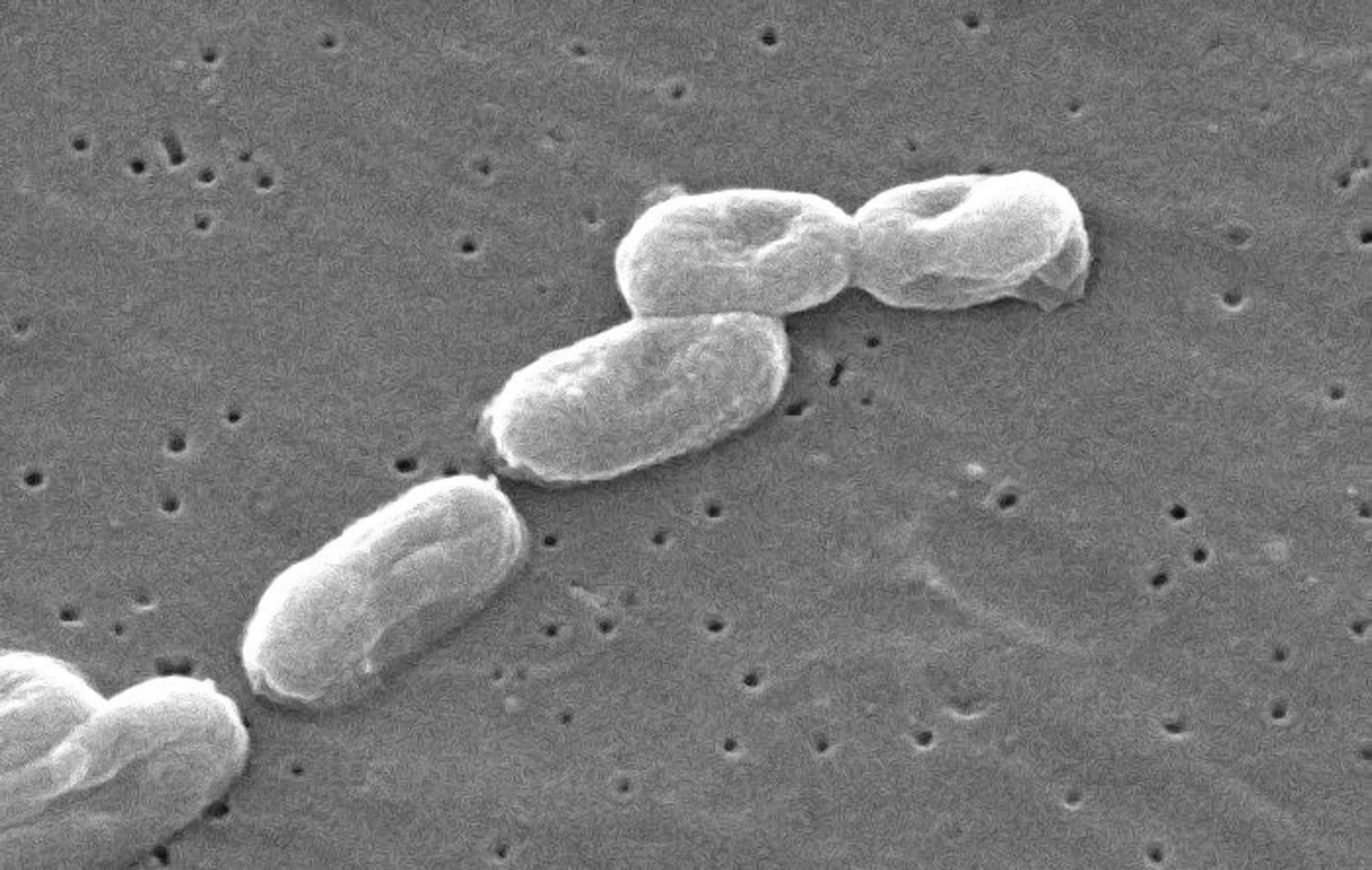
Image source: Wikipedia/Wikimedia
| Ecology, Host, and Life Cycle | |
|---|---|
| Oxygen requirements | Microaerophile |
| Optimal temperature | Not Available |
| Temperature range | Not Available |
| Habitat | Not Available |
| Biotic relationship | Not Available |
| Host(s) | Not Available |
| Cell arrangement | Not Available |
| Sporulation | Not Available |
| Energy source | Not Available |
| Pathogenicity | Not Available |
Gene Summary
Adenine Count
217900 bp
Thymine Count
215538 bp
Guanine Count
427819 bp
Cytosine Count
429135 bp
Genome Length
1290392 bp
Protein-coding Genes
1070 genes
Non-Coding Genes
5 genes
# of Chromosomes/Plasmids
2
Genes
| Name | Locus Tag | UniProt ID | Strand Orientation | Gene Start/End | Protein Molecular Weight |
|---|---|---|---|---|---|
| alpha/beta fold hydrolase | P350_RS02305 | Not Available | Negative | 497217 - 498032 | 29948.7 |
| cgnr zinc finger domain-containing protein | P350_RS02310 | Not Available | Positive | 498114 - 498728 | 22574.6 |
| duf3592 domain-containing protein | P350_RS02315 | Not Available | Negative | 498769 - 499818 | 37712.2 |
| Trna-lys | Not Available | Not Available | Positive | 500004 - 500079 | Not Available |
| paai family thioesterase | P350_RS02325 | Not Available | Positive | 500270 - 500674 | 14540.7 |
| patatin-like phospholipase family protein | P350_RS02330 | Not Available | Positive | 500683 - 501549 | 32204.8 |
| d-2-hydroxyacid dehydrogenase family protein | P350_RS02335 | Not Available | Negative | 501598 - 502611 | 37284.1 |
| lysr family transcriptional regulator | P350_RS02340 | Not Available | Positive | 503039 - 504088 | 38465.3 |
| dna topoisomerase iii | P350_RS02345 | Not Available | Negative | 504219 - 506816 | 96449.3 |
| thioredoxin family protein | P350_RS02350 | Not Available | Negative | 507010 - 507390 | 13831.4 |
Pathways
0 pathways
No pathways found
No metabolic pathways have been associated with this bacterium yet.
Health Effects
No health effects information available for this bacterium.



