
Kingdom
Pseudomonadati
Phylum
Pseudomonadota
Class
Betaproteobacteria
Order
Burkholderiales
Family
Burkholderiaceae
Genus
Burkholderia
Description
Taxonomy
| Kingdom | Pseudomonadati |
|---|---|
| Phylum | Pseudomonadota |
| Class | Betaproteobacteria |
| Order | Burkholderiales |
| Family | Burkholderiaceae |
| Genus | Burkholderia |
| Species | Burkholderia cepacia |
| Strain | JBK9 |
Profile
| Physiology | |
|---|---|
| Gram staining properties | Negative |
| Shape | Not Available |
| Mobility | Not Available |
| Flagellar presence | Not Available |
| Number of membranes | Not Available |
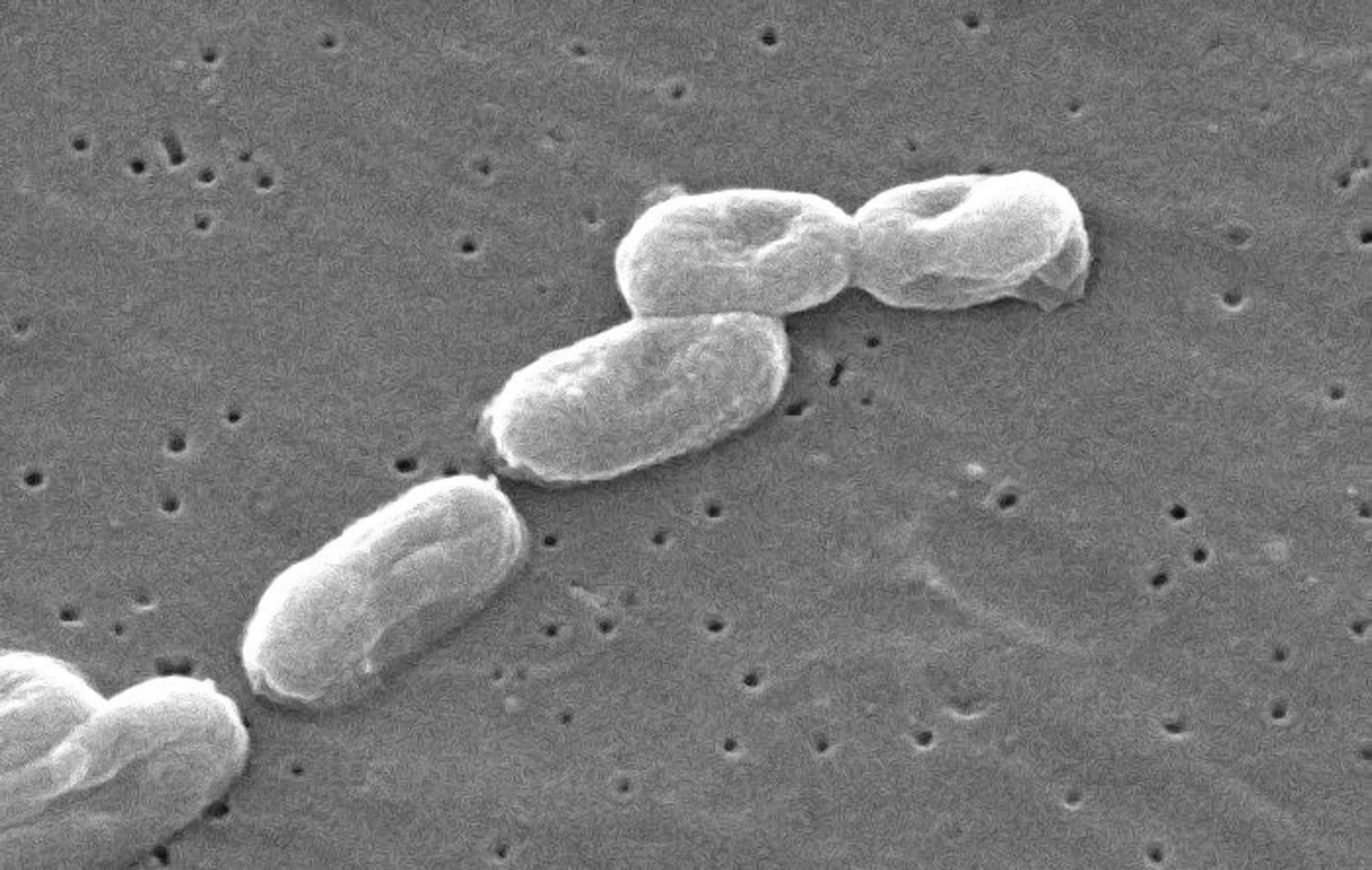
Image source: Wikipedia/Wikimedia
| Ecology, Host, and Life Cycle | |
|---|---|
| Oxygen requirements | Microaerophile |
| Optimal temperature | Not Available |
| Temperature range | Not Available |
| Habitat | Not Available |
| Biotic relationship | Not Available |
| Host(s) | Not Available |
| Cell arrangement | Not Available |
| Sporulation | Not Available |
| Energy source | Not Available |
| Pathogenicity | Not Available |
Gene Summary
Adenine Count
217900 bp
Thymine Count
215538 bp
Guanine Count
427819 bp
Cytosine Count
429135 bp
Genome Length
1290392 bp
Protein-coding Genes
1070 genes
Non-Coding Genes
5 genes
# of Chromosomes/Plasmids
2
Genes
| Name | Locus Tag | UniProt ID | Strand Orientation | Gene Start/End | Protein Molecular Weight |
|---|---|---|---|---|---|
| proq/fino family protein | P350_RS32915 | Not Available | Positive | 134808 - 135587 | 27634.3 |
| dmt family transporter | P350_RS32920 | Not Available | Positive | 136063 - 137124 | 36951.4 |
| nitrogen fixation protein nifq | P350_RS32925 | Not Available | Negative | 137265 - 137855 | 20459.7 |
| molybdopterin-binding protein | P350_RS32930 | Not Available | Negative | 137931 - 138356 | 13904.7 |
| efflux transporter outer membrane subunit | P350_RS32935 | Not Available | Negative | 138537 - 140045 | 52817.0 |
| hlyd family secretion protein | P350_RS32940 | Not Available | Negative | 140042 - 141013 | 34899.7 |
| duf1656 domain-containing protein | P350_RS32945 | Not Available | Negative | 141015 - 141227 | 7852.05 |
| fusc family protein | P350_RS32950 | Not Available | Negative | 141262 - 143385 | 77044.6 |
| marr family winged helix-turn-helix transcriptional regulator | P350_RS32955 | Not Available | Negative | 143382 - 143861 | 17062.3 |
| maoc family dehydratase n-terminal domain-containing protein | P350_RS32960 | Not Available | Positive | 144186 - 145046 | 31153.1 |
Pathways
0 pathways
No pathways found
No metabolic pathways have been associated with this bacterium yet.
Health Effects
No health effects information available for this bacterium.



