
Kingdom
Pseudomonadati
Phylum
Pseudomonadota
Class
Gammaproteobacteria
Order
Enterobacterales
Family
Enterobacteriaceae
Genus
Salmonella
Description
Taxonomy
| Kingdom | Pseudomonadati |
|---|---|
| Phylum | Pseudomonadota |
| Class | Gammaproteobacteria |
| Order | Enterobacterales |
| Family | Enterobacteriaceae |
| Genus | Salmonella |
| Species | Salmonella enterica |
| Strain | subsp. enterica serovar Typhimurium strain |
Profile
| Physiology | |
|---|---|
| Gram staining properties | Negative |
| Shape | Spirilla |
| Mobility | No |
| Flagellar presence | Yes |
| Number of membranes | 2 |
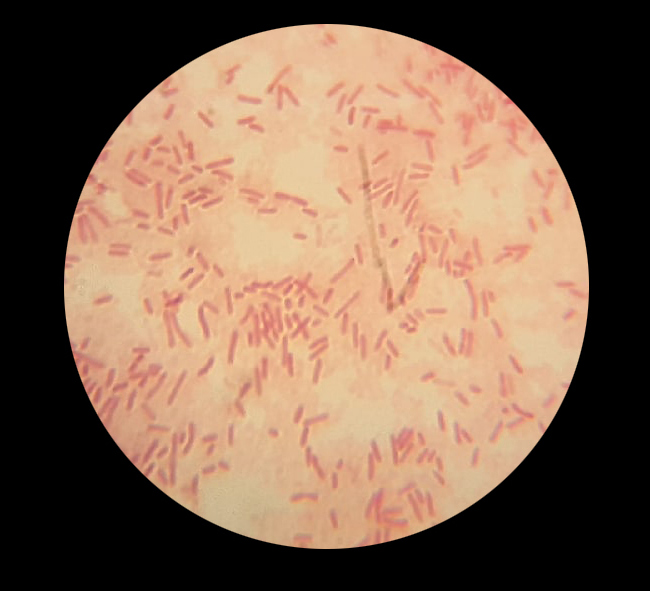
Image source: Wikipedia/Wikimedia
| Ecology, Host, and Life Cycle | |
|---|---|
| Oxygen requirements | Microaerophilic |
| Optimal temperature | 37 |
| Temperature range | Mesophilic |
| Habitat | HostAssociated |
| Biotic relationship | Free living |
| Host(s) | Homo sapiens, Gallus gallus, Metazoa |
| Cell arrangement | Chains - Singles |
| Sporulation | Nonsporulating |
| Energy source | Chemoorganotroph |
| Pathogenicity | Not Available |
Genome Summary
Salmonella enterica subsp. enterica serovar Typhimurium strain
Gene Summary
Adenine Count
12373 bp
Thymine Count
12428 bp
Guanine Count
8391 bp
Cytosine Count
9007 bp
Genome Length
42199 bp
Protein-coding Genes
54 genes
Non-Coding Genes
0 genes
# of Chromosomes/Plasmids
6
Genes
| Name | Locus Tag | UniProt ID | Strand Orientation | Gene Start/End | Protein Molecular Weight |
|---|---|---|---|---|---|
| nif3-like dinuclear metal center hexameric protein | AU613_24475 | Not Available | Negative | 4730622 - 4731365 | 26947.1 |
| transporter | AU613_24480 | Not Available | Positive | 4731537 - 4731650 | 4418.51 |
| dipeptide permease d | AU613_24485 | Not Available | Positive | 4731694 - 4733175 | 53821.6 |
| deoxyribodipyrimidine photo-lyase | AU613_24490 | Not Available | Negative | 4733214 - 4734635 | 53678.1 |
| duf2517 family protein | AU613_24495 | Not Available | Negative | 4734746 - 4734952 | 8129.9 |
| potassium-transporting atpase subunit f | AU613_24500 | Not Available | Positive | 4735289 - 4735378 | 3071.95 |
| potassium-transporting atpase subunit kdpa | AU613_24505 | Not Available | Positive | 4735378 - 4737057 | 59253.7 |
| potassium-transporting atpase subunit b | AU613_24510 | Not Available | Positive | 4737078 - 4739126 | 72145.4 |
| potassium-transporting atpase subunit c | AU613_24515 | Not Available | Positive | 4739135 - 4739719 | 20440.5 |
| two-component system sensor histidine kinase kdbd | AU613_24520 | Not Available | Positive | 4739716 - 4742400 | 98902.5 |
Pathways
1196 pathways
Health Effects
| Health Condition | Relation | Reference |
|---|---|---|
| Gastroenteritis | Causes | PMC12502522 |
| Diarrhea | Causes | PMC12502522 |
| Gastroenteritis | Causes | PMC5109407 |
| Food poisoning | Causes | PMC5109407 |
| Salmonellosis | Causes | PMC6516042 |
| Acute gastroenteritis | Causes | PMC6516042 |
| Intestinal inflammation | Causes | PMC6516042 |
| Gallbladder empyema | Causes | PMC10442058 |
| Disseminated disease | Causes | PMC10442058 |
| Gastroenteritis | Causes | PMC10442058 |


