
Kingdom
Pseudomonadati
Phylum
Pseudomonadota
Class
Betaproteobacteria
Order
Burkholderiales
Family
Burkholderiaceae
Genus
Burkholderia
Description
Taxonomy
| Kingdom | Pseudomonadati |
|---|---|
| Phylum | Pseudomonadota |
| Class | Betaproteobacteria |
| Order | Burkholderiales |
| Family | Burkholderiaceae |
| Genus | Burkholderia |
| Species | Burkholderia cepacia |
| Strain | strain DDS 7H-2 |
Profile
| Physiology | |
|---|---|
| Gram staining properties | Negative |
| Shape | Not Available |
| Mobility | Not Available |
| Flagellar presence | Not Available |
| Number of membranes | Not Available |
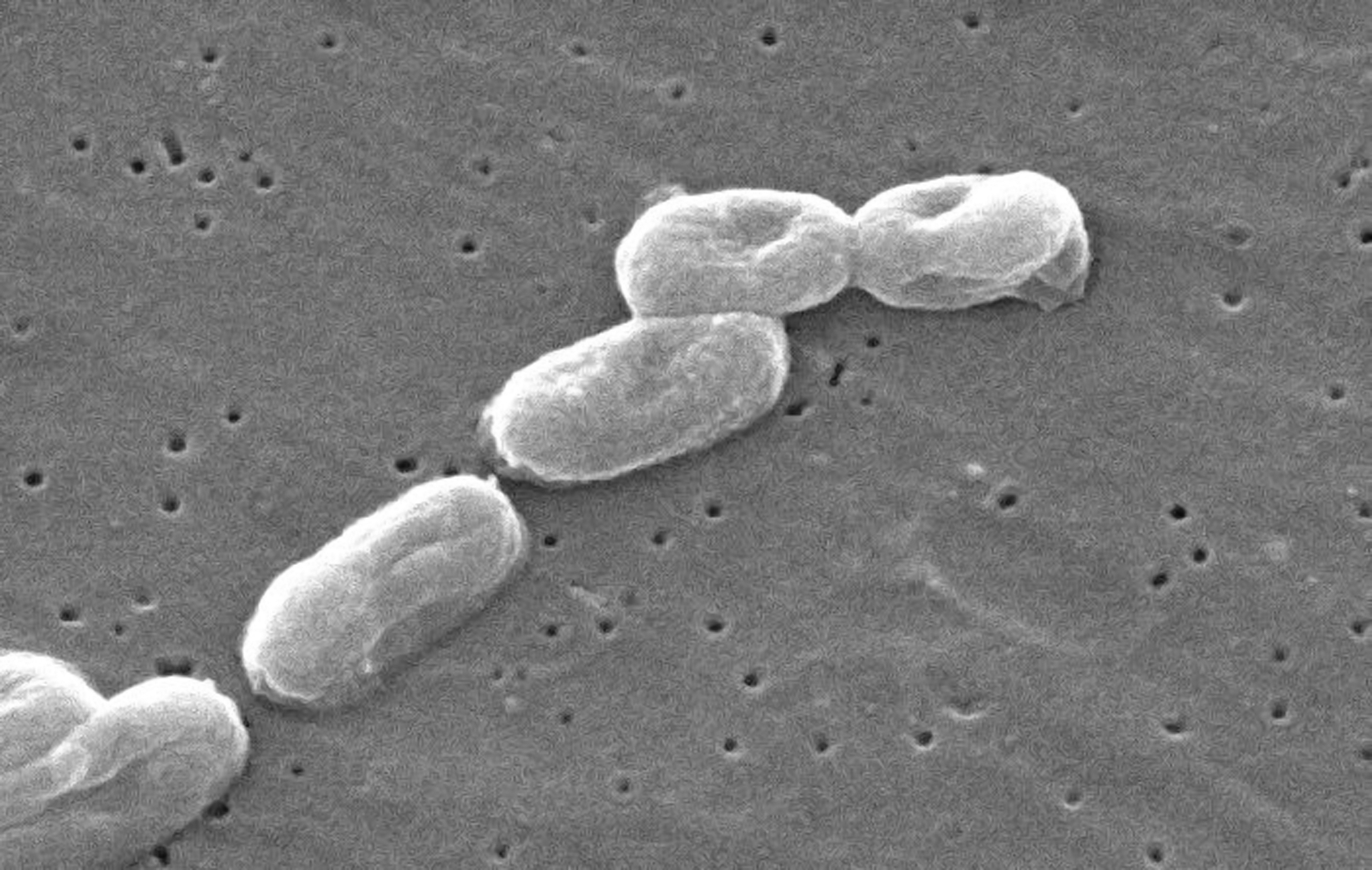
Image source: Wikipedia/Wikimedia
| Ecology, Host, and Life Cycle | |
|---|---|
| Oxygen requirements | Microaerophile |
| Optimal temperature | Not Available |
| Temperature range | Not Available |
| Habitat | rhizosphere |
| Biotic relationship | Not Available |
| Host(s) | Homo sapiens, Viridiplantae, Anura |
| Cell arrangement | Not Available |
| Sporulation | Not Available |
| Energy source | Not Available |
| Pathogenicity | Not Available |
Genome Summary
Burkholderia cepacia strain DDS 7H-2 chromosome 1, complete
Gene Summary
Adenine Count
621107 bp
Thymine Count
621250 bp
Guanine Count
1255081 bp
Cytosine Count
1262791 bp
Genome Length
3760231 bp
Protein-coding Genes
3367 genes
Non-Coding Genes
185 genes
# of Chromosomes/Plasmids
3
Genes
| Name | Locus Tag | UniProt ID | Strand Orientation | Gene Start/End | Protein Molecular Weight |
|---|---|---|---|---|---|
| sodium:solute symporter family protein | DM42_RS33590 | Not Available | Positive | 3094520 - 3096535 | 73268.8 |
| hypothetical protein | DM42_RS39660 | Not Available | Negative | 3096746 - 3096994 | 9746.82 |
| hypothetical protein | DM42_RS33595 | Not Available | Negative | 3097938 - 3098486 | 21330.5 |
| tyrosine-type recombinase/integrase | DM42_RS38865 | Not Available | Negative | 3098884 - 3099981 | 42473.2 |
| Trna-ser | Not Available | Not Available | Positive | 3100210 - 3100300 | Not Available |
| tonb-dependent receptor | DM42_RS33605 | Not Available | Negative | 3100358 - 3102538 | 77342.3 |
| lyse family translocator | DM42_RS33610 | Not Available | Positive | 3102880 - 3103509 | 21932.5 |
| type vi secretion system vgr family protein | DM42_RS33615 | Not Available | Positive | 3103928 - 3106705 | 99368.5 |
| membrane protein | DM42_RS33620 | Not Available | Positive | 3106729 - 3108990 | 84377.9 |
| hypothetical protein | DM42_RS33625 | Not Available | Positive | 3109113 - 3110468 | 48996.1 |
Pathways
1357 pathways
Health Effects
| Health Condition | Relation | Reference |
|---|---|---|
| Infective endocarditis | Causes | PMC3112426 |
| Native valve endocarditis | Causes | PMC3112426 |
| Pneumonia | Causes | PMC9294674 |



