Kingdom
Pseudomonadati
Phylum
Pseudomonadota
Class
Gammaproteobacteria
Order
Enterobacterales
Family
Enterobacteriaceae
Genus
Escherichia
Description
Taxonomy
| Kingdom | Pseudomonadati |
|---|---|
| Phylum | Pseudomonadota |
| Class | Gammaproteobacteria |
| Order | Enterobacterales |
| Family | Enterobacteriaceae |
| Genus | Escherichia |
| Species | Escherichia coli |
| Strain | strain KS-NP019 |
Profile
| Physiology | |
|---|---|
| Gram staining properties | Negative |
| Shape | Rod |
| Mobility | Yes |
| Flagellar presence | Yes |
| Number of membranes | 2 |

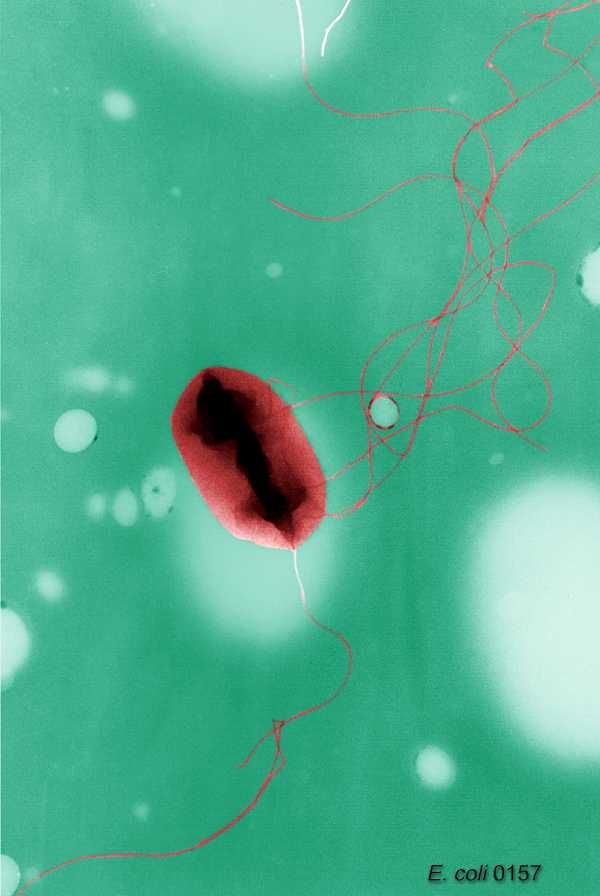
Image source: Wikipedia/Wikimedia
| Ecology, Host, and Life Cycle | |
|---|---|
| Oxygen requirements | Facultative anaerobe |
| Optimal temperature | 37 |
| Temperature range | Mesophilic |
| Habitat | HostAssociated |
| Biotic relationship | Free living |
| Host(s) | Homo sapiens, Gallus gallus, Bos taurus |
| Cell arrangement | Pairs - Singles |
| Sporulation | Not Available |
| Energy source | Not Available |
| Pathogenicity | Human |
Genome Summary
Escherichia coli strain KS-NP019 chromosome, complete genome.
Gene Summary
Adenine Count
1275315 bp
Thymine Count
1270163 bp
Guanine Count
1315610 bp
Cytosine Count
1317672 bp
Genome Length
5178760 bp
Protein-coding Genes
4450 genes
Non-Coding Genes
635 genes
# of Chromosomes/Plasmids
2
Genes
| Name | Locus Tag | UniProt ID | Strand Orientation | Gene Start/End | Protein Molecular Weight |
|---|---|---|---|---|---|
| transcriptional regulator yeil | FFG67_RS07625 | Not Available | Positive | 1540412 - 1541110 | 26931.7 |
| nupc/nupg family nucleoside cnt transporter | FFG67_RS07630 | Not Available | Negative | 1541178 - 1542428 | 43420.3 |
| pseudouridine-5'-phosphate glycosidase | FFG67_RS07635 | Not Available | Negative | 1542522 - 1543460 | 33059.0 |
| pseudouridine kinase | FFG67_RS07640 | Not Available | Negative | 1543448 - 1544389 | 33687.0 |
| pts fructose transporter subunit iibc | FFG67_RS07645 | Not Available | Negative | 1544813 - 1546504 | 57478.6 |
| 1-phosphofructokinase | FFG67_RS07650 | Not Available | Negative | 1546521 - 1547459 | 33757.6 |
| fused pts fructose transporter subunit iia/hpr protein | FFG67_RS07655 | Not Available | Negative | 1547459 - 1548589 | 39735.3 |
| sugar efflux transporter setb | FFG67_RS07660 | Not Available | Positive | 1548957 - 1550138 | 42706.6 |
| ykgj family cysteine cluster protein | FFG67_RS07665 | Not Available | Negative | 1550135 - 1550389 | 8954.96 |
| elongation factor p-like protein yeip | FFG67_RS07670 | Not Available | Positive | 1550544 - 1551116 | 21533.9 |
Pathways
1297 pathways
Health Effects
| Health Condition | Relation | Reference |
|---|---|---|
| Gi disease | Causes | PMC11149725 |
| Utis | Causes | PMC11434687 |
| Colorectal cancer | Causes | PMC12198655 |
| Pyogenic liver abscesses | Causes | PMC12392612 |
| Uti | Causes | PMC13014981 |
| Colibacillosis | Causes | PMC13255289 |
| Enteric infections | Causes | PMC13255289 |
| Foodborne infections | Causes | PMC13255289 |
| Clinical mastitis | Causes | PMC13293316 |
| Diarrhea | Causes | PMC3035056 |