
Kingdom
Bacillati
Phylum
Bacillota
Class
Bacilli
Order
Caryophanales
Family
Bacillaceae
Genus
Bacillus
Description
Taxonomy
| Kingdom | Bacillati |
|---|---|
| Phylum | Bacillota |
| Class | Bacilli |
| Order | Caryophanales |
| Family | Bacillaceae |
| Genus | Bacillus |
| Species | Bacillus anthracis |
| Strain | strain AFS072084 |
Profile
| Physiology | |
|---|---|
| Gram staining properties | Positive |
| Shape | Rod |
| Mobility | No |
| Flagellar presence | Yes |
| Number of membranes | 1 |
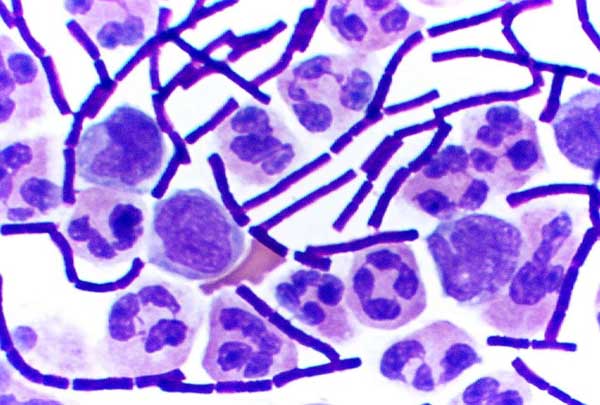
Image source: Wikipedia/Wikimedia
| Ecology, Host, and Life Cycle | |
|---|---|
| Oxygen requirements | Facultative anaerobe |
| Optimal temperature | 37 |
| Temperature range | Mesophilic |
| Habitat | Soil |
| Biotic relationship | Free living |
| Host(s) | Homo sapiens, Bos, Metazoa |
| Cell arrangement | Not Available |
| Sporulation | Sporulating |
| Energy source | Chemoheterotroph |
| Pathogenicity | Animal |
Gene Summary
Adenine Count
1796406 bp
Thymine Count
1805143 bp
Guanine Count
960073 bp
Cytosine Count
983148 bp
Genome Length
5544905 bp
Protein-coding Genes
5565 genes
Non-Coding Genes
220 genes
# of Chromosomes/Plasmids
1
Genes
| Name | Locus Tag | UniProt ID | Strand Orientation | Gene Start/End | Protein Molecular Weight |
|---|---|---|---|---|---|
| hypothetical protein | COL95_23930 | Not Available | Negative | 4422915 - 4423679 | 30318.0 |
| iron abc transporter permease | COL95_23935 | Not Available | Positive | 4423955 - 4424989 | 36652.5 |
| iron abc transporter permease | COL95_23940 | Not Available | Positive | 4424990 - 4426006 | 35814.9 |
| iron-hydroxamate abc transporter substrate-binding protein | COL95_23945 | Not Available | Positive | 4426028 - 4426927 | 33617.8 |
| gnat family n-acetyltransferase | COL95_23950 | Not Available | Positive | 4427146 - 4427697 | 20929.3 |
| hypothetical protein | COL95_23955 | Not Available | Positive | 4427901 - 4428128 | 8304.32 |
| hypothetical protein | COL95_23960 | Not Available | Negative | 4428298 - 4429623 | 47668.6 |
| duf1806 domain-containing protein | COL95_23965 | Not Available | Positive | 4429886 - 4430236 | 13311.0 |
| bacillithiol biosynthesis deacetylase bshb2 | COL95_23970 | Not Available | Positive | 4430252 - 4430914 | 24815.7 |
| xre family transcriptional regulator | COL95_23975 | Not Available | Positive | 4431232 - 4431792 | 21732.2 |
Pathways
0 pathways
No pathways found
No metabolic pathways have been associated with this bacterium yet.
Health Effects
| Health Condition | Relation | Reference |
|---|---|---|
| Anthrax | Causes | PMC4987991 |
| Anthrax | Causes | PMC6842932 |
| Anthrax | Causes | PMC11302227 |
| Anthrax | Causes | PMC11877637 |
| Anthrax | Causes | PMC5241308 |
| Anthrax | Causes | PMC6542083 |
| Anthrax | Causes | PMC8504768 |
| Anthrax-like disease | Causes | PMC8504768 |
| Anthrax | Causes | PMC7464528 |
| Anthrax | Causes | PMC1800911 |






