
Kingdom
Bacillati
Phylum
Bacillota
Class
Bacilli
Order
Caryophanales
Family
Bacillaceae
Genus
Bacillus
Description
Taxonomy
| Kingdom | Bacillati |
|---|---|
| Phylum | Bacillota |
| Class | Bacilli |
| Order | Caryophanales |
| Family | Bacillaceae |
| Genus | Bacillus |
| Species | Bacillus anthracis |
| Strain | strain AFS072084 |
Profile
| Physiology | |
|---|---|
| Gram staining properties | Positive |
| Shape | Rod |
| Mobility | No |
| Flagellar presence | Yes |
| Number of membranes | 1 |
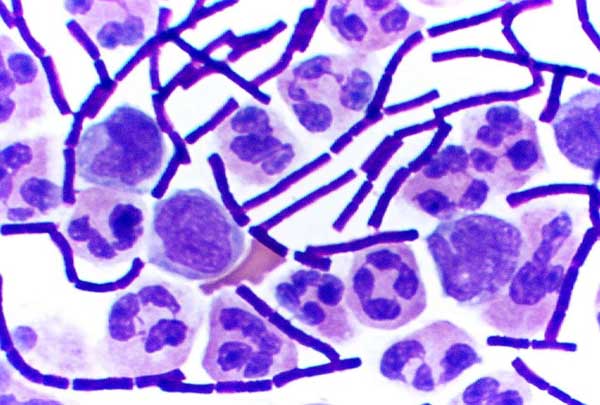
Image source: Wikipedia/Wikimedia
| Ecology, Host, and Life Cycle | |
|---|---|
| Oxygen requirements | Facultative anaerobe |
| Optimal temperature | 37 |
| Temperature range | Mesophilic |
| Habitat | Soil |
| Biotic relationship | Free living |
| Host(s) | Homo sapiens, Bos, Metazoa |
| Cell arrangement | Not Available |
| Sporulation | Sporulating |
| Energy source | Chemoheterotroph |
| Pathogenicity | Animal |
Gene Summary
Adenine Count
1796406 bp
Thymine Count
1805143 bp
Guanine Count
960073 bp
Cytosine Count
983148 bp
Genome Length
5544905 bp
Protein-coding Genes
5565 genes
Non-Coding Genes
220 genes
# of Chromosomes/Plasmids
1
Genes
| Name | Locus Tag | UniProt ID | Strand Orientation | Gene Start/End | Protein Molecular Weight |
|---|---|---|---|---|---|
| glutamate synthase | COL95_23720 | Not Available | Positive | 4380237 - 4384673 | 163144.0 |
| aromatic acid exporter family protein | COL95_23725 | Not Available | Positive | 4384934 - 4386022 | 41778.1 |
| abc transporter atp-binding protein | COL95_23730 | Not Available | Negative | 4386036 - 4387796 | 66127.6 |
| hypothetical protein | COL95_23735 | Not Available | Negative | 4387852 - 4388382 | 21009.9 |
| stress-induced protein | COL95_23740 | Not Available | Negative | 4388615 - 4388875 | 10293.3 |
| gamma-type small acid-soluble spore protein | COL95_23745 | Not Available | Negative | 4389064 - 4389345 | 9638.72 |
| hypothetical protein | COL95_23750 | Not Available | Positive | 4389408 - 4389695 | 11014.2 |
| a/g-specific adenine glycosylase | COL95_23755 | Not Available | Negative | 4389730 - 4390827 | 41814.5 |
| hypothetical protein | COL95_23760 | Not Available | Positive | 4390977 - 4391957 | 37813.2 |
| hypothetical protein | COL95_23765 | Not Available | Negative | 4391982 - 4392248 | 10550.3 |
Pathways
0 pathways
No pathways found
No metabolic pathways have been associated with this bacterium yet.
Health Effects
| Health Condition | Relation | Reference |
|---|---|---|
| Anthrax | Causes | PMC4987991 |
| Anthrax | Causes | PMC6842932 |
| Anthrax | Causes | PMC11302227 |
| Anthrax | Causes | PMC11877637 |
| Anthrax | Causes | PMC5241308 |
| Anthrax | Causes | PMC6542083 |
| Anthrax | Causes | PMC8504768 |
| Anthrax-like disease | Causes | PMC8504768 |
| Anthrax | Causes | PMC7464528 |
| Anthrax | Causes | PMC1800911 |






