
Kingdom
Bacillati
Phylum
Bacillota
Class
Bacilli
Order
Caryophanales
Family
Bacillaceae
Genus
Bacillus
Description
Taxonomy
| Kingdom | Bacillati |
|---|---|
| Phylum | Bacillota |
| Class | Bacilli |
| Order | Caryophanales |
| Family | Bacillaceae |
| Genus | Bacillus |
| Species | Bacillus anthracis |
| Strain | strain AFS072084 |
Profile
| Physiology | |
|---|---|
| Gram staining properties | Positive |
| Shape | Rod |
| Mobility | No |
| Flagellar presence | Yes |
| Number of membranes | 1 |
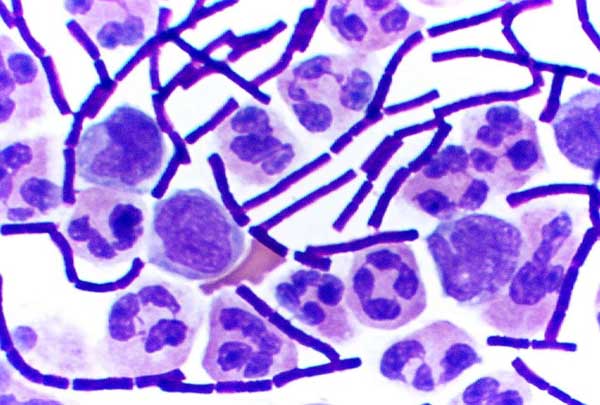
Image source: Wikipedia/Wikimedia
| Ecology, Host, and Life Cycle | |
|---|---|
| Oxygen requirements | Facultative anaerobe |
| Optimal temperature | 37 |
| Temperature range | Mesophilic |
| Habitat | Soil |
| Biotic relationship | Free living |
| Host(s) | Homo sapiens, Bos, Metazoa |
| Cell arrangement | Not Available |
| Sporulation | Sporulating |
| Energy source | Chemoheterotroph |
| Pathogenicity | Animal |
Gene Summary
Adenine Count
1796406 bp
Thymine Count
1805143 bp
Guanine Count
960073 bp
Cytosine Count
983148 bp
Genome Length
5544905 bp
Protein-coding Genes
5565 genes
Non-Coding Genes
220 genes
# of Chromosomes/Plasmids
1
Genes
| Name | Locus Tag | UniProt ID | Strand Orientation | Gene Start/End | Protein Molecular Weight |
|---|---|---|---|---|---|
| ribosome silencing factor | COL95_19155 | Not Available | Negative | 3547468 - 3547824 | 13545.1 |
| hd domain-containing protein | COL95_19160 | Not Available | Negative | 3547821 - 3548390 | 21852.6 |
| nicotinate-nicotinamide nucleotide adenylyltransferase | COL95_19165 | Not Available | Negative | 3548380 - 3548949 | 21956.6 |
| ribosome assembly rna-binding protein yhby | COL95_19170 | Not Available | Negative | 3549081 - 3549374 | 11062.5 |
| shikimate dehydrogenase | COL95_19175 | Not Available | Negative | 3549380 - 3550213 | 30151.7 |
| ribosome biogenesis gtpase yqeh | COL95_19180 | Not Available | Negative | 3550229 - 3551335 | 41303.6 |
| yqeg family had iiia-type phosphatase | COL95_19185 | Not Available | Negative | 3551339 - 3551851 | 19741.2 |
| sporulation histidine kinase inhibitor sda | COL95_19190 | Not Available | Positive | 3552114 - 3552254 | 5455.7 |
| phosphatidylserine decarboxylase proenzyme | COL95_19195 | Not Available | Negative | 3552401 - 3553189 | 29920.1 |
| rna polymerase sporulation sigma factor sigk | COL95_19200 | Not Available | Negative | 3553481 - 3554194 | 27138.0 |
Pathways
0 pathways
No pathways found
No metabolic pathways have been associated with this bacterium yet.
Health Effects
| Health Condition | Relation | Reference |
|---|---|---|
| Anthrax | Causes | PMC4987991 |
| Anthrax | Causes | PMC6842932 |
| Anthrax | Causes | PMC11302227 |
| Anthrax | Causes | PMC11877637 |
| Anthrax | Causes | PMC5241308 |
| Anthrax | Causes | PMC6542083 |
| Anthrax | Causes | PMC8504768 |
| Anthrax-like disease | Causes | PMC8504768 |
| Anthrax | Causes | PMC7464528 |
| Anthrax | Causes | PMC1800911 |






