
Kingdom
Bacillati
Phylum
Bacillota
Class
Bacilli
Order
Caryophanales
Family
Bacillaceae
Genus
Bacillus
Description
Taxonomy
| Kingdom | Bacillati |
|---|---|
| Phylum | Bacillota |
| Class | Bacilli |
| Order | Caryophanales |
| Family | Bacillaceae |
| Genus | Bacillus |
| Species | Bacillus anthracis |
| Strain | strain AFS072084 |
Profile
| Physiology | |
|---|---|
| Gram staining properties | Positive |
| Shape | Rod |
| Mobility | No |
| Flagellar presence | Yes |
| Number of membranes | 1 |
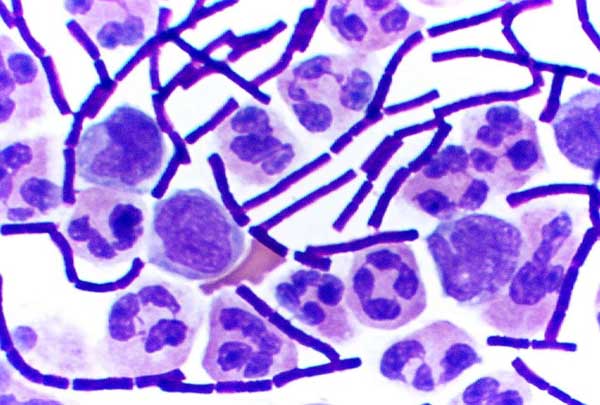
Image source: Wikipedia/Wikimedia
| Ecology, Host, and Life Cycle | |
|---|---|
| Oxygen requirements | Facultative anaerobe |
| Optimal temperature | 37 |
| Temperature range | Mesophilic |
| Habitat | Soil |
| Biotic relationship | Free living |
| Host(s) | Homo sapiens, Bos, Metazoa |
| Cell arrangement | Not Available |
| Sporulation | Sporulating |
| Energy source | Chemoheterotroph |
| Pathogenicity | Animal |
Gene Summary
Adenine Count
1796406 bp
Thymine Count
1805143 bp
Guanine Count
960073 bp
Cytosine Count
983148 bp
Genome Length
5544905 bp
Protein-coding Genes
5565 genes
Non-Coding Genes
220 genes
# of Chromosomes/Plasmids
1
Genes
| Name | Locus Tag | UniProt ID | Strand Orientation | Gene Start/End | Protein Molecular Weight |
|---|---|---|---|---|---|
| adenosylmethionine--8-amino-7-oxononanoate aminotransferase bioa | COL95_17500 | Not Available | Positive | 3246936 - 3248324 | 52101.7 |
| atp-dependent dethiobiotin synthetase biod | COL95_17505 | Not Available | Positive | 3248324 - 3249052 | 26283.8 |
| 8-amino-7-oxononanoate synthase | COL95_17510 | Not Available | Positive | 3249018 - 3250205 | 44093.9 |
| alpha/beta hydrolase | COL95_17515 | Not Available | Positive | 3250202 - 3250942 | 28056.9 |
| malonyl-[acyl-carrier protein] o-methyltransferase bioc | COL95_17520 | Not Available | Positive | 3250908 - 3251717 | 31239.2 |
| biotin synthase biob | COL95_17525 | Not Available | Positive | 3251719 - 3252717 | 37016.4 |
| hypothetical protein | COL95_17530 | Not Available | Positive | 3252900 - 3253220 | 12471.4 |
| 6,7-dimethyl-8-ribityllumazine synthase | COL95_17535 | Not Available | Negative | 3253248 - 3253709 | 16255.6 |
| bifunctional 3,4-dihydroxy-2-butanone-4-phosphate synthase/gtp cyclohydrolase ii | COL95_17540 | Not Available | Negative | 3253728 - 3254921 | 43909.7 |
| riboflavin synthase | COL95_17545 | Not Available | Negative | 3254934 - 3255578 | 23422.3 |
Pathways
0 pathways
No pathways found
No metabolic pathways have been associated with this bacterium yet.
Health Effects
| Health Condition | Relation | Reference |
|---|---|---|
| Anthrax | Causes | PMC4987991 |
| Anthrax | Causes | PMC6842932 |
| Anthrax | Causes | PMC11302227 |
| Anthrax | Causes | PMC11877637 |
| Anthrax | Causes | PMC5241308 |
| Anthrax | Causes | PMC6542083 |
| Anthrax | Causes | PMC8504768 |
| Anthrax-like disease | Causes | PMC8504768 |
| Anthrax | Causes | PMC7464528 |
| Anthrax | Causes | PMC1800911 |






