
Kingdom
Bacillati
Phylum
Bacillota
Class
Bacilli
Order
Caryophanales
Family
Bacillaceae
Genus
Bacillus
Description
Taxonomy
| Kingdom | Bacillati |
|---|---|
| Phylum | Bacillota |
| Class | Bacilli |
| Order | Caryophanales |
| Family | Bacillaceae |
| Genus | Bacillus |
| Species | Bacillus anthracis |
| Strain | strain AFS072084 |
Profile
| Physiology | |
|---|---|
| Gram staining properties | Positive |
| Shape | Rod |
| Mobility | No |
| Flagellar presence | Yes |
| Number of membranes | 1 |
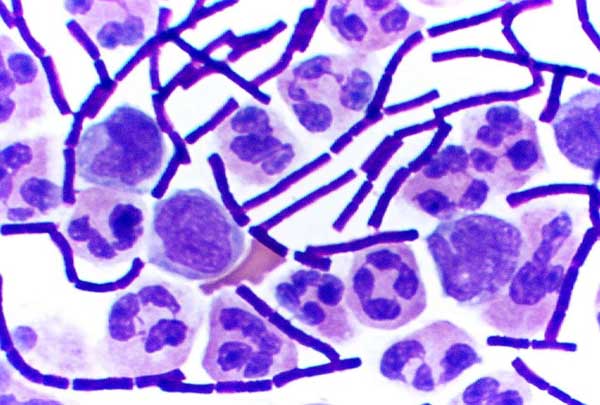
Image source: Wikipedia/Wikimedia
| Ecology, Host, and Life Cycle | |
|---|---|
| Oxygen requirements | Facultative anaerobe |
| Optimal temperature | 37 |
| Temperature range | Mesophilic |
| Habitat | Soil |
| Biotic relationship | Free living |
| Host(s) | Homo sapiens, Bos, Metazoa |
| Cell arrangement | Not Available |
| Sporulation | Sporulating |
| Energy source | Chemoheterotroph |
| Pathogenicity | Animal |
Gene Summary
Adenine Count
1796406 bp
Thymine Count
1805143 bp
Guanine Count
960073 bp
Cytosine Count
983148 bp
Genome Length
5544905 bp
Protein-coding Genes
5565 genes
Non-Coding Genes
220 genes
# of Chromosomes/Plasmids
1
Genes
| Name | Locus Tag | UniProt ID | Strand Orientation | Gene Start/End | Protein Molecular Weight |
|---|---|---|---|---|---|
| beta 1,4 glucosyltransferase | COL95_09545 | Not Available | Positive | 1788433 - 1789533 | 42763.8 |
| class i sam-dependent methyltransferase | COL95_09550 | Not Available | Positive | 1789685 - 1790374 | 26050.4 |
| streptomycin biosynthesis protein strf | COL95_09555 | Not Available | Positive | 1790371 - 1791057 | 26415.8 |
| streptomycin biosynthesis protein strf | COL95_09560 | Not Available | Positive | 1791070 - 1791750 | 26507.7 |
| spore coat protein | COL95_09565 | Not Available | Positive | 1791765 - 1792502 | 27483.0 |
| dtdp-4-dehydrorhamnose 3,5-epimerase | COL95_09570 | Not Available | Positive | 1792511 - 1793056 | 20708.8 |
| dtdp-glucose 4,6-dehydratase | COL95_09575 | Not Available | Positive | 1793073 - 1794041 | 36863.8 |
| dtdp-4-dehydrorhamnose reductase | COL95_09580 | Not Available | Positive | 1794053 - 1794907 | 32440.8 |
| enoyl-[acyl-carrier-protein] reductase fabi | COL95_09585 | Not Available | Positive | 1795016 - 1795786 | 27742.1 |
| hypothetical protein | COL95_09590 | Not Available | Positive | 1795927 - 1796490 | 21577.6 |
Pathways
0 pathways
No pathways found
No metabolic pathways have been associated with this bacterium yet.
Health Effects
| Health Condition | Relation | Reference |
|---|---|---|
| Anthrax | Causes | PMC4987991 |
| Anthrax | Causes | PMC6842932 |
| Anthrax | Causes | PMC11302227 |
| Anthrax | Causes | PMC11877637 |
| Anthrax | Causes | PMC5241308 |
| Anthrax | Causes | PMC6542083 |
| Anthrax | Causes | PMC8504768 |
| Anthrax-like disease | Causes | PMC8504768 |
| Anthrax | Causes | PMC7464528 |
| Anthrax | Causes | PMC1800911 |






