
Kingdom
Bacillati
Phylum
Bacillota
Class
Bacilli
Order
Caryophanales
Family
Bacillaceae
Genus
Bacillus
Description
Taxonomy
| Kingdom | Bacillati |
|---|---|
| Phylum | Bacillota |
| Class | Bacilli |
| Order | Caryophanales |
| Family | Bacillaceae |
| Genus | Bacillus |
| Species | Bacillus cereus |
| Strain | strain AFS044520 |
Profile
| Physiology | |
|---|---|
| Gram staining properties | Positive |
| Shape | Rod |
| Mobility | Yes |
| Flagellar presence | Yes |
| Number of membranes | 1 |
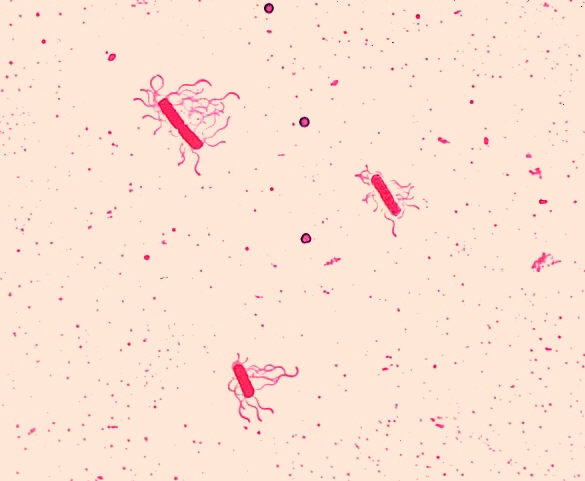
Image source: Wikipedia/Wikimedia
| Ecology, Host, and Life Cycle | |
|---|---|
| Oxygen requirements | Aerobe |
| Optimal temperature | 25 |
| Temperature range | Mesophilic |
| Habitat | Multiple |
| Biotic relationship | Free living |
| Host(s) | Homo sapiens, Gallus gallus, Metazoa |
| Cell arrangement | Chains |
| Sporulation | Not Available |
| Energy source | Not Available |
| Pathogenicity | Human |
Gene Summary
Adenine Count
1984520 bp
Thymine Count
1955748 bp
Guanine Count
1064600 bp
Cytosine Count
1023993 bp
Genome Length
6028976 bp
Protein-coding Genes
5883 genes
Non-Coding Genes
206 genes
# of Chromosomes/Plasmids
1
Genes
| Name | Locus Tag | UniProt ID | Strand Orientation | Gene Start/End | Protein Molecular Weight |
|---|---|---|---|---|---|
| abc transporter permease | COA24_20530 | Not Available | Positive | 3764416 - 3765333 | 33666.1 |
| abc transporter permease | COA24_20535 | Not Available | Positive | 3765350 - 3766354 | 36880.7 |
| peptide abc transporter atp-binding protein | COA24_20540 | Not Available | Positive | 3766311 - 3767321 | 37359.1 |
| abc transporter atp-binding protein | COA24_20545 | Not Available | Positive | 3767318 - 3768091 | 28585.6 |
| peptide abc transporter substrate-binding protein | COA24_20550 | Not Available | Positive | 3768105 - 3769715 | 60683.3 |
| hypothetical protein | COA24_20555 | Not Available | Negative | 3769740 - 3770207 | 17653.0 |
| arac family transcriptional regulator | COA24_20560 | Not Available | Positive | 3770380 - 3771279 | 34884.6 |
| hypothetical protein | COA24_20565 | Not Available | Positive | 3771298 - 3771489 | 7341.27 |
| hypothetical protein | COA24_20570 | Not Available | Positive | 3771555 - 3771836 | 10023.9 |
| peptide abc transporter substrate-binding protein | COA24_20575 | Not Available | Negative | 3771877 - 3773517 | 61199.4 |
Pathways
1324 pathways
Health Effects
| Health Condition | Relation | Reference |
|---|---|---|
| Late-onset neonatal sepsis | Causes | PMC11282708 |
| Neonatal sepsis | Causes | PMC11282708 |
| Food poisoning | Causes | PMC11282708 |
| Sepsis | Causes | PMC11282708 |
| Meningitis | Causes | PMC11282708 |
| Pneumonia | Causes | PMC11282708 |
| Foodborne illnesses | Causes | PMC11282708 |
| Severe systemic multi-organ failure | Causes | PMC11282708 |
| Anthrax-like skin infections | Causes | PMC11282708 |
| Severe neonatal skin infections resembling anthrax-like lesions | Causes | PMC11282708 |






