
Kingdom
Bacillati
Phylum
Bacillota
Class
Bacilli
Order
Caryophanales
Family
Bacillaceae
Genus
Bacillus
Description
Taxonomy
| Kingdom | Bacillati |
|---|---|
| Phylum | Bacillota |
| Class | Bacilli |
| Order | Caryophanales |
| Family | Bacillaceae |
| Genus | Bacillus |
| Species | Bacillus cereus |
| Strain | strain AFS044520 |
Profile
| Physiology | |
|---|---|
| Gram staining properties | Positive |
| Shape | Rod |
| Mobility | Yes |
| Flagellar presence | Yes |
| Number of membranes | 1 |
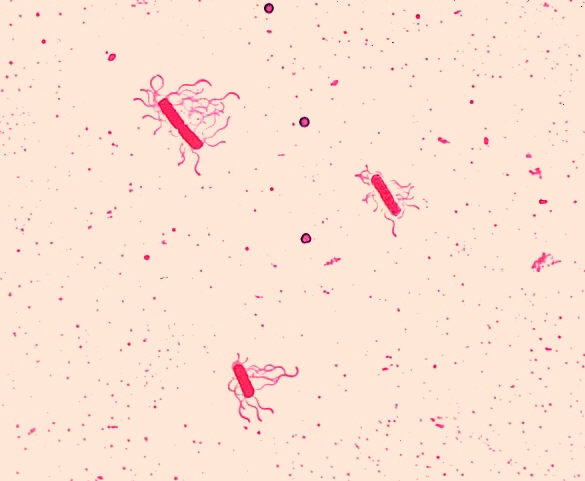
Image source: Wikipedia/Wikimedia
| Ecology, Host, and Life Cycle | |
|---|---|
| Oxygen requirements | Aerobe |
| Optimal temperature | 25 |
| Temperature range | Mesophilic |
| Habitat | Multiple |
| Biotic relationship | Free living |
| Host(s) | Homo sapiens, Gallus gallus, Metazoa |
| Cell arrangement | Chains |
| Sporulation | Not Available |
| Energy source | Not Available |
| Pathogenicity | Human |
Gene Summary
Adenine Count
1984520 bp
Thymine Count
1955748 bp
Guanine Count
1064600 bp
Cytosine Count
1023993 bp
Genome Length
6028976 bp
Protein-coding Genes
5883 genes
Non-Coding Genes
206 genes
# of Chromosomes/Plasmids
1
Genes
| Name | Locus Tag | UniProt ID | Strand Orientation | Gene Start/End | Protein Molecular Weight |
|---|---|---|---|---|---|
| duf1806 domain-containing protein | COA24_17765 | Not Available | Positive | 3247628 - 3247978 | 13243.9 |
| bacillithiol biosynthesis deacetylase bshb2 | COA24_17770 | Not Available | Positive | 3247994 - 3248656 | 24921.9 |
| short-chain dehydrogenase | COA24_17775 | Not Available | Negative | 3248769 - 3249512 | 26489.5 |
| hypothetical protein | COA24_17780 | Not Available | Negative | 3249562 - 3249939 | 14579.4 |
| hypothetical protein | COA24_17785 | Not Available | Positive | 3250444 - 3250722 | 10487.7 |
| hypothetical protein | COA24_17790 | Not Available | Positive | 3251020 - 3251265 | 9333.68 |
| hypothetical protein | COA24_17795 | Not Available | Negative | 3251309 - 3251875 | 21412.8 |
| bcr/cfla family drug resistance efflux transporter | COA24_17800 | Not Available | Positive | 3252274 - 3253473 | 43283.6 |
| amino acid permease | COA24_17805 | Not Available | Positive | 3254026 - 3255444 | 51253.9 |
| n-acyl homoserine lactonase family protein | COA24_17815 | Not Available | Positive | 3255873 - 3256625 | 28120.6 |
Pathways
1452 pathways
Health Effects
| Health Condition | Relation | Reference |
|---|---|---|
| Late-onset neonatal sepsis | Causes | PMC11282708 |
| Neonatal sepsis | Causes | PMC11282708 |
| Food poisoning | Causes | PMC11282708 |
| Sepsis | Causes | PMC11282708 |
| Meningitis | Causes | PMC11282708 |
| Pneumonia | Causes | PMC11282708 |
| Foodborne illnesses | Causes | PMC11282708 |
| Severe systemic multi-organ failure | Causes | PMC11282708 |
| Anthrax-like skin infections | Causes | PMC11282708 |
| Severe neonatal skin infections resembling anthrax-like lesions | Causes | PMC11282708 |






