Kingdom
Pseudomonadati
Phylum
Pseudomonadota
Class
Gammaproteobacteria
Order
Enterobacterales
Family
Enterobacteriaceae
Genus
Escherichia
Description
Taxonomy
| Kingdom | Pseudomonadati |
|---|---|
| Phylum | Pseudomonadota |
| Class | Gammaproteobacteria |
| Order | Enterobacterales |
| Family | Enterobacteriaceae |
| Genus | Escherichia |
| Species | Escherichia coli |
| Strain | strain OLC1000 |
Profile
| Physiology | |
|---|---|
| Gram staining properties | Negative |
| Shape | Rod |
| Mobility | Yes |
| Flagellar presence | Yes |
| Number of membranes | 2 |

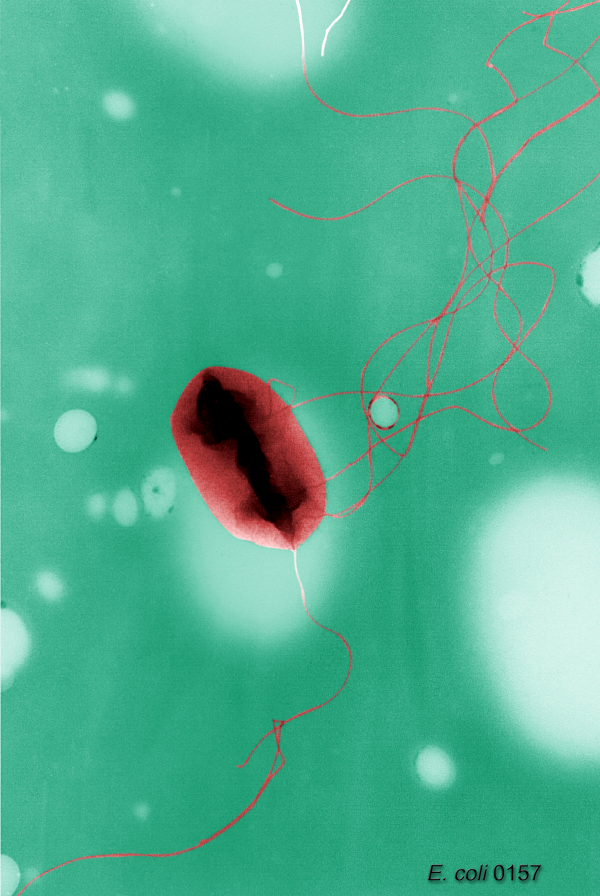
Image source: Wikipedia/Wikimedia
| Ecology, Host, and Life Cycle | |
|---|---|
| Oxygen requirements | Facultative anaerobe |
| Optimal temperature | 37 |
| Temperature range | Mesophilic |
| Habitat | HostAssociated |
| Biotic relationship | Free living |
| Host(s) | Homo sapiens, Gallus gallus, Bos taurus |
| Cell arrangement | Pairs - Singles |
| Sporulation | Not Available |
| Energy source | Not Available |
| Pathogenicity | Human |
Gene Summary
Adenine Count
1309692 bp
Thymine Count
1317008 bp
Guanine Count
1348180 bp
Cytosine Count
1316072 bp
Genome Length
5290952 bp
Protein-coding Genes
4873 genes
Non-Coding Genes
368 genes
# of Chromosomes/Plasmids
1
Genes
| Name | Locus Tag | UniProt ID | Strand Orientation | Gene Start/End | Protein Molecular Weight |
|---|---|---|---|---|---|
| Tail tape measure protein | AW059_04175 | Not Available | Positive | 848820 - 851627 | 100039.0 |
| Tail protein | AW059_04180 | Not Available | Positive | 851634 - 852128 | 18535.2 |
| Serine acetyltransferase | AW059_04185 | Not Available | Positive | 852381 - 852857 | 17577.7 |
| Qin prophage | AW059_04190 | Not Available | Negative | 852901 - 853479 | 21198.8 |
| Tail fiber protein | AW059_04195 | Not Available | Negative | 853488 - 854378 | 32410.4 |
| Side tail fiber | AW059_04200 | Not Available | Negative | 854375 - 856924 | 90889.3 |
| Tail protein i | AW059_04205 | Not Available | Negative | 856927 - 857457 | 19789.6 |
| Baseplate j/gp47 family protein | AW059_04210 | Not Available | Negative | 857450 - 858346 | 31888.7 |
| Lysozyme family baseplate assembly protein | AW059_04215 | Not Available | Negative | 858350 - 858700 | 12893.7 |
| Baseplate assembly protein v | AW059_04220 | Not Available | Negative | 858697 - 859263 | 19577.2 |
Pathways
0 pathways
No pathways found
No metabolic pathways have been associated with this bacterium yet.
Health Effects
| Health Condition | Relation | Reference |
|---|---|---|
| Gi disease | Causes | PMC11149725 |
| Utis | Causes | PMC11434687 |
| Colorectal cancer | Causes | PMC12198655 |
| Pyogenic liver abscesses | Causes | PMC12392612 |
| Uti | Causes | PMC13014981 |
| Colibacillosis | Causes | PMC13255289 |
| Enteric infections | Causes | PMC13255289 |
| Foodborne infections | Causes | PMC13255289 |
| Clinical mastitis | Causes | PMC13293316 |
| Diarrhea | Causes | PMC3035056 |