
Kingdom
Pseudomonadati
Phylum
Pseudomonadota
Class
Alphaproteobacteria
Order
Hyphomicrobiales
Family
Bartonellaceae
Genus
Bartonella
Description
Taxonomy
| Kingdom | Pseudomonadati |
|---|---|
| Phylum | Pseudomonadota |
| Class | Alphaproteobacteria |
| Order | Hyphomicrobiales |
| Family | Bartonellaceae |
| Genus | Bartonella |
| Species | Bartonella clarridgeiae |
| Strain | 73 |
Profile
| Physiology | |
|---|---|
| Gram staining properties | Negative |
| Shape | Bacilli |
| Mobility | Yes |
| Flagellar presence | Yes |
| Number of membranes | 2 |
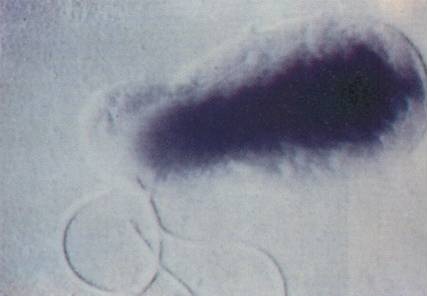
Image source: Wikipedia/Wikimedia
| Ecology, Host, and Life Cycle | |
|---|---|
| Oxygen requirements | Aerobic |
| Optimal temperature | Not Available |
| Temperature range | Mesophilic |
| Habitat | HostAssociated |
| Biotic relationship | Free living |
| Host(s) | Not Available |
| Cell arrangement | Not Available |
| Sporulation | Nonsporulating |
| Energy source | Not Available |
| Pathogenicity | Yes |
Gene Summary
Adenine Count
485648 bp
Thymine Count
493065 bp
Guanine Count
271592 bp
Cytosine Count
272438 bp
Genome Length
1522743 bp
Protein-coding Genes
1234 genes
Non-Coding Genes
51 genes
# of Chromosomes/Plasmids
1
Genes
| Name | Locus Tag | UniProt ID | Strand Orientation | Gene Start/End | Protein Molecular Weight |
|---|---|---|---|---|---|
| bifunctional folylpolyglutamate synthase/dihydrofolate synthase | BARCL_RS00165 | Not Available | Negative | 38160 - 39479 | 48401.1 |
| acetyl-coa carboxylase, carboxyltransferase subunit beta | BARCL_RS00170 | Not Available | Negative | 39498 - 40403 | 33502.0 |
| sulfate transporter family protein | BARCL_RS00175 | Not Available | Negative | 40928 - 41641 | 27569.2 |
| bifunctional phosphopantothenoylcysteine decarboxylase/phosphopantothenate--cysteine ligase coabc | BARCL_RS00180 | Not Available | Negative | 41772 - 43172 | 50341.1 |
| 2-polyprenylphenol 6-hydroxylase | BARCL_RS00185 | Not Available | Negative | 43255 - 44841 | 59650.5 |
| bifunctional demethylmenaquinone methyltransferase/2-methoxy-6-polyprenyl-1,4-benzoquinol methylase ubie | BARCL_RS00190 | Not Available | Negative | 44845 - 45627 | 29394.4 |
| dna topoisomerase (atp-hydrolyzing) subunit b | BARCL_RS00195 | Not Available | Negative | 45749 - 48178 | 89271.4 |
| transporter substrate-binding domain-containing protein | BARCL_RS00200 | Not Available | Positive | 48934 - 49749 | 31102.8 |
| yifb family mg chelatase-like aaa atpase | BARCL_RS00205 | Not Available | Negative | 49761 - 51293 | 55478.9 |
| autotransporter assembly complex protein tama | BARCL_RS00210 | Not Available | Positive | 51758 - 53698 | 71217.3 |
Pathways
0 pathways
No pathways found
No metabolic pathways have been associated with this bacterium yet.
Health Effects
No health effects information available for this bacterium.