
Kingdom
Pseudomonadati
Phylum
Chrysiogenota
Class
Chrysiogenia
Order
Chrysiogenales
Family
Chrysiogenaceae
Genus
Desulfurispirillum
Description
Taxonomy
| Kingdom | Pseudomonadati |
|---|---|
| Phylum | Chrysiogenota |
| Class | Chrysiogenia |
| Order | Chrysiogenales |
| Family | Chrysiogenaceae |
| Genus | Desulfurispirillum |
| Species | Desulfurispirillum indicum |
| Strain | S5 |
Profile
| Physiology | |
|---|---|
| Gram staining properties | Negative |
| Shape | Spirilla |
| Mobility | Yes |
| Flagellar presence | Yes |
| Number of membranes | 2 |
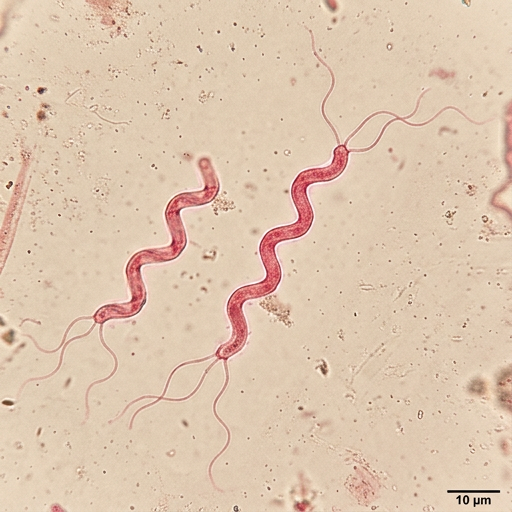
AI-generated image based on bacteria physiology
| Ecology, Host, and Life Cycle | |
|---|---|
| Oxygen requirements | Anaerobic |
| Optimal temperature | 29 |
| Temperature range | Mesophilic |
| Habitat | Fresh water- Sediment |
| Biotic relationship | Free living |
| Host(s) | Not Available |
| Cell arrangement | Not Available |
| Sporulation | Nonsporulating |
| Energy source | Not Available |
| Pathogenicity | No |
Gene Summary
Adenine Count
644692 bp
Thymine Count
640610 bp
Guanine Count
823802 bp
Cytosine Count
819273 bp
Genome Length
2928377 bp
Protein-coding Genes
2603 genes
Non-Coding Genes
50 genes
# of Chromosomes/Plasmids
1
Genes
| Name | Locus Tag | UniProt ID | Strand Orientation | Gene Start/End | Protein Molecular Weight |
|---|---|---|---|---|---|
| peptidylprolyl isomerase | SELIN_RS01315 | Not Available | Positive | 295345 - 295779 | 15834.5 |
| adp-ribosyl-[dinitrogen reductase] hydrolase | SELIN_RS01320 | Not Available | Negative | 295856 - 296773 | 33807.7 |
| nad(+)--dinitrogen-reductase adp-d-ribosyltransferase | SELIN_RS01325 | Not Available | Positive | 296954 - 297745 | 30879.9 |
| nitrogen fixation protein nifz | SELIN_RS01330 | Not Available | Negative | 298240 - 298506 | 10005.7 |
| ferredoxin iii, nif-specific | SELIN_RS01335 | Not Available | Negative | 298585 - 298899 | 11161.5 |
| nitrogenase iron-molybdenum cofactor biosynthesis protein nife | SELIN_RS01340 | Not Available | Positive | 299222 - 300586 | 49711.7 |
| nitrogenase iron-molybdenum cofactor biosynthesis protein nifn | SELIN_RS01345 | Not Available | Positive | 300804 - 302120 | 47722.3 |
| nitrogen fixation protein nifx | SELIN_RS01350 | Not Available | Positive | 302117 - 302491 | 13699.6 |
| nucleotidyltransferase domain-containing protein | SELIN_RS01355 | Not Available | Negative | 303674 - 303997 | 11754.1 |
| nucleotidyltransferase substrate binding protein | SELIN_RS01360 | Not Available | Negative | 303987 - 304409 | 16468.5 |
Pathways
0 pathways
No pathways found
No metabolic pathways have been associated with this bacterium yet.
Health Effects
No health effects information available for this bacterium.