Kingdom
Pseudomonadati
Phylum
Pseudomonadota
Class
Gammaproteobacteria
Order
Enterobacterales
Family
Enterobacteriaceae
Genus
Salmonella
Description
Taxonomy
| Kingdom | Pseudomonadati |
|---|---|
| Phylum | Pseudomonadota |
| Class | Gammaproteobacteria |
| Order | Enterobacterales |
| Family | Enterobacteriaceae |
| Genus | Salmonella |
| Species | Salmonella enterica |
| Strain | subsp. enterica serovar Paratyphi C |
Profile
| Physiology | |
|---|---|
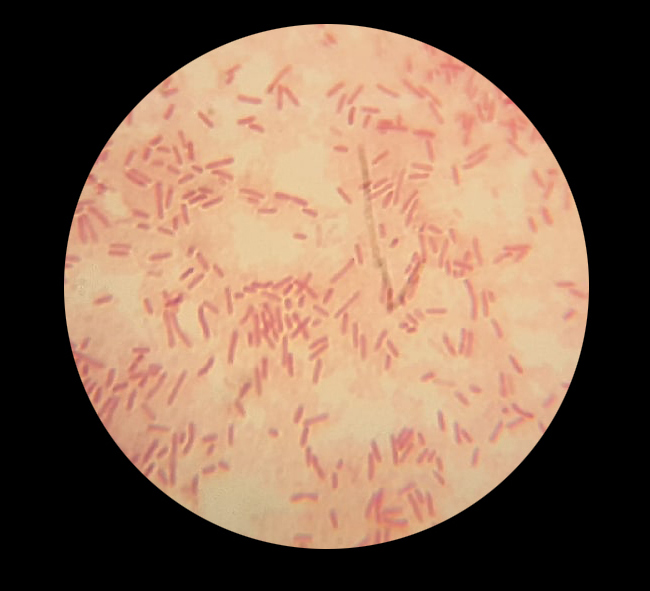
| Gram staining properties | Negative |
| Shape | Spirilla |
| Mobility | No |
| Flagellar presence | Yes |
| Number of membranes | 2 |

Image source: Wikipedia/Wikimedia
| Ecology, Host, and Life Cycle | |
|---|---|
| Oxygen requirements | Microaerophilic |
| Optimal temperature | 37 |
| Temperature range | Mesophilic |
| Habitat | HostAssociated |
| Biotic relationship | Free living |
| Host(s) | Homo sapiens, Gallus gallus, Metazoa |
| Cell arrangement | Chains - Singles |
| Sporulation | Nonsporulating |
| Energy source | Chemoorganotroph |
| Pathogenicity | Not Available |
Genome Summary
Salmonella enterica subsp. enterica serovar Paratyphi C str.
Gene Summary
Adenine Count
Not Available
Thymine Count
Not Available
Guanine Count
Not Available
Cytosine Count
Not Available
Genome Length
Not Available
Protein-coding Genes
Not Available
Non-Coding Genes
Not Available
# of Chromosomes/Plasmids
2
Genes
| Name | Locus Tag | UniProt ID | Strand Orientation | Gene Start/End | Protein Molecular Weight |
|---|---|---|---|---|---|
| exea family protein | SPC_RS23920 | Not Available | Positive | 52556 - 53581 | 38449.6 |
| is630 family transposase | SPC_RS23925 | Not Available | Negative | 53770 - 54807 | 40222.1 |
Pathways
0 pathways
No pathways found
No metabolic pathways have been associated with this bacterium yet.
Health Effects
| Health Condition | Relation | Reference |
|---|---|---|
| Gastroenteritis | Causes | PMC12502522 |
| Diarrhea | Causes | PMC12502522 |
| Gastroenteritis | Causes | PMC5109407 |
| Food poisoning | Causes | PMC5109407 |
| Salmonellosis | Causes | PMC6516042 |
| Acute gastroenteritis | Causes | PMC6516042 |
| Intestinal inflammation | Causes | PMC6516042 |
| Gallbladder empyema | Causes | PMC10442058 |
| Disseminated disease | Causes | PMC10442058 |
| Gastroenteritis | Causes | PMC10442058 |