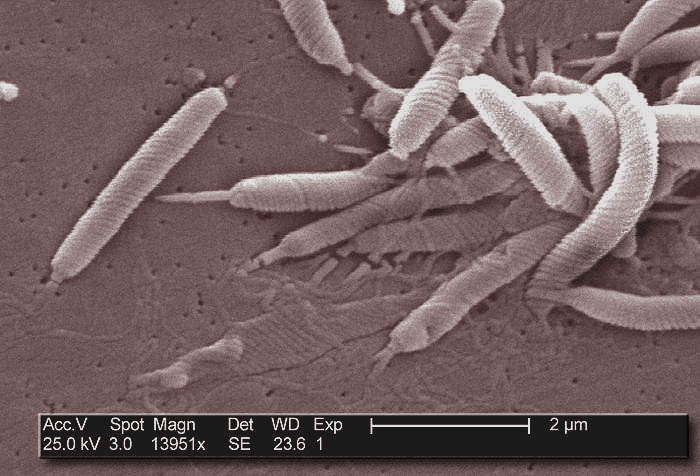
Kingdom
Pseudomonadati
Phylum
Campylobacterota
Class
Epsilonproteobacteria
Order
Campylobacterales
Family
Helicobacteraceae
Genus
Helicobacter
Description
Taxonomy
| Kingdom | Pseudomonadati |
|---|---|
| Phylum | Campylobacterota |
| Class | Epsilonproteobacteria |
| Order | Campylobacterales |
| Family | Helicobacteraceae |
| Genus | Helicobacter |
| Species | Helicobacter pylori |
| Strain | HPAG1 |
Profile
| Physiology | |
|---|---|
| Gram staining properties | Negative |
| Shape | Spirilla |
| Mobility | No |
| Flagellar presence | Yes |
| Number of membranes | 2 |

Image source: Wikipedia/Wikimedia
| Ecology, Host, and Life Cycle | |
|---|---|
| Oxygen requirements | Microaerophilic |
| Optimal temperature | 37 |
| Temperature range | Mesophilic |
| Habitat | HostAssociated |
| Biotic relationship | Free living |
| Host(s) | Not Available |
| Cell arrangement | Singles |
| Sporulation | Nonsporulating |
| Energy source | Not Available |
| Pathogenicity | Yes |
Gene Summary
Adenine Count
3028 bp
Thymine Count
2932 bp
Guanine Count
1684 bp
Cytosine Count
1726 bp
Genome Length
9370 bp
Protein-coding Genes
8 genes
Non-Coding Genes
0 genes
# of Chromosomes/Plasmids
2
Genes
| Name | Locus Tag | UniProt ID | Strand Orientation | Gene Start/End | Protein Molecular Weight |
|---|---|---|---|---|---|
| nad(p)-binding domain-containing protein | HPAG1_RS05595 | Not Available | Positive | 1159334 - 1160308 | 35944.0 |
| hp1165 family mfs efflux transporter | HPAG1_RS05600 | Not Available | Negative | 1160315 - 1161475 | 43748.1 |
| glucose-6-phosphate isomerase | HPAG1_RS05605 | Not Available | Positive | 1161539 - 1163176 | 62348.2 |
| outer membrane beta-barrel protein hofh | HPAG1_RS05610 | Not Available | Positive | 1163482 - 1164897 | 52684.3 |
| carbon starvation csta family protein | HPAG1_RS05615 | Not Available | Negative | 1165190 - 1167253 | 74209.3 |
| amino acid abc transporter permease | HPAG1_RS05620 | Not Available | Positive | 1167463 - 1168116 | 24227.8 |
| amino acid abc transporter permease | HPAG1_RS05625 | Not Available | Positive | 1168119 - 1168790 | 24852.4 |
| amino acid abc transporter atp-binding protein | HPAG1_RS05630 | Not Available | Positive | 1168792 - 1169538 | 28033.5 |
| transporter substrate-binding domain-containing protein | HPAG1_RS05635 | Not Available | Positive | 1169587 - 1170420 | 31261.0 |
| hypothetical protein | HPAG1_RS05640 | Not Available | Positive | 1170542 - 1171093 | 20631.1 |
Pathways
0 pathways
No pathways found
No metabolic pathways have been associated with this bacterium yet.
Health Effects
No health effects information available for this bacterium.