Kingdom
Pseudomonadati
Phylum
Campylobacterota
Class
Epsilonproteobacteria
Order
Campylobacterales
Family
Helicobacteraceae
Genus
Helicobacter
Description
Taxonomy
| Kingdom | Pseudomonadati |
|---|---|
| Phylum | Campylobacterota |
| Class | Epsilonproteobacteria |
| Order | Campylobacterales |
| Family | Helicobacteraceae |
| Genus | Helicobacter |
| Species | Helicobacter pylori |
| Strain | HPAG1 |
Profile
| Physiology | |
|---|---|
| Gram staining properties | Negative |
| Shape | Spirilla |
| Mobility | No |
| Flagellar presence | Yes |
| Number of membranes | 2 |

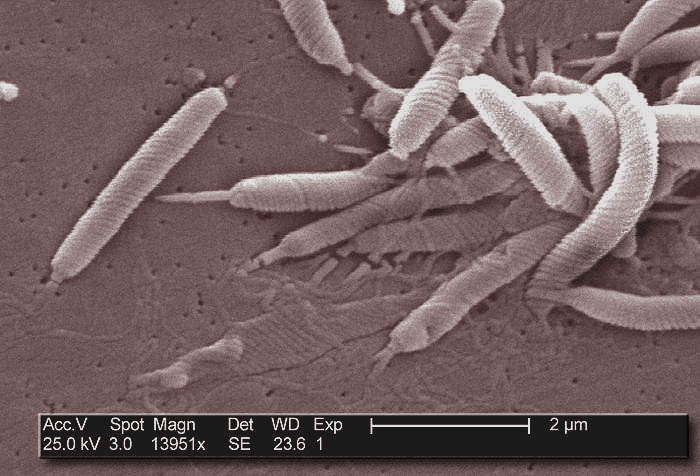
Image source: Wikipedia/Wikimedia
| Ecology, Host, and Life Cycle | |
|---|---|
| Oxygen requirements | Microaerophilic |
| Optimal temperature | 37 |
| Temperature range | Mesophilic |
| Habitat | HostAssociated |
| Biotic relationship | Free living |
| Host(s) | Not Available |
| Cell arrangement | Singles |
| Sporulation | Nonsporulating |
| Energy source | Not Available |
| Pathogenicity | Yes |
Gene Summary
Adenine Count
3028 bp
Thymine Count
2932 bp
Guanine Count
1684 bp
Cytosine Count
1726 bp
Genome Length
9370 bp
Protein-coding Genes
8 genes
Non-Coding Genes
0 genes
# of Chromosomes/Plasmids
2
Genes
| Name | Locus Tag | UniProt ID | Strand Orientation | Gene Start/End | Protein Molecular Weight |
|---|---|---|---|---|---|
| peptidylprolyl isomerase | HPAG1_RS05395 | Not Available | Negative | 1119019 - 1119576 | 19985.5 |
| tetratricopeptide repeat protein | HPAG1_RS05400 | Not Available | Negative | 1119563 - 1120558 | 38523.9 |
| outer membrane protein omp18 | HPAG1_RS05405 | Not Available | Negative | 1120566 - 1121105 | 19916.8 |
| tol-pal system protein tolb | HPAG1_RS05410 | Not Available | Negative | 1121172 - 1122425 | 47710.5 |
| energy transducer tonb | HPAG1_RS05415 | Not Available | Negative | 1122422 - 1123246 | 31990.7 |
| exbd/tolr family protein | HPAG1_RS05420 | Not Available | Negative | 1123265 - 1123666 | 15414.7 |
| mota/tolq/exbb proton channel family protein | HPAG1_RS05425 | Not Available | Negative | 1123719 - 1124288 | 21212.3 |
| atp synthase f1 subunit epsilon | HPAG1_RS05430 | Not Available | Negative | 1124299 - 1124670 | 13358.0 |
| f0f1 atp synthase subunit beta | HPAG1_RS05435 | Not Available | Negative | 1124681 - 1126081 | 51176.9 |
| atp synthase f1 subunit gamma | HPAG1_RS05440 | Not Available | Negative | 1126114 - 1127019 | 34032.1 |
Pathways
0 pathways
No pathways found
No metabolic pathways have been associated with this bacterium yet.
Health Effects
No health effects information available for this bacterium.