Kingdom
Pseudomonadati
Phylum
Pseudomonadota
Class
Gammaproteobacteria
Order
Enterobacterales
Family
Enterobacteriaceae
Genus
Escherichia
Description
Taxonomy
| Kingdom | Pseudomonadati |
|---|---|
| Phylum | Pseudomonadota |
| Class | Gammaproteobacteria |
| Order | Enterobacterales |
| Family | Enterobacteriaceae |
| Genus | Escherichia |
| Species | Escherichia coli |
| Strain | strain ICBEcBL-II-13 |
Profile
| Physiology | |
|---|---|
| Gram staining properties | Negative |
| Shape | Rod |
| Mobility | Yes |
| Flagellar presence | Yes |
| Number of membranes | 2 |

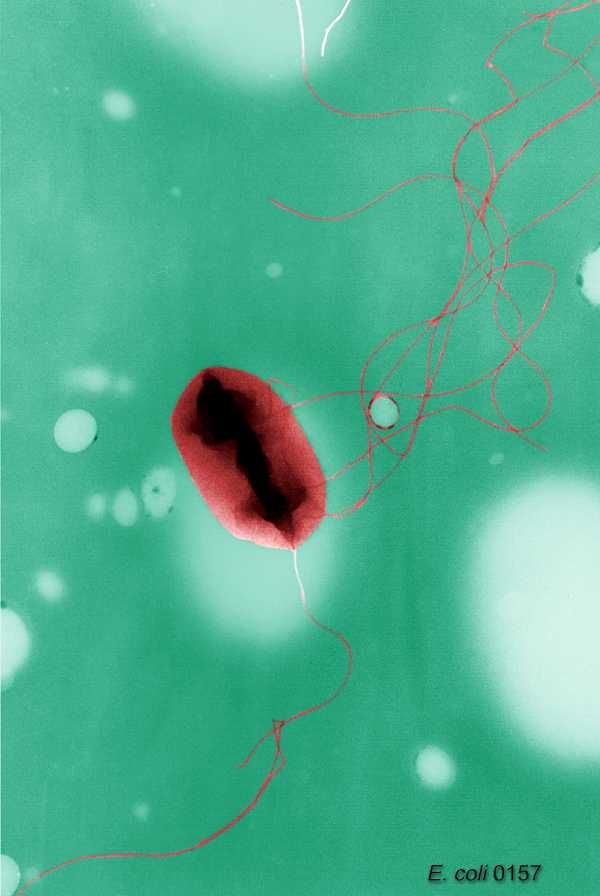
Image source: Wikipedia/Wikimedia
| Ecology, Host, and Life Cycle | |
|---|---|
| Oxygen requirements | Facultative anaerobe |
| Optimal temperature | 37 |
| Temperature range | Mesophilic |
| Habitat | HostAssociated |
| Biotic relationship | Free living |
| Host(s) | Homo sapiens, Gallus gallus, Bos taurus |
| Cell arrangement | Pairs - Singles |
| Sporulation | Not Available |
| Energy source | Not Available |
| Pathogenicity | Human |
Gene Summary
Adenine Count
1232445 bp
Thymine Count
1231303 bp
Guanine Count
1255900 bp
Cytosine Count
1252694 bp
Genome Length
4972342 bp
Protein-coding Genes
5228 genes
Non-Coding Genes
122 genes
# of Chromosomes/Plasmids
1
Genes
| Name | Locus Tag | UniProt ID | Strand Orientation | Gene Start/End | Protein Molecular Weight |
|---|---|---|---|---|---|
| hydrogenase formation protein hypd | BXT93_17995 | Not Available | Negative | 3439729 - 3440850 | 41367.7 |
| hydrogenase assembly protein hypc | BXT93_18000 | Not Available | Negative | 3440850 - 3441122 | 9732.58 |
| hydrogenase isoenzymes nickel incorporation protein hypb | BXT93_18005 | Not Available | Negative | 3441113 - 3441985 | 31566.8 |
| hydrogenase maturation nickel metallochaperone hypa | BXT93_18010 | Not Available | Negative | 3441989 - 3442351 | 13529.3 |
| formate hydrogenlyase regulatory protein hyca | BXT93_18015 | Not Available | Positive | 3442551 - 3443012 | 17627.9 |
| hypothetical protein | BXT93_18020 | Not Available | Negative | 3442928 - 3443236 | 11381.7 |
| formate hydrogenlyase subunit 2 | BXT93_18025 | Not Available | Positive | 3443137 - 3443748 | 21874.4 |
| formate hydrogenlyase subunit 3 | BXT93_18030 | Not Available | Positive | 3443745 - 3445571 | 64085.1 |
| hydrogenase 3 membrane subunit | BXT93_18035 | Not Available | Positive | 3445574 - 3445888 | 11398.5 |
| alkene reductase | BXT93_18040 | Not Available | Negative | 3445889 - 3446463 | 20465.4 |
Pathways
1297 pathways
Health Effects
| Health Condition | Relation | Reference |
|---|---|---|
| Gi disease | Causes | PMC11149725 |
| Utis | Causes | PMC11434687 |
| Colorectal cancer | Causes | PMC12198655 |
| Pyogenic liver abscesses | Causes | PMC12392612 |
| Uti | Causes | PMC13014981 |
| Colibacillosis | Causes | PMC13255289 |
| Enteric infections | Causes | PMC13255289 |
| Foodborne infections | Causes | PMC13255289 |
| Clinical mastitis | Causes | PMC13293316 |
| Diarrhea | Causes | PMC3035056 |