Kingdom
Pseudomonadati
Phylum
Pseudomonadota
Class
Gammaproteobacteria
Order
Legionellales
Family
Legionellaceae
Genus
Legionella
Description
Taxonomy
| Kingdom | Pseudomonadati |
|---|---|
| Phylum | Pseudomonadota |
| Class | Gammaproteobacteria |
| Order | Legionellales |
| Family | Legionellaceae |
| Genus | Legionella |
| Species | Legionella sp. 39-23 |
| Strain | No strain |
Profile
| Physiology | |
|---|---|
| Gram staining properties | Not Available |
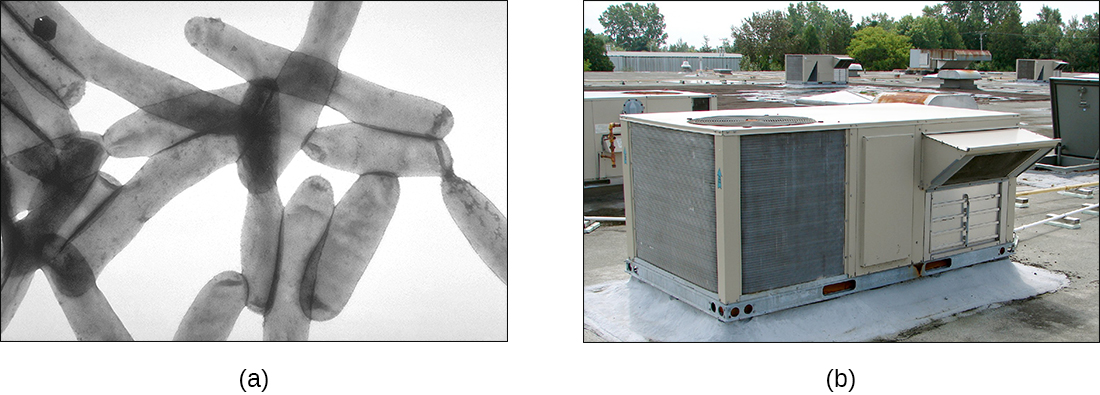
| Shape | Rod |
| Mobility | Not Available |
| Flagellar presence | Yes |
| Number of membranes | Not Available |

Image source: Wikipedia/Wikimedia
| Ecology, Host, and Life Cycle | |
|---|---|
| Oxygen requirements | Not Available |
| Optimal temperature | Not Available |
| Temperature range | Not Available |
| Habitat | Not Available |
| Biotic relationship | Not Available |
| Host(s) | Not Available |
| Cell arrangement | Not Available |
| Sporulation | Not Available |
| Energy source | Not Available |
| Pathogenicity | Not Available |
Gene Summary
Adenine Count
1282110 bp
Thymine Count
1274642 bp
Guanine Count
800676 bp
Cytosine Count
809883 bp
Genome Length
4167318 bp
Protein-coding Genes
3582 genes
Non-Coding Genes
39 genes
# of Chromosomes/Plasmids
1
Genes
| Name | Locus Tag | UniProt ID | Strand Orientation | Gene Start/End | Protein Molecular Weight |
|---|---|---|---|---|---|
| gnat family n-acetyltransferase | BGO44_00485 | Not Available | Positive | 50630 - 51322 | 26278.3 |
| asparagine synthase (glutamine-hydrolyzing) | BGO44_00490 | Not Available | Positive | 51337 - 53121 | 67316.3 |
| hypothetical protein | BGO44_00495 | Not Available | Positive | 53162 - 53593 | 16240.4 |
| Ncrna_class:rnase_p_rna | Not Available | Not Available | Positive | 53407 - 53762 | Not Available |
| chloride channel protein | BGO44_00500 | Not Available | Negative | 53689 - 54978 | 46798.2 |
| alpha,alpha-trehalase | BGO44_00505 | Not Available | Negative | 55051 - 56595 | 60063.2 |
| hypothetical protein | BGO44_00510 | Not Available | Negative | 56846 - 57103 | 10040.8 |
| hypothetical protein | BGO44_00515 | Not Available | Negative | 57103 - 57363 | 9491.11 |
| hypothetical protein | BGO44_00520 | Not Available | Negative | 57366 - 57755 | 15102.1 |
| fmn-binding glutamate synthase family protein | BGO44_00525 | Not Available | Negative | 58073 - 59677 | 59555.1 |
Pathways
0 pathways
No pathways found
No metabolic pathways have been associated with this bacterium yet.
Health Effects
No health effects information available for this bacterium.