Kingdom
Pseudomonadati
Phylum
Pseudomonadota
Class
Gammaproteobacteria
Order
Legionellales
Family
Legionellaceae
Genus
Legionella
Description
Taxonomy
| Kingdom | Pseudomonadati |
|---|---|
| Phylum | Pseudomonadota |
| Class | Gammaproteobacteria |
| Order | Legionellales |
| Family | Legionellaceae |
| Genus | Legionella |
| Species | Legionella sp. 39-23 |
| Strain | No strain |
Profile
| Physiology | |
|---|---|
| Gram staining properties | Not Available |
| Shape | Rod |
| Mobility | Not Available |
| Flagellar presence | Yes |
| Number of membranes | Not Available |

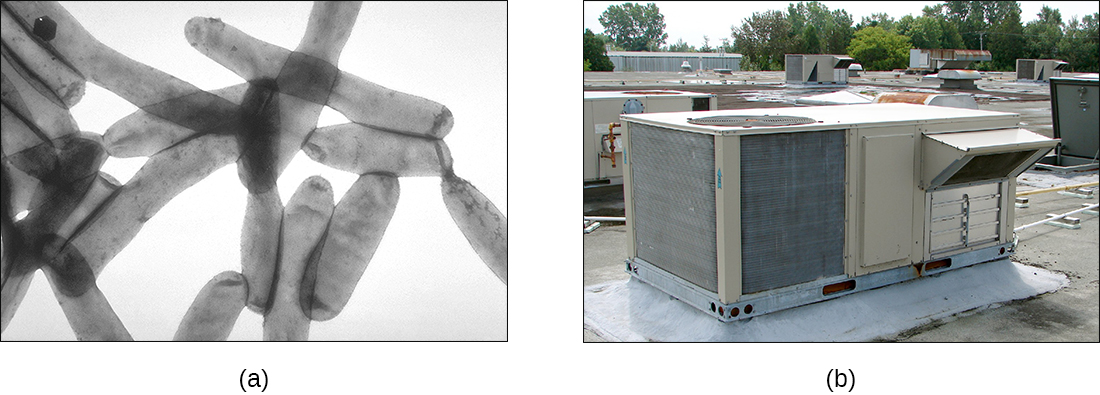
Image source: Wikipedia/Wikimedia
| Ecology, Host, and Life Cycle | |
|---|---|
| Oxygen requirements | Not Available |
| Optimal temperature | Not Available |
| Temperature range | Not Available |
| Habitat | Not Available |
| Biotic relationship | Not Available |
| Host(s) | Not Available |
| Cell arrangement | Not Available |
| Sporulation | Not Available |
| Energy source | Not Available |
| Pathogenicity | Not Available |
Gene Summary
Adenine Count
1282110 bp
Thymine Count
1274642 bp
Guanine Count
800676 bp
Cytosine Count
809883 bp
Genome Length
4167318 bp
Protein-coding Genes
3582 genes
Non-Coding Genes
39 genes
# of Chromosomes/Plasmids
1
Genes
| Name | Locus Tag | UniProt ID | Strand Orientation | Gene Start/End | Protein Molecular Weight |
|---|---|---|---|---|---|
| 30s ribosomal protein s4 | BGO44_12640 | Not Available | Positive | 3850549 - 3851169 | 23163.2 |
| dna-directed rna polymerase subunit alpha | BGO44_12645 | Not Available | Positive | 3851188 - 3852180 | 36854.2 |
| 50s ribosomal protein l17 | BGO44_12650 | Not Available | Positive | 3852199 - 3852582 | 14343.4 |
| hypothetical protein | BGO44_12655 | Not Available | Negative | 3852807 - 3854549 | 66869.8 |
| single-stranded dna-binding protein | BGO44_12665 | Not Available | Negative | 3855386 - 3855856 | 17510.3 |
| nudix hydrolase | BGO44_12670 | Not Available | Negative | 3855989 - 3856612 | 23842.3 |
| nadph-dependent 7-cyano-7-deazaguanine reductase quef | BGO44_12675 | Not Available | Positive | 3857097 - 3857954 | 33094.1 |
| hypothetical protein | BGO44_12680 | Not Available | Negative | 3858057 - 3858398 | 12916.5 |
| mfs transporter | BGO44_12685 | Not Available | Negative | 3858421 - 3859773 | 49362.1 |
| enoyl-[acyl-carrier-protein] reductase | BGO44_12690 | Not Available | Positive | 3860045 - 3860800 | 26855.3 |
Pathways
0 pathways
No pathways found
No metabolic pathways have been associated with this bacterium yet.
Health Effects
No health effects information available for this bacterium.