Kingdom
Pseudomonadati
Phylum
Pseudomonadota
Class
Gammaproteobacteria
Order
Enterobacterales
Family
Enterobacteriaceae
Genus
Shigella
Description
Taxonomy
| Kingdom | Pseudomonadati |
|---|---|
| Phylum | Pseudomonadota |
| Class | Gammaproteobacteria |
| Order | Enterobacterales |
| Family | Enterobacteriaceae |
| Genus | Shigella |
| Species | Shigella sp. FC569 |
| Strain | No strain |
Profile
| Physiology | |
|---|---|
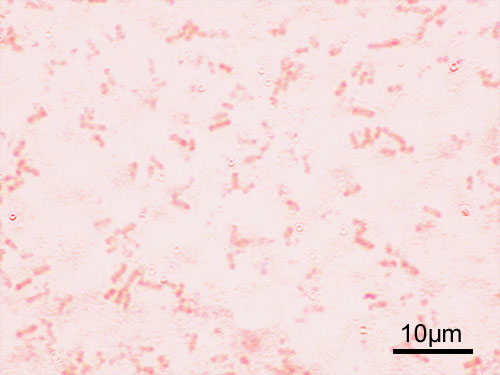
| Gram staining properties | Negative |
| Shape | Rod |
| Mobility | Not Available |
| Flagellar presence | Yes |
| Number of membranes | Not Available |

Image source: Wikipedia/Wikimedia
| Ecology, Host, and Life Cycle | |
|---|---|
| Oxygen requirements | Not Available |
| Optimal temperature | Not Available |
| Temperature range | Not Available |
| Habitat | Not Available |
| Biotic relationship | Not Available |
| Host(s) | Not Available |
| Cell arrangement | Not Available |
| Sporulation | Not Available |
| Energy source | Not Available |
| Pathogenicity | Not Available |
Gene Summary
Adenine Count
Not Available
Thymine Count
Not Available
Guanine Count
Not Available
Cytosine Count
Not Available
Genome Length
Not Available
Protein-coding Genes
2212 genes
Non-Coding Genes
54 genes
# of Chromosomes/Plasmids
1
Genes
| Name | Locus Tag | UniProt ID | Strand Orientation | Gene Start/End | Protein Molecular Weight |
|---|---|---|---|---|---|
| phosphopentomutase | BGK51_06100 | Not Available | Positive | 1598743 - 1599966 | 44421.5 |
| purine-nucleoside phosphorylase | BGK51_06105 | Not Available | Positive | 1600023 - 1600742 | 25937.4 |
| transcriptional regulator | BGK51_06110 | Not Available | Negative | 1600903 - 1601166 | 9901.29 |
| lipoate--protein ligase | BGK51_06115 | Not Available | Negative | 1601198 - 1602214 | 37934.9 |
| hypothetical protein | BGK51_06120 | Not Available | Negative | 1602242 - 1602886 | 24070.2 |
| phosphoserine phosphatase serb | BGK51_06125 | Not Available | Positive | 1602992 - 1603960 | 35115.9 |
| dna repair protein rada | BGK51_06130 | Not Available | Positive | 1604009 - 1605391 | 49445.0 |
| trifunctional nicotinamide-nucleotide adenylyltransferase/ribosylnicotinamide kinase/transcriptional regulator nadr | BGK51_06135 | Not Available | Positive | 1605412 - 1606644 | 47350.4 |
| addiction module toxin rele | BGK51_06140 | Not Available | Positive | 1606736 - 1607068 | 12287.2 |
| transcriptional regulator | BGK51_06145 | Not Available | Positive | 1607070 - 1607354 | 10533.6 |
Pathways
0 pathways
No pathways found
No metabolic pathways have been associated with this bacterium yet.
Health Effects
No health effects information available for this bacterium.