
Kingdom
Pseudomonadati
Phylum
Pseudomonadota
Class
Gammaproteobacteria
Order
Lysobacterales
Family
Lysobacteraceae
Genus
Xanthomonas
Description
Taxonomy
| Kingdom | Pseudomonadati |
|---|---|
| Phylum | Pseudomonadota |
| Class | Gammaproteobacteria |
| Order | Lysobacterales |
| Family | Lysobacteraceae |
| Genus | Xanthomonas |
| Species | Xanthomonas hyacinthi |
| Strain | strain CFBP1156 Xhy-CFBP1156-G1104 |
Profile
| Physiology | |
|---|---|
| Gram staining properties | Not Available |
| Shape | Rod |
| Mobility | Not Available |
| Flagellar presence | Yes |
| Number of membranes | Not Available |
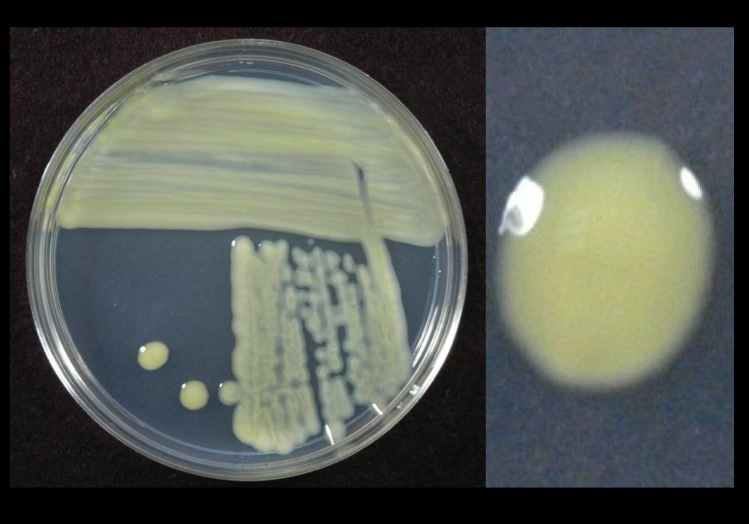
Image source: Wikipedia/Wikimedia
| Ecology, Host, and Life Cycle | |
|---|---|
| Oxygen requirements | Not Available |
| Optimal temperature | Not Available |
| Temperature range | Not Available |
| Habitat | Not Available |
| Biotic relationship | Not Available |
| Host(s) | Not Available |
| Cell arrangement | Not Available |
| Sporulation | Not Available |
| Energy source | Not Available |
| Pathogenicity | Not Available |
Gene Summary
Adenine Count
783579 bp
Thymine Count
786085 bp
Guanine Count
1678423 bp
Cytosine Count
1666902 bp
Genome Length
4914999 bp
Protein-coding Genes
3956 genes
Non-Coding Genes
59 genes
# of Chromosomes/Plasmids
1
Genes
| Name | Locus Tag | UniProt ID | Strand Orientation | Gene Start/End | Protein Molecular Weight |
|---|---|---|---|---|---|
| hypothetical protein | XhyaCFBP1156_05930 | Not Available | Positive | 1369775 - 1370776 | 35246.4 |
| hypothetical protein | XhyaCFBP1156_05935 | Not Available | Positive | 1370773 - 1371432 | 23190.7 |
| voc family protein | XhyaCFBP1156_05940 | Not Available | Positive | 1371483 - 1372082 | 22643.5 |
| fad-binding oxidoreductase | XhyaCFBP1156_05945 | Not Available | Positive | 1372086 - 1373528 | 52003.3 |
| abc transporter atp-binding protein | XhyaCFBP1156_05950 | Not Available | Positive | 1373619 - 1375457 | 66859.1 |
| 3-mercaptopyruvate sulfurtransferase | XhyaCFBP1156_05955 | Not Available | Positive | 1375661 - 1376512 | 29715.5 |
| cysteine synthase a | XhyaCFBP1156_05960 | Not Available | Positive | 1376523 - 1377551 | 35455.5 |
| purine nucleoside permease | XhyaCFBP1156_05965 | Not Available | Positive | 1378205 - 1379257 | 37232.4 |
| zn-dependent hydrolase | XhyaCFBP1156_05970 | Not Available | Positive | 1379609 - 1380865 | 42783.6 |
| alanine--glyoxylate aminotransferase family protein | XhyaCFBP1156_05975 | Not Available | Positive | 1380855 - 1382114 | 44437.7 |
Pathways
0 pathways
No pathways found
No metabolic pathways have been associated with this bacterium yet.
Health Effects
No health effects information available for this bacterium.