
Kingdom
Pseudomonadati
Phylum
Pseudomonadota
Class
Gammaproteobacteria
Order
Lysobacterales
Family
Lysobacteraceae
Genus
Xanthomonas
Description
Taxonomy
| Kingdom | Pseudomonadati |
|---|---|
| Phylum | Pseudomonadota |
| Class | Gammaproteobacteria |
| Order | Lysobacterales |
| Family | Lysobacteraceae |
| Genus | Xanthomonas |
| Species | Xanthomonas hyacinthi |
| Strain | strain CFBP1156 Xhy-CFBP1156-G1104 |
Profile
| Physiology | |
|---|---|
| Gram staining properties | Not Available |
| Shape | Rod |
| Mobility | Not Available |
| Flagellar presence | Yes |
| Number of membranes | Not Available |
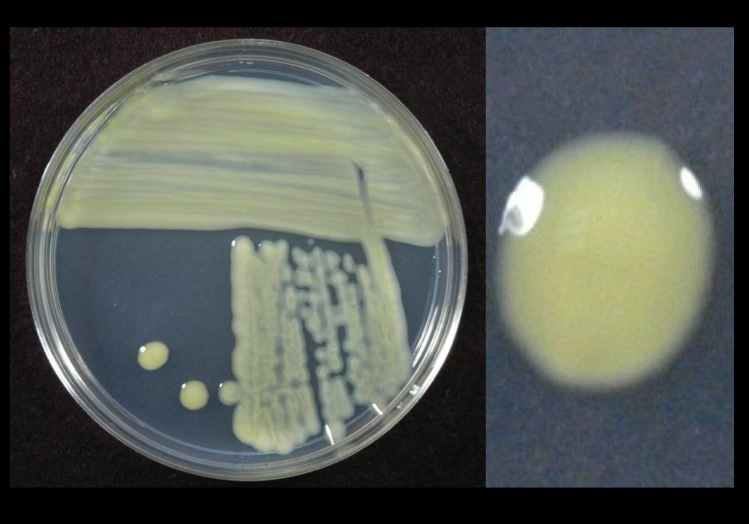
Image source: Wikipedia/Wikimedia
| Ecology, Host, and Life Cycle | |
|---|---|
| Oxygen requirements | Not Available |
| Optimal temperature | Not Available |
| Temperature range | Not Available |
| Habitat | Not Available |
| Biotic relationship | Not Available |
| Host(s) | Not Available |
| Cell arrangement | Not Available |
| Sporulation | Not Available |
| Energy source | Not Available |
| Pathogenicity | Not Available |
Gene Summary
Adenine Count
783579 bp
Thymine Count
786085 bp
Guanine Count
1678423 bp
Cytosine Count
1666902 bp
Genome Length
4914999 bp
Protein-coding Genes
3956 genes
Non-Coding Genes
59 genes
# of Chromosomes/Plasmids
1
Genes
| Name | Locus Tag | UniProt ID | Strand Orientation | Gene Start/End | Protein Molecular Weight |
|---|---|---|---|---|---|
| lysr family transcriptional regulator | XhyaCFBP1156_05725 | Not Available | Positive | 1317914 - 1318858 | 34585.7 |
| entry exclusion lipoprotein trbk | XhyaCFBP1156_05730 | Not Available | Positive | 1318855 - 1319118 | 9853.97 |
| conjugal transfer protein trag | XhyaCFBP1156_05735 | Not Available | Positive | 1319339 - 1321333 | 72842.1 |
| ribbon-helix-helix protein, copg family | XhyaCFBP1156_05740 | Not Available | Positive | 1321330 - 1321806 | 17706.0 |
| p-type conjugative transfer atpase trbb | XhyaCFBP1156_05745 | Not Available | Positive | 1321803 - 1322831 | 36467.5 |
| conjugal transfer protein trbc | XhyaCFBP1156_05750 | Not Available | Positive | 1322828 - 1323214 | 13492.7 |
| conjugal transfer protein trbd | XhyaCFBP1156_05755 | Not Available | Positive | 1323211 - 1323483 | 9655.03 |
| duf853 domain-containing protein | XhyaCFBP1156_05760 | Not Available | Positive | 1323494 - 1325926 | 89716.6 |
| p-type conjugative transfer protein trbj | XhyaCFBP1156_05765 | Not Available | Positive | 1325923 - 1326651 | 26913.0 |
| hypothetical protein | XhyaCFBP1156_05770 | Not Available | Positive | 1326662 - 1326955 | 10248.1 |
Pathways
0 pathways
No pathways found
No metabolic pathways have been associated with this bacterium yet.
Health Effects
No health effects information available for this bacterium.