
Kingdom
Pseudomonadati
Phylum
Pseudomonadota
Class
Gammaproteobacteria
Order
Lysobacterales
Family
Lysobacteraceae
Genus
Xanthomonas
Description
Taxonomy
| Kingdom | Pseudomonadati |
|---|---|
| Phylum | Pseudomonadota |
| Class | Gammaproteobacteria |
| Order | Lysobacterales |
| Family | Lysobacteraceae |
| Genus | Xanthomonas |
| Species | Xanthomonas hyacinthi |
| Strain | strain CFBP1156 Xhy-CFBP1156-G1104 |
Profile
| Physiology | |
|---|---|
| Gram staining properties | Not Available |
| Shape | Rod |
| Mobility | Not Available |
| Flagellar presence | Yes |
| Number of membranes | Not Available |
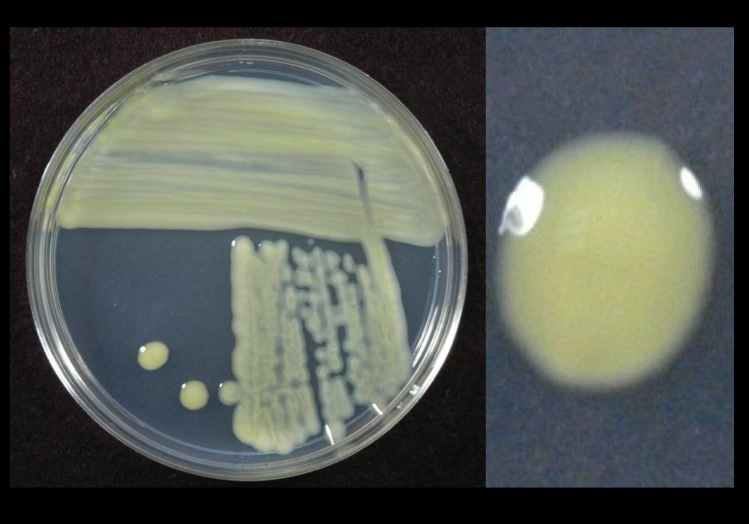
Image source: Wikipedia/Wikimedia
| Ecology, Host, and Life Cycle | |
|---|---|
| Oxygen requirements | Not Available |
| Optimal temperature | Not Available |
| Temperature range | Not Available |
| Habitat | Not Available |
| Biotic relationship | Not Available |
| Host(s) | Not Available |
| Cell arrangement | Not Available |
| Sporulation | Not Available |
| Energy source | Not Available |
| Pathogenicity | Not Available |
Gene Summary
Adenine Count
783579 bp
Thymine Count
786085 bp
Guanine Count
1678423 bp
Cytosine Count
1666902 bp
Genome Length
4914999 bp
Protein-coding Genes
3956 genes
Non-Coding Genes
59 genes
# of Chromosomes/Plasmids
1
Genes
| Name | Locus Tag | UniProt ID | Strand Orientation | Gene Start/End | Protein Molecular Weight |
|---|---|---|---|---|---|
| hypothetical protein | XhyaCFBP1156_05675 | Not Available | Positive | 1305824 - 1306225 | 14182.3 |
| type vi secretion protein | XhyaCFBP1156_05680 | Not Available | Positive | 1306222 - 1308180 | 72622.6 |
| lysr family transcriptional regulator | XhyaCFBP1156_05685 | Not Available | Negative | 1308198 - 1309112 | 33313.2 |
| mfs transporter | XhyaCFBP1156_05690 | Not Available | Positive | 1309271 - 1310455 | 40079.7 |
| nadh:flavin oxidoreductase/nadh oxidase | XhyaCFBP1156_05695 | Not Available | Positive | 1310499 - 1311617 | 40412.1 |
| lysr family transcriptional regulator | XhyaCFBP1156_05700 | Not Available | Negative | 1311803 - 1312690 | 32437.4 |
| mfs transporter | XhyaCFBP1156_05705 | Not Available | Positive | 1312865 - 1314397 | 52407.0 |
| llm class flavin-dependent oxidoreductase | XhyaCFBP1156_05710 | Not Available | Positive | 1314394 - 1315416 | 37194.4 |
| serine hydrolase | XhyaCFBP1156_05715 | Not Available | Positive | 1315466 - 1316608 | 40364.5 |
| mfs transporter | XhyaCFBP1156_05720 | Not Available | Positive | 1316646 - 1317911 | 43473.3 |
Pathways
0 pathways
No pathways found
No metabolic pathways have been associated with this bacterium yet.
Health Effects
No health effects information available for this bacterium.