Kingdom
Bacillati
Phylum
Cyanobacteriota
Class
Cyanophyceae
Order
Nostocales
Family
Nostocaceae
Genus
Nostoc
Description
Taxonomy
| Kingdom | Bacillati |
|---|---|
| Phylum | Cyanobacteriota |
| Class | Cyanophyceae |
| Order | Nostocales |
| Family | Nostocaceae |
| Genus | Nostoc |
| Species | Nostoc sp. ATCC 43529 |
| Strain | No strain |
Profile
| Physiology | |
|---|---|
| Gram staining properties | Negative |
| Shape | Filamentous |
| Mobility | Not Available |
| Flagellar presence | Yes |
| Number of membranes | Not Available |
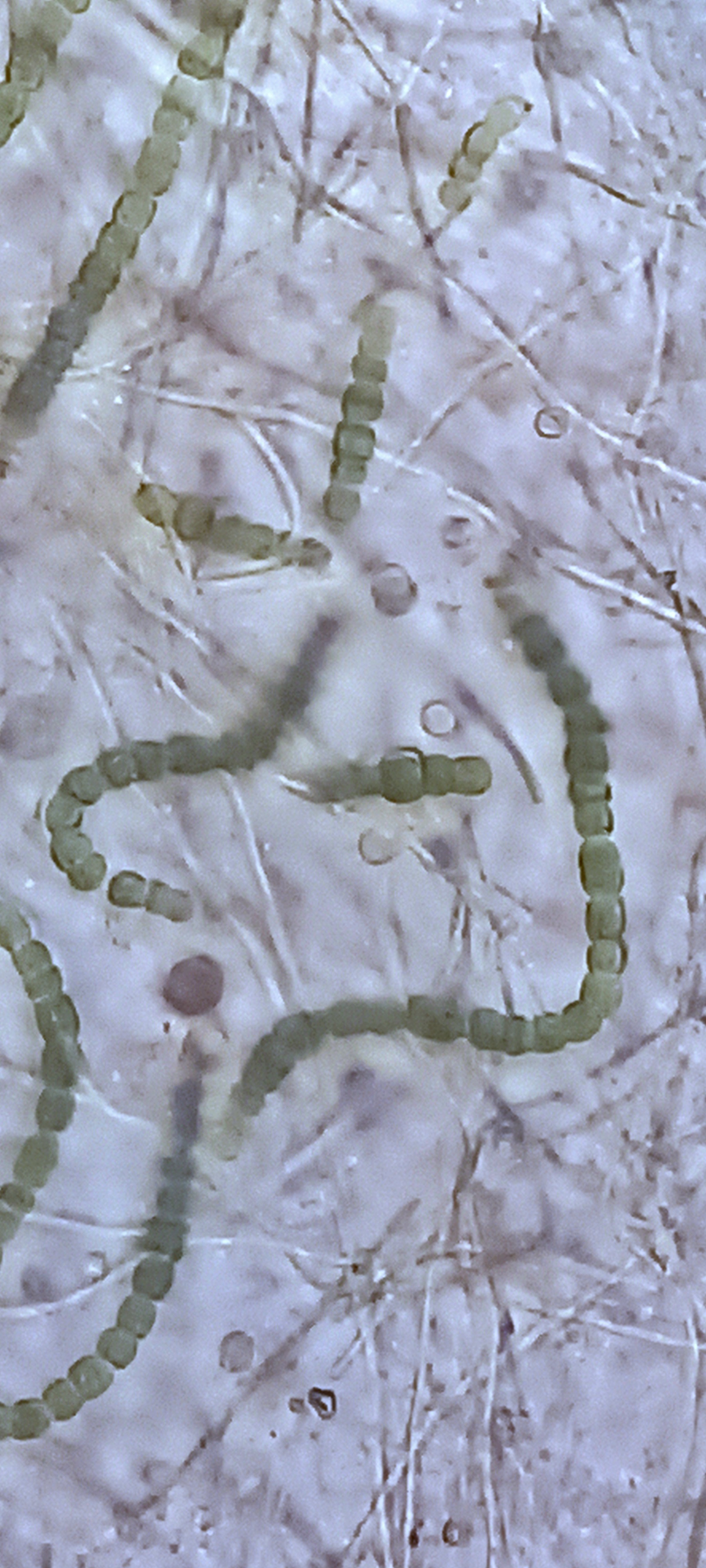
Image source: Wikipedia/Wikimedia
| Ecology, Host, and Life Cycle | |
|---|---|
| Oxygen requirements | Not Available |
| Optimal temperature | Not Available |
| Temperature range | Not Available |
| Habitat | Not Available |
| Biotic relationship | Not Available |
| Host(s) | Not Available |
| Cell arrangement | Not Available |
| Sporulation | Not Available |
| Energy source | Not Available |
| Pathogenicity | Not Available |
Gene Summary
Adenine Count
2495114 bp
Thymine Count
2493868 bp
Guanine Count
1738530 bp
Cytosine Count
1730927 bp
Genome Length
8458523 bp
Protein-coding Genes
6655 genes
Non-Coding Genes
89 genes
# of Chromosomes/Plasmids
1
Genes
| Name | Locus Tag | UniProt ID | Strand Orientation | Gene Start/End | Protein Molecular Weight |
|---|---|---|---|---|---|
| s-layer protein | A6S26_23740 | Not Available | Negative | 3772274 - 3773413 | 40614.4 |
| cyclomaltodextrin glucanotransferase | A6S26_23750 | Not Available | Negative | 3773924 - 3775852 | 74051.6 |
| hypothetical protein | A6S26_23755 | Not Available | Positive | 3776381 - 3777616 | 48629.3 |
| hypothetical protein | A6S26_23760 | Not Available | Positive | 3777905 - 3778954 | 38855.9 |
| 30s ribosomal protein s2 | A6S26_23765 | Not Available | Positive | 3779217 - 3780014 | 30344.9 |
| elongation factor ts | A6S26_23770 | Not Available | Positive | 3780265 - 3781209 | 34374.1 |
| hypothetical protein | A6S26_23775 | Not Available | Positive | 3781460 - 3782323 | 31747.6 |
| atp-dependent dna helicase recg | A6S26_23780 | Not Available | Positive | 3782419 - 3784905 | 93241.8 |
| hypothetical protein | A6S26_23785 | Not Available | Negative | 3784917 - 3785111 | 7398.89 |
| bifunctional phosphoribosylaminoimidazolecarboxamide formyltransferase/inosine monophosphate cyclohydrolase | A6S26_23790 | Not Available | Positive | 3785444 - 3786964 | 53992.1 |
Pathways
0 pathways
No pathways found
No metabolic pathways have been associated with this bacterium yet.
Health Effects
No health effects information available for this bacterium.