
Kingdom
Pseudomonadati
Phylum
Pseudomonadota
Class
Gammaproteobacteria
Order
Legionellales
Family
Legionellaceae
Genus
Legionella
Description
Taxonomy
| Kingdom | Pseudomonadati |
|---|---|
| Phylum | Pseudomonadota |
| Class | Gammaproteobacteria |
| Order | Legionellales |
| Family | Legionellaceae |
| Genus | Legionella |
| Species | Legionella parisiensis |
| Strain | strain DSM 19216 |
Profile
| Physiology | |
|---|---|
| Gram staining properties | Not Available |
| Shape | Rod |
| Mobility | Not Available |
| Flagellar presence | Yes |
| Number of membranes | Not Available |
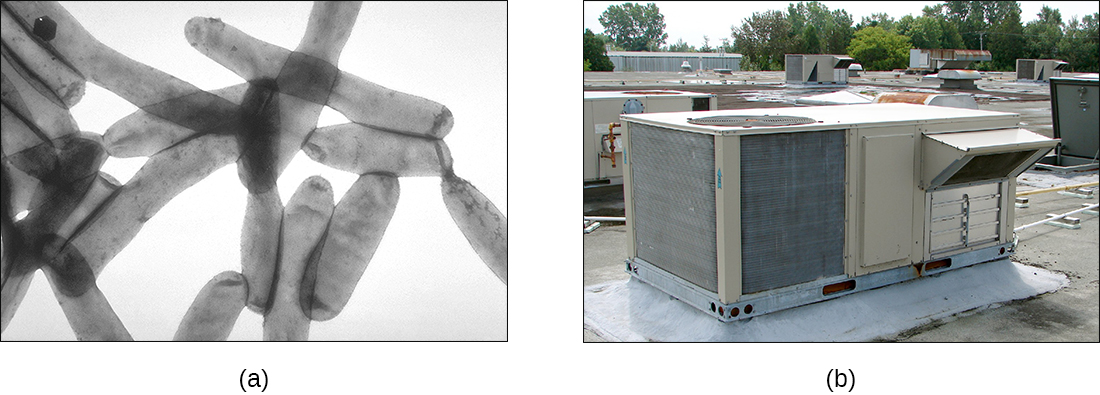
Image source: Wikipedia/Wikimedia
| Ecology, Host, and Life Cycle | |
|---|---|
| Oxygen requirements | microaerophile |
| Optimal temperature | Not Available |
| Temperature range | Not Available |
| Habitat | Not Available |
| Biotic relationship | Not Available |
| Host(s) | Homo sapiens |
| Cell arrangement | Not Available |
| Sporulation | Not Available |
| Energy source | Not Available |
| Pathogenicity | Not Available |
Gene Summary
Adenine Count
1315426 bp
Thymine Count
1309668 bp
Guanine Count
798430 bp
Cytosine Count
808760 bp
Genome Length
4232284 bp
Protein-coding Genes
3916 genes
Non-Coding Genes
51 genes
# of Chromosomes/Plasmids
1
Genes
| Name | Locus Tag | UniProt ID | Strand Orientation | Gene Start/End | Protein Molecular Weight |
|---|---|---|---|---|---|
| doxorubicin resistance atp-binding protein drra | lpari_02476 | Not Available | Positive | 2609949 - 2610881 | 34636.0 |
| inner membrane transport permease yadh | lpari_02477 | Not Available | Positive | 2610878 - 2611639 | 27975.1 |
| hypothetical protein | lpari_02478 | Not Available | Negative | 2611702 - 2611866 | 5942.28 |
| hypothetical protein | lpari_02479 | Not Available | Positive | 2612082 - 2613845 | 65574.1 |
| hypothetical protein | lpari_02480 | Not Available | Negative | 2613981 - 2614655 | 26316.2 |
| ll-diaminopimelate aminotransferase | lpari_02481 | Not Available | Positive | 2614955 - 2616529 | 58912.1 |
| sodium, potassium, lithium and rubidium/h(+) antiporter | lpari_02482 | Not Available | Positive | 2616596 - 2618212 | 60490.8 |
| hypothetical protein | lpari_02483 | Not Available | Positive | 2618414 - 2618560 | 5403.43 |
| hypothetical protein | lpari_02484 | Not Available | Positive | 2618722 - 2620050 | 51301.0 |
| hypothetical protein | lpari_02485 | Not Available | Negative | 2620105 - 2620443 | 12230.0 |
Pathways
0 pathways
No pathways found
No metabolic pathways have been associated with this bacterium yet.


