
Kingdom
Pseudomonadati
Phylum
Pseudomonadota
Class
Gammaproteobacteria
Order
Legionellales
Family
Legionellaceae
Genus
Legionella
Description
Taxonomy
| Kingdom | Pseudomonadati |
|---|---|
| Phylum | Pseudomonadota |
| Class | Gammaproteobacteria |
| Order | Legionellales |
| Family | Legionellaceae |
| Genus | Legionella |
| Species | Legionella oakridgensis |
| Strain | strain Oak Ridge-10 |
Profile
| Physiology | |
|---|---|
| Gram staining properties | Not Available |
| Shape | Rod |
| Mobility | Not Available |
| Flagellar presence | Yes |
| Number of membranes | Not Available |
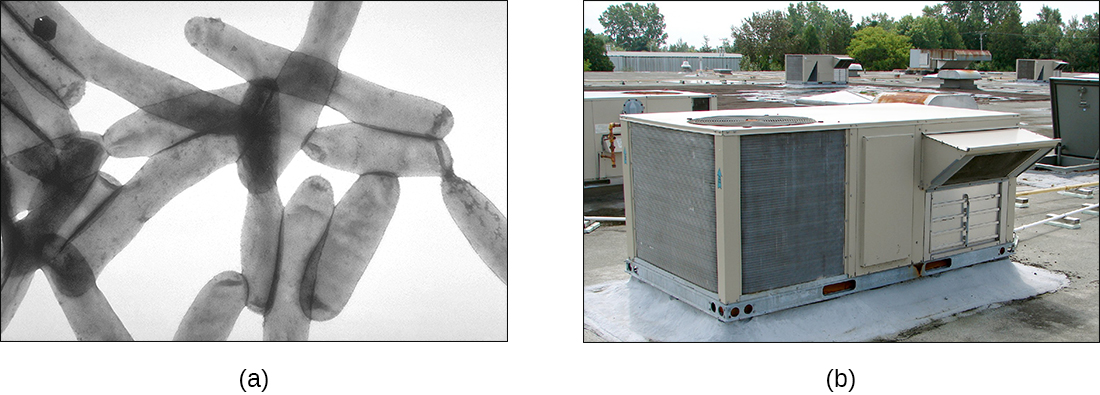
Image source: Wikipedia/Wikimedia
| Ecology, Host, and Life Cycle | |
|---|---|
| Oxygen requirements | Not Available |
| Optimal temperature | Not Available |
| Temperature range | Not Available |
| Habitat | aquatic environment; Groundwater |
| Biotic relationship | Not Available |
| Host(s) | Homo sapiens |
| Cell arrangement | Not Available |
| Sporulation | Not Available |
| Energy source | Not Available |
| Pathogenicity | Not Available |
Gene Summary
Adenine Count
784124 bp
Thymine Count
793951 bp
Guanine Count
553353 bp
Cytosine Count
535679 bp
Genome Length
2668211 bp
Protein-coding Genes
2469 genes
Non-Coding Genes
42 genes
# of Chromosomes/Plasmids
1
Genes
| Name | Locus Tag | UniProt ID | Strand Orientation | Gene Start/End | Protein Molecular Weight |
|---|---|---|---|---|---|
| hemolysin d | Loak_1275 | Not Available | Negative | 1362215 - 1363171 | 35982.4 |
| transferase | Loak_1276 | Not Available | Positive | 1363327 - 1363869 | 19574.5 |
| hypothetical protein | Loak_1277 | Not Available | Negative | 1363913 - 1364088 | 6583.05 |
| hypothetical protein | Loak_1278 | Not Available | Negative | 1364089 - 1364321 | 8414.07 |
| periplasmic serine protease, do/deqq family | Loak_1279 | Not Available | Negative | 1364602 - 1365975 | 48951.9 |
| laccase domain protein yfih | Loak_1280 | Not Available | Negative | 1365977 - 1366708 | 27551.8 |
| uracil hydrolyase | Loak_1281 | Not Available | Negative | 1366701 - 1367651 | 36152.0 |
| (dimethylallyl)adenosine trna methylthiotransferase | Loak_1282 | Not Available | Negative | 1367730 - 1369037 | 48637.5 |
| major facilitator superfamily (mfs) transporter | Loak_1283 | Not Available | Negative | 1369148 - 1370455 | 47290.4 |
| Trna-met | Not Available | Not Available | Positive | 1370692 - 1370768 | Not Available |
Pathways
0 pathways
No pathways found
No metabolic pathways have been associated with this bacterium yet.


